In this section we explore the relationship between the derivative of a function and the derivative of its inverse. For functions whose derivatives we already know, we can use this relationship to find derivatives of inverses without having to use the limit definition of the derivative. In particular, we will apply the formula for derivatives of inverse functions to trigonometric functions. This formula may also be used to extend the power rule to rational exponents.
The Derivative of an Inverse Function
We begin by considering a function and its inverse. If is both invertible and differentiable, it seems reasonable that the inverse of is also differentiable. Figure 3.28 shows the relationship between a function and its inverse Look at the point on the graph of having a tangent line with a slope of This point corresponds to a point on the graph of having a tangent line with a slope of Thus, if is differentiable at then it must be the case that
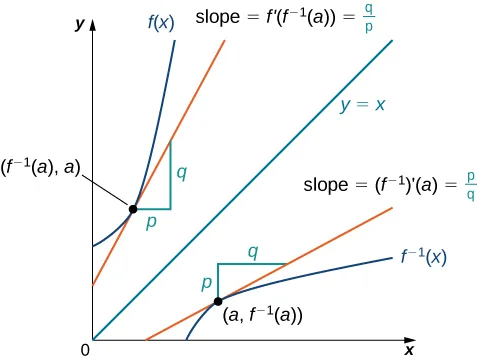
We may also derive the formula for the derivative of the inverse by first recalling that Then by differentiating both sides of this equation (using the chain rule on the right), we obtain
Solving for we obtain
We summarize this result in the following theorem.
From the previous example, we see that we can use the inverse function theorem to extend the power rule to exponents of the form where is a positive integer. This extension will ultimately allow us to differentiate where is any rational number.
Proof
The function is the inverse of the function Since begin by finding Thus,
Finally,
To differentiate we must rewrite it as and apply the chain rule. Thus,
□
Derivatives of Inverse Trigonometric Functions
We now turn our attention to finding derivatives of inverse trigonometric functions. These derivatives will prove invaluable in the study of integration later in this text. The derivatives of inverse trigonometric functions are quite surprising in that their derivatives are actually algebraic functions. Previously, derivatives of algebraic functions have proven to be algebraic functions and derivatives of trigonometric functions have been shown to be trigonometric functions. Here, for the first time, we see that the derivative of a function need not be of the same type as the original function.
The derivatives of the remaining inverse trigonometric functions may also be found by using the inverse function theorem. These formulas are provided in the following theorem.
Key Concepts
- The inverse function theorem allows us to compute derivatives of inverse functions without using the limit definition of the derivative.
- We can use the inverse function theorem to develop differentiation formulas for the inverse trigonometric functions.
Key Equations
| Inverse function theorem | whenever and is differentiable. |