Preparing your lesson…正在准备你的课程…正在準備你的課程…Preparando tu lección…Préparation de votre leçon…Deine Lektion wird vorbereitet…Sto preparando la tua lezione…Preparando sua aula…レッスンを準備しています…수업을 준비하고 있어요…Menyediakan pelajaran anda…Menyiapkan pelajaranmu…
5.6 Integrals Involving Exponential and Logarithmic Functions | ahaboard
Preparing your lesson…正在准备你的课程…正在準備你的課程…Preparando tu lección…Préparation de votre leçon…Deine Lektion wird vorbereitet…Sto preparando la tua lezione…Preparando sua aula…レッスンを準備しています…수업을 준비하고 있어요…Menyediakan pelajaran anda…Menyiapkan pelajaranmu…
5.6 Integrals Involving Exponential and Logarithmic Functions
Exponential and logarithmic functions are used to model population growth, cell growth, and financial growth, as well as depreciation, radioactive decay, and resource consumption, to name only a few applications. In this section, we explore integration involving exponential and logarithmic functions.
Integrals of Exponential Functions
The exponential function is perhaps the most efficient function in terms of the operations of calculus. The exponential function, y=ex, is its own derivative and its own integral.
A common mistake when dealing with exponential expressions is treating the exponent on e the same way we treat exponents in polynomial expressions. We cannot use the power rule for the exponent on e. This can be especially confusing when we have both exponentials and polynomials in the same expression, as in the previous checkpoint. In these cases, we should always double-check to make sure we’re using the right rules for the functions we’re integrating.
As mentioned at the beginning of this section, exponential functions are used in many real-life applications. The number e is often associated with compounded or accelerating growth, as we have seen in earlier sections about the derivative. Although the derivative represents a rate of change or a growth rate, the integral represents the total change or the total growth. Let’s look at an example in which integration of an exponential function solves a common business application.
A price–demand function tells us the relationship between the quantity of a product demanded and the price of the product. In general, price decreases as quantity demanded increases. The marginal price–demand function is the derivative of the price–demand function and it tells us how fast the price changes at a given level of production. These functions are used in business to determine the price–elasticity of demand, and to help companies determine whether changing production levels would be profitable.
Integrals Involving Logarithmic Functions
Integrating functions of the form f(x)=x−1 result in the absolute value of the natural log function, as shown in the following rule. Integral formulas for other logarithmic functions, such as f(x)=lnx and f(x)=logax, are also included in the rule.
Example 5.48 is a definite integral of a trigonometric function. With trigonometric functions, we often have to apply a trigonometric property or an identity before we can move forward. Finding the right form of the integrand is usually the key to a smooth integration.
Key Concepts
Exponential and logarithmic functions arise in many real-world applications, especially those involving growth and decay.
Substitution is often used to evaluate integrals involving exponential functions or logarithms.
Key Equations
Integrals of Exponential Functions
∫exdx=ex+C ∫axdx=lnaax+C
∫e-xdx=-∫eudu=-eu+C=-e-x+C.
First rewrite the problem using a rational exponent:
∫ex1+exdx=∫ex(1+ex)1/2dx.
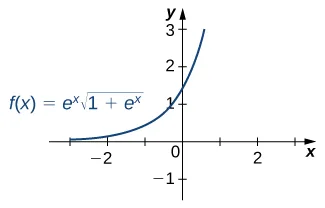
Using substitution, choose u=1+ex. Then, du=exdx. We have (Figure 5.37)
∫ex(1+ex)1/2dx=∫u1/2du.
Then
∫u1/2du=3/2u3/2+C=32u3/2+C=32(1+ex)3/2+C.
Figure 5.37The graph shows an exponential function times the square root of an exponential function.
Answer
∫ex(3ex−2)2dx=91(3ex−2)3
du=6x2dx..
du
x
x
21
u
x
∫3x2e2x3dx=21∫eudu.
Integrate the expression in u and then substitute the original expression in x back into the u integral:
21∫eudu=21eu+C=21e2x3+C.
Answer
∫2x3ex4dx=21ex4
If the supermarket chain sells 100 tubes per week, what price should it set?
Solution
To find the price–demand equation, integrate the marginal price–demand function. First find the antiderivative, then look at the particulars. Thus,
p(x)=∫−0.015e−0.01xdx=−0.015∫e−0.01xdx.
Using substitution, let u=−0.01x and du=−0.01dx. Then, divide both sides of the du equation by −0.01. This gives
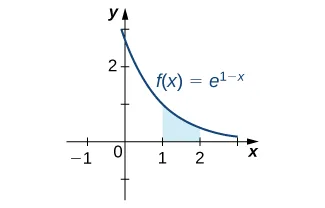
Figure 5.38The indicated area can be calculated by evaluating a definite integral using substitution.
Then, at t=0 we have Q(0)=10=ln31+C, so C≈9.090 and we get
Q(t)=ln33t+9.090.
At time t=2, we have
Q(2)=ln332+9.090
=17.282.
After 2 hours, there are 17,282 bacteria in the dish.
There are 122 flies in the population after 10 days.
Solution
This problem requires some rewriting to simplify applying the properties. First, rewrite the exponent on e as a power of x, then bring the x² in the denominator up to the numerator using a negative exponent. We have
∫12x2e1/xdx=∫12ex−1x−2dx.
Let u=x−1, the exponent on e. Then
du−du=-x−2dx=x−2dx.
Bringing the negative sign outside the integral sign, the problem now reads
-∫eudu.
Next, change the limits of integration:
u=(1)−1=1u=(2)−1=21.
Notice that now the limits begin with the larger number, meaning we must multiply by −1 and interchange the limits. Thus,
-∫11/2eudu=∫1/21eudu=eu∣1/21=e−e1/2=e−e.
Hint
Let u=4x−2.
Answer
∫12x31e4x−2dx=81[e4−e]
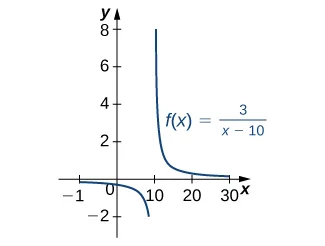
See Figure 5.39.
Figure 5.39The domain of this function is x=10.
This can be rewritten as ∫(2x3+3x)(x4+3x2)−1dx. Use substitution. Let u=x4+3x2, then du=4x3+6x. Alter du by factoring out the 2. Thus,
du21du===(4x3+6x)dx2(2x3+3x)dx(2x3+3x)dx.
Rewrite the integrand in u:
∫(2x3+3x)(x4+3x2)−1dx=21∫u−1du.
Then we have
21∫u−1du=21ln∣u∣+C=21ln∣x4+3x2∣+C.
Solution
We need substitution to evaluate this problem. Let u=1+cosx,, so du=-sinxdx. Rewrite the integral in terms of u, changing the limits of integration as well. Thus,