Preparing your lesson…正在准备你的课程…正在準備你的課程…Preparando tu lección…Préparation de votre leçon…Deine Lektion wird vorbereitet…Sto preparando la tua lezione…Preparando sua aula…レッスンを準備しています…수업을 준비하고 있어요…Menyediakan pelajaran anda…Menyiapkan pelajaranmu…
4.7 Applied Optimization Problems | ahaboard
Preparing your lesson…正在准备你的课程…正在準備你的課程…Preparando tu lección…Préparation de votre leçon…Deine Lektion wird vorbereitet…Sto preparando la tua lezione…Preparando sua aula…レッスンを準備しています…수업을 준비하고 있어요…Menyediakan pelajaran anda…Menyiapkan pelajaranmu…
One common application of calculus is calculating the minimum or maximum value of a function. For example, companies often want to minimize production costs or maximize revenue. In manufacturing, it is often desirable to minimize the amount of material used to package a product with a certain volume. In this section, we show how to set up these types of minimization and maximization problems and solve them by using the tools developed in this chapter.
Solving Optimization Problems over a Closed, Bounded Interval
The basic idea of the optimization problems that follow is the same. We have a particular quantity that we are interested in maximizing or minimizing. However, we also have some auxiliary condition that needs to be satisfied. For example, in Example 4.32, we are interested in maximizing the area of a rectangular garden. Certainly, if we keep making the side lengths of the garden larger, the area will continue to become larger. However, what if we have some restriction on how much fencing we can use for the perimeter? In this case, we cannot make the garden as large as we like. Let’s look at how we can maximize the area of a rectangle subject to some constraint on the perimeter.
Now let’s look at a general strategy for solving optimization problems similar to Example 4.32.
Now let’s apply this strategy to maximize the volume of an open-top box given a constraint on the amount of material to be used.
In business, companies are interested in maximizing revenue. In the following example, we consider a scenario in which a company has collected data on how many cars it is able to lease, depending on the price it charges its customers to rent a car. Let’s use these data to determine the price the company should charge to maximize the amount of money it brings in.
Solving Optimization Problems when the Interval Is Not Closed or Is Unbounded
In the previous examples, we considered functions on closed, bounded domains. Consequently, by the extreme value theorem, we were guaranteed that the functions had absolute extrema. Let’s now consider functions for which the domain is neither closed nor bounded.
Many functions still have at least one absolute extrema, even if the domain is not closed or the domain is unbounded. For example, the function f(x)=x2+4 over (-∞,∞) has an absolute minimum of 4 at x=0. Therefore, we can still consider functions over unbounded domains or open intervals and determine whether they have any absolute extrema. In the next example, we try to minimize a function over an unbounded domain. We will see that, although the domain of consideration is (0,∞), the function has an absolute minimum.
In the following example, we look at constructing a box of least surface area with a prescribed volume. It is not difficult to show that for a closed-top box, by symmetry, among all boxes with a specified volume, a cube will have the smallest surface area. Consequently, we consider the modified problem of determining which open-topped box with a specified volume has the smallest surface area.
Key Concepts
To solve an optimization problem, begin by drawing a picture and introducing variables.
Find an equation relating the variables.
Find a function of one variable to describe the quantity that is to be minimized or maximized.
Look for critical points to locate local extrema.
2x+y=100.
Solving this equation for y, we have y=100−2x. Thus, we can write the area as
A(x)=x⋅(100−2x)=100x−2x2.
Before trying to maximize the area function A(x)=100x−2x2, we need to determine the domain under consideration. To construct a rectangular garden, we certainly need the lengths of both sides to be positive. Therefore, we need x>0 and y>0. Since y=100−2x, if y>0, then x<50. Therefore, we are trying to determine the maximum value of A(x) for x over the open interval (0,50). We do not know that a function necessarily has a maximum value over an open interval. However, we do know that a continuous function has an absolute maximum (and absolute minimum) over a closed interval. Therefore, let’s consider the function A(x)=100x−2x2 over the closed interval [0,50]. If the maximum value occurs at an interior point, then we have found the value x in the open interval (0,50) that maximizes the area of the garden. Therefore, we consider the following problem:
Maximize A(x)=100x−2x2 over the interval [0,50].
As mentioned earlier, since A is a continuous function on a closed, bounded interval, by the extreme value theorem, it has a maximum and a minimum. These extreme values occur either at endpoints or critical points. At the endpoints, A(x)=0. Since the area is positive for all x in the open interval (0,50), the maximum must occur at a critical point. Differentiating the function A(x), we obtain
A′(x)=100−4x.
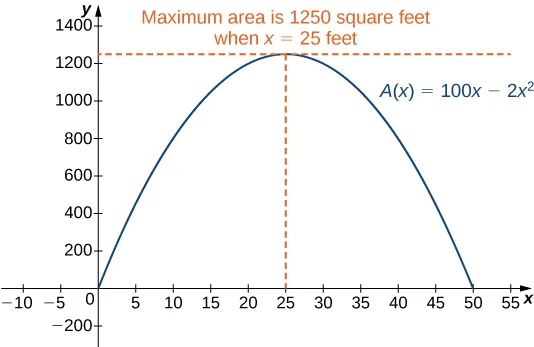
Therefore, the only critical point is x=25 (Figure 4.63). We conclude that the maximum area must occur when x=25. Then we have y=100−2x=100−2(25)=50. To maximize the area of the garden, let x=25 ft and y=50ft. The area of this garden is 1250ft2.
Figure 4.63To maximize the area of the garden, we need to find the maximum value of the function A(x)=100x−2x2.
V.
Step 3: As mentioned in step 2, we are trying to maximize the volume of a box. The volume of a box is V=L⋅W⋅H, where L,W,andH are the length, width, and height, respectively.
Step 4: From Figure 4.64, we see that the height of the box is x inches, the length is 36−2x inches, and the width is 24−2x inches. Therefore, the volume of the box is
V(x)=(36−2x)(24−2x)x=4x3−120x2+864x.
Step 5: To determine the domain of consideration, let’s examine Figure 4.64. Certainly, we need x>0. Furthermore, the side length of the square cannot be greater than or equal to half the length of the shorter side, 24 in.; otherwise, one of the flaps would be completely cut off. Therefore, we are trying to determine whether there is a maximum volume of the box for x over the open interval (0,12). Since V is a continuous function over the closed interval [0,12], we know V will have an absolute maximum over the closed interval. Therefore, we consider V over the closed interval [0,12] and check whether the absolute maximum occurs at an interior point.
Step 6: Since V(x) is a continuous function over the closed, bounded interval [0,12],V must have an absolute maximum (and an absolute minimum). Since V(x)=0 at the endpoints and V(x)>0 for 0<x<12, the maximum must occur at a critical point. The derivative is
V′(x)=12x2−240x+864.
To find the critical points, we need to solve the equation
12x2−240x+864=0.
Dividing both sides of this equation by 12, the problem simplifies to solving the equation
x2−20x+72=0.
Using the quadratic formula, we find that the critical points are
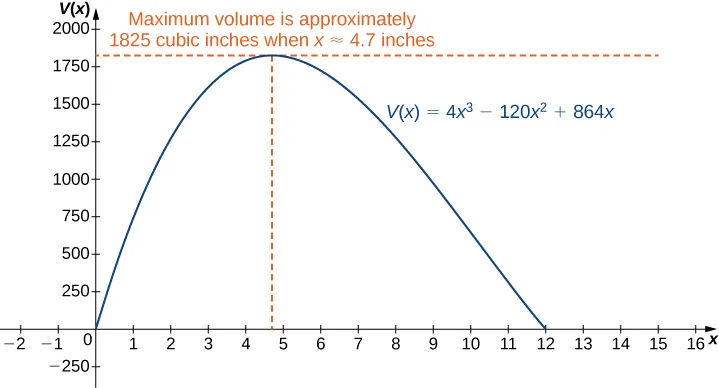
Since 10+27 is not in the domain of consideration, the only critical point we need to consider is 10−27. Therefore, the volume is maximized if we let x=10−27in. The maximum volume is V(10−27)=640+4487≈1825in.3 as shown in the following graph.
Figure 4.65Maximizing the volume of the box leads to finding the maximum value of a cubic polynomial.
[0,10].
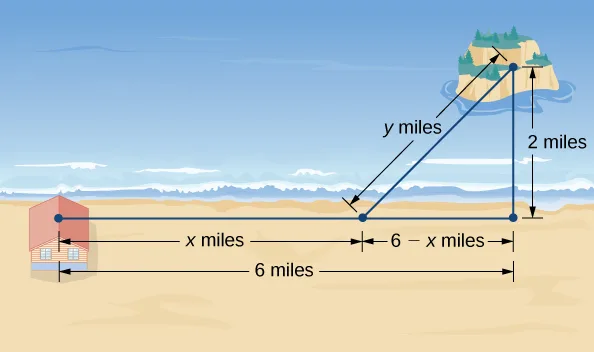
Figure 4.66How can we choose x and y to minimize the travel time from the cabin to the island?
Step 2: The problem is to minimize T.
Step 3: To find the time spent traveling from the cabin to the island, add the time spent running and the time spent swimming. Since Distance = Rate × Time (D=R×T), the time spent running is
Trunning=RrunningDrunning=8x,
and the time spent swimming is
Tswimming=RswimmingDswimming=3y.
Therefore, the total time spent traveling is
T=8x+3y.
Step 4: From Figure 4.66, the line segment of y miles forms the hypotenuse of a right triangle with legs of length 2mi and 6−xmi. Therefore, by the Pythagorean theorem, 22+(6−x)2=y2, and we obtain y=(6−x)2+4. Thus, the total time spent traveling is given by the function
T(x)=8x+3(6−x)2+4.
Step 5: From Figure 4.66, we see that 0≤x≤6. Therefore, [0,6] is the domain of consideration.
Step 6: Since T(x) is a continuous function over a closed, bounded interval, it has a maximum and a minimum. Let’s begin by looking for any critical points of T over the interval [0,6]. The derivative is
Squaring both sides of this equation, we see that if x satisfies this equation, then x must satisfy
9[(6−x)2+4]=64(6−x)2,
which implies
55(6−x)2=36.
We conclude that if x is a critical point, then x satisfies
(x−6)2=5536.
Therefore, the possibilities for critical points are
x=6±556.
Since x=6+6/55 is not in the domain, it is not a possibility for a critical point. On the other hand, x=6−6/55 is in the domain. Since we squared both sides of Applied Optimization Problems to arrive at the possible critical points, it remains to verify that x=6−6/55 satisfies Applied Optimization Problems. Since x=6−6/55 does satisfy that equation, we conclude that x=6−6/55 is a critical point, and it is the only one. To justify that the time is minimized for this value of x, we just need to check the values of T(x) at the endpoints x=0 and x=6, and compare them with the value of T(x) at the critical point x=6−6/55. We find that T(0)≈2.108h and T(6)≈1.417h, whereas T(6−6/55)≈1.368h. Therefore, we conclude that T has a local minimum at x≈5.19 mi.
Answer
T(x)=6x+2.5(15−x)2+1
$200
$200
Solution
Step 1: Let p be the price charged per car per day and let n be the number of cars rented per day. Let R be the revenue per day.
Step 2: The problem is to maximize R.
Step 3: The revenue (per day) is equal to the number of cars rented per day times the price charged per car per day—that is, R=n×p.
Step 4: Since the number of cars rented per day is modeled by the linear function n(p)=1000−5p, the revenue R can be represented by the function
R(p)=n×p=(1000−5p)p=−5p2+1000p.
Step 5: Since the owners plan to charge between $50 per car per day and $200 per car per day, the problem is to find the maximum revenue R(p) for p in the closed interval [50,200].
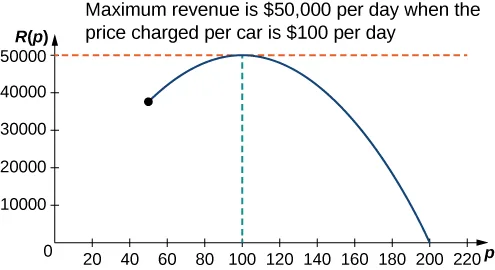
Step 6: Since R is a continuous function over the closed, bounded interval [50,200], it has an absolute maximum (and an absolute minimum) in that interval. To find the maximum value, look for critical points. The derivative is R′(p)=−10p+1000. Therefore, the critical point is p=100 When p=100, When When Therefore, the absolute maximum occurs at The car rental company should charge per day per car to maximize revenue as shown in the following figure.
Figure 4.67To maximize revenue, a car rental company has to balance the price of a rental against the number of cars people will rent at that price.
n
p
Answer
The company should charge $75 per car per day.
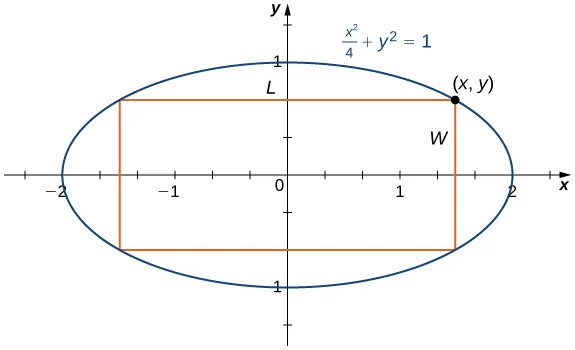
Step 1: For a rectangle to be inscribed in the ellipse, the sides of the rectangle must be parallel to the axes. Let L be the length of the rectangle and W be its width. Let A be the area of the rectangle.
Figure 4.68We want to maximize the area of a rectangle inscribed in an ellipse.
Step 2: The problem is to maximize A.
Step 3: The area of the rectangle is A=LW.
Step 4: Let (x,y) be the corner of the rectangle that lies in the first quadrant, as shown in Figure 4.68. We can write length L=2x and width W=2y. Since 4x2+y2=1 and y>0, we have y=1−4x2. Therefore, the area is
A=LW=(2x)(2y)=4x1−4x2=2x4−x2.
Step 5: From Figure 4.68, we see that to inscribe a rectangle in the ellipse, the x-coordinate of the corner in the first quadrant must satisfy 0<x<2. Therefore, the problem reduces to looking for the maximum value of A(x) over the open interval (0,2). Since A(x) will have an absolute maximum (and absolute minimum) over the closed interval [0,2], we consider A(x)=2x4−x2 over the interval If the absolute maximum occurs at an interior point, then we have found an absolute maximum in the open interval.
Step 6: As mentioned earlier, A(x) is a continuous function over the closed, bounded interval [0,2]. Therefore, it has an absolute maximum (and absolute minimum). At the endpoints x=0 and x=2,A(x)=0. For 0<x<2, Therefore, the maximum must occur at a critical point. Taking the derivative of we obtain
To find critical points, we need to find where A′(x)=0. We can see that if x is a solution of
4−x28−4x2=0,
then x must satisfy
8−4x2=0.
Therefore, x2=2. Thus, x=±2 are the possible solutions of Applied Optimization Problems. Since we are considering x over the interval [0,2], is a possibility for a critical point, but is not. Therefore, we check whether is a solution of Applied Optimization Problems. Since is a solution of Applied Optimization Problems, we conclude that is the only critical point of in the interval Therefore, must have an absolute maximum at the critical point To determine the dimensions of the rectangle, we need to find the length and the width If then
y=1−4(2)2=1−21=21.
Therefore, the dimensions of the rectangle are L=2x=22 and W=2y=22=2. The area of this rectangle is
Answer
A(x)=4x1−x2. The domain of consideration is [0,1].
x⋅y.
x2.
S=4xy+x2.
Step 4: Since the volume of this box is x2y and the volume is given as 216in.3, the constraint equation is
x2y=216.
Solving the constraint equation for y, we have y=x2216. Therefore, we can write the surface area as a function of x only:
S(x)=4x(x2216)+x2.
Therefore, S(x)=x864+x2.
Step 5: Since we are requiring that x2y=216, we cannot have x=0. Therefore, we need x>0. On the other hand, x is allowed to have any positive value. Note that as x becomes large, the height of the box y becomes correspondingly small so that x2y=216. Similarly, as x becomes small, the height of the box becomes correspondingly large. We conclude that the domain is the open, unbounded interval (0,∞). Note that, unlike the previous examples, we cannot reduce our problem to looking for an absolute maximum or absolute minimum over a closed, bounded interval. However, in the next step, we discover why this function must have an absolute minimum over the interval (0,∞).
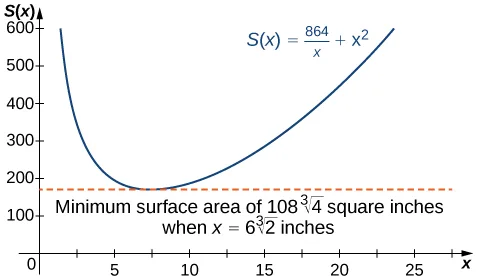
Step 6: Note that as x→0+,S(x)→∞. Also, as x→∞,S(x)→∞. Since S is a continuous function that approaches infinity at the ends, it must have an absolute minimum at some x∈(0,∞). This minimum must occur at a critical point of S. The derivative is
S′(x)=−x2864+2x.
Therefore, S′(x)=0 when 2x=x2864. Solving this equation for x, we obtain x3=432, so x=3432=632. Since this is the only critical point of S, the absolute minimum must occur at x=632 (see Figure 4.70). When x=632,y=(632)2216=332in. Therefore, the dimensions of the box should be x=632in. and y=332in. With these dimensions, the surface area is
S(632)=632864+(632)2=10834in.2
Figure 4.70We can use a graph to determine the dimensions of a box of given the volume and the minimum surface area.
Hint
If the cost of one of the sides is 30¢/in.2, the cost of that side is 0.30xy.