So far, we have learned how to differentiate a variety of functions, including trigonometric, inverse, and implicit functions. In this section, we explore derivatives of exponential and logarithmic functions. As we discussed in Introduction to Functions and Graphs, exponential functions play an important role in modeling population growth and the decay of radioactive materials. Logarithmic functions can help rescale large quantities and are particularly helpful for rewriting complicated expressions.
Derivative of the Exponential Function
Just as when we found the derivatives of other functions, we can find the derivatives of exponential and logarithmic functions using formulas. As we develop these formulas, we need to make certain basic assumptions. The proofs that these assumptions hold are beyond the scope of this course.
First of all, we begin with the assumption that the function is defined for every real number and is continuous. In previous courses, the values of exponential functions for all rational numbers were defined—beginning with the definition of where is a positive integer—as the product of multiplied by itself times. Later, we defined for a positive integer and for positive integers and These definitions leave open the question of the value of where is an arbitrary real number. By assuming the continuity of we may interpret as where the values of as we take the limit are rational. For example, we may view as the number satisfying
As we see in the following table,
We also assume that for the value of the derivative exists. In this section, we show that by making this one additional assumption, it is possible to prove that the function is differentiable everywhere.
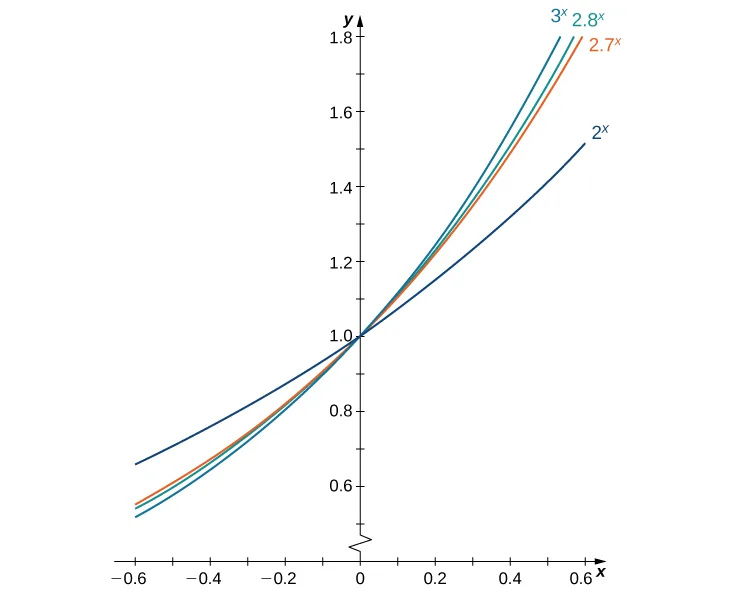
We make one final assumption: that there is a unique value of for which We define to be this unique value, as we did in Introduction to Functions and Graphs. Figure 3.33 provides graphs of the functions and A visual estimate of the slopes of the tangent lines to these functions at 0 provides evidence that the value of lies somewhere between 2.7 and 2.8. The function is called the . Its inverse, is called the .
For a better estimate of we may construct a table of estimates of for functions of the form Before doing this, recall that
for values of very close to zero. For our estimates, we choose and to obtain the estimate
See the following table.
The evidence from the table suggests that
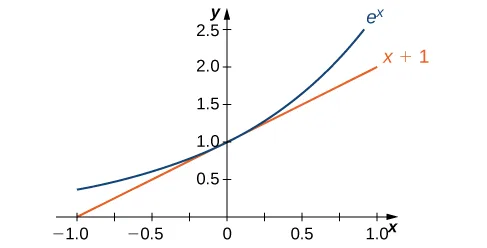
The graph of together with the line are shown in Figure 3.34. This line is tangent to the graph of at
Now that we have laid out our basic assumptions, we begin our investigation by exploring the derivative of Recall that we have assumed that exists. By applying the limit definition to the derivative we conclude that
Turning to we obtain the following.
We see that on the basis of the assumption that is differentiable at is not only differentiable everywhere, but its derivative is
For Thus, we have (The value of for an arbitrary function of the form will be derived later.)
Derivative of the Logarithmic Function
Now that we have the derivative of the natural exponential function, we can use implicit differentiation to find the derivative of its inverse, the natural logarithmic function.
Proof
If and then Differentiating both sides of this equation results in the equation
Solving for yields
Finally, we substitute to obtain
We may also derive this result by applying the inverse function theorem, as follows. Since is the inverse of by applying the inverse function theorem we have
Using this result and applying the chain rule to yields
□
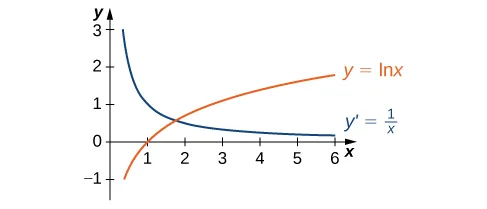
The graph of and its derivative are shown in Figure 3.35.
Now that we can differentiate the natural logarithmic function, we can use this result to find the derivatives of and for
Proof
If then It follows that Thus Solving for we have Differentiating and keeping in mind that is a constant, we see that
The derivative in Derivatives of Exponential and Logarithmic Functions now follows from the chain rule.
If then Using implicit differentiation, again keeping in mind that is constant, it follows that Solving for and substituting we see that
The more general derivative (Derivatives of Exponential and Logarithmic Functions) follows from the chain rule.
□
Logarithmic Differentiation
At this point, we can take derivatives of functions of the form for certain values of as well as functions of the form where and Unfortunately, we still do not know the derivatives of functions such as or These functions require a technique called , which allows us to differentiate any function of the form It can also be used to convert a very complex differentiation problem into a simpler one, such as finding the derivative of We outline this technique in the following problem-solving strategy.
Key Concepts
- On the basis of the assumption that the exponential function is continuous everywhere and differentiable at 0, this function is differentiable everywhere and there is a formula for its derivative.
- We can use a formula to find the derivative of and the relationship allows us to extend our differentiation formulas to include logarithms with arbitrary bases.
Key Equations
| Derivative of the natural exponential function |