Preparing your lesson…正在准备你的课程…正在準備你的課程…Preparando tu lección…Préparation de votre leçon…Deine Lektion wird vorbereitet…Sto preparando la tua lezione…Preparando sua aula…レッスンを準備しています…수업을 준비하고 있어요…Menyediakan pelajaran anda…Menyiapkan pelajaranmu…
4.1 Related Rates | ahaboard
Preparing your lesson…正在准备你的课程…正在準備你的課程…Preparando tu lección…Préparation de votre leçon…Deine Lektion wird vorbereitet…Sto preparando la tua lezione…Preparando sua aula…レッスンを準備しています…수업을 준비하고 있어요…Menyediakan pelajaran anda…Menyiapkan pelajaranmu…
We have seen that for quantities that are changing over time, the rates at which these quantities change are given by derivatives. If two related quantities are changing over time, the rates at which the quantities change are related. For example, if a balloon is being filled with air, both the radius of the balloon and the volume of the balloon are increasing. In this section, we consider several problems in which two or more related quantities are changing and we study how to determine the relationship between the rates of change of these quantities.
Setting up Related-Rates Problems
In many real-world applications, related quantities are changing with respect to time. For example, if we consider the balloon example again, we can say that the rate of change in the volume, V, is related to the rate of change in the radius, r. In this case, we say that dtdV and dtdr are related rates because V is related to r. Here we study several examples of related quantities that are changing with respect to time and we look at how to calculate one rate of change given another rate of change.
Before looking at other examples, let’s outline the problem-solving strategy we will be using to solve related-rates problems.
Note that when solving a related-rates problem, it is crucial not to substitute known values too soon. For example, if the value for a changing quantity is substituted into an equation before both sides of the equation are differentiated, then that quantity will behave as a constant and its derivative will not appear in the new equation found in step 4. We examine this potential error in the following example.
Examples of the Process
Let’s now implement the strategy just described to solve several related-rates problems. The first example involves a plane flying overhead. The relationship we are studying is between the speed of the plane and the rate at which the distance between the plane and a person on the ground is changing.
We now return to the problem involving the rocket launch from the beginning of the chapter.
In the next example, we consider water draining from a cone-shaped funnel. We compare the rate at which the level of water in the cone is decreasing with the rate at which the volume of water is decreasing.
Key Concepts
To solve a related rates problem, first draw a picture that illustrates the relationship between the two or more related quantities that are changing with respect to time.
In terms of the quantities, state the information given and the rate to be found.
Find an equation relating the quantities.
Use differentiation, applying the chain rule as necessary, to find an equation that relates the rates.
Be sure not to substitute a variable quantity for one of the variables until after finding an equation relating the rates.
Since the balloon is being filled with air, both the volume and the radius are functions of time. Therefore, t seconds after beginning to fill the balloon with air, the volume of air in the balloon is
V(t)=34π[r(t)]3cm3.
Differentiating both sides of this equation with respect to time and applying the chain rule, we see that the rate of change in the volume is related to the rate of change in the radius by the equation
V′(t)=4π[r(t)]2r′(t).
The balloon is being filled with air at the constant rate of 2 cm³/sec, so V′(t)=2cm3/sec. Therefore,
2cm3/sec=(4π[r(t)]2cm2)⋅(r′(t)cm/s),
which implies
r′(t)=2π[r(t)]21cm/sec.
When the radius r=3cm,
r′(t)=18π1cm/sec.
Answer
72π1cm/sec, or approximately 0.0044 cm/sec
x,
As shown, x denotes the distance between the man and the position on the ground directly below the airplane. The variable s denotes the distance between the man and the plane. Note that both x and s are functions of time. We do not introduce a variable for the height of the plane because it remains at a constant elevation of 4000ft. Since an object’s height above the ground is measured as the shortest distance between the object and the ground, the line segment of length 4000 ft is perpendicular to the line segment of length x feet, creating a right triangle.
Step 2. Since x denotes the horizontal distance between the man and the point on the ground below the plane, dx/dt represents the speed of the plane. We are told the speed of the plane is 600 ft/sec. Therefore, dtdx=600 ft/sec. Since we are asked to find the rate of change in the distance between the man and the plane when the plane is directly above the radio tower, we need to find ds/dt when x=3000ft.
Step 3. From the figure, we can use the Pythagorean theorem to write an equation relating x and s:
[x(t)]2+40002=[s(t)]2.
Step 4. Differentiating this equation with respect to time and using the fact that the derivative of a constant is zero, we arrive at the equation
xdtdx=sdtds.
Step 5. Find the rate at which the distance between the man and the plane is increasing when the plane is directly over the radio tower. That is, find dtds when x=3000ft. Since the speed of the plane is 600ft/sec, we know that dtdx=600ft/sec. We are not given an explicit value for s; however, since we are trying to find dtds when x=3000ft, we can use the Pythagorean theorem to determine the distance s when x=3000 and the height is 4000ft. Solving the equation
30002+40002=s2
for s, we have s=5000ft at the time of interest. Using these values, we conclude that ds/dt is a solution of the equation
(3000)(600)=(5000)⋅dtds.
Therefore,
dtds=50003000⋅600=360ft/sec.
Note: When solving related-rates problems, it is important not to substitute values for the variables too soon. For example, in step 3, we related the variable quantities x(t) and s(t) by the equation
[x(t)]2+40002=[s(t)]2.
Since the plane remains at a constant height, it is not necessary to introduce a variable for the height, and we are allowed to use the constant 4000 to denote that quantity. However, the other two quantities are changing. If we mistakenly substituted x(t)=3000 into the equation before differentiating, our equation would have been
30002+40002=[s(t)]2.
After differentiating, our equation would become
0=s(t)dtds.
As a result, we would incorrectly conclude that dtds=0.
h
θ,
Let h denote the height of the rocket above the launch pad and θ be the angle between the camera lens and the ground.
Step 2. We are trying to find the rate of change in the angle of the camera with respect to time when the rocket is 1000 ft off the ground. That is, we need to find dtdθ when h=1000ft. At that time, we know the velocity of the rocket is dtdh=600ft/sec.
Step 3. Now we need to find an equation relating the two quantities that are changing with respect to time: h and θ. How can we create such an equation? Using the fact that we have drawn a right triangle, it is natural to think about trigonometric functions. Recall that tanθ is the ratio of the length of the opposite side of the triangle to the length of the adjacent side. Thus, we have
tanθ=5000h.
This gives us the equation
h=5000tanθ.
Step 4. Differentiating this equation with respect to time t, we obtain
dtdh=5000sec2θdtdθ.
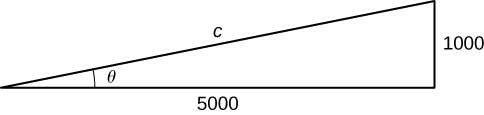
Step 5. We want to find dtdθ when h=1000ft. At this time, we know that dtdh=600ft/sec. We need to determine sec2θ. Recall that secθ is the ratio of the length of the hypotenuse to the length of the adjacent side. We know the length of the adjacent side is 5000ft. To determine the length of the hypotenuse, we use the Pythagorean theorem, where the length of one leg is 5000ft, the length of the other leg is h=1000ft, and the length of the hypotenuse is c feet as shown in the following figure.
We see that
10002+50002=c2
and we conclude that the hypotenuse is
c=100026ft.
Therefore, when h=1000, we have
sec2θ=(5000100026)2=2526.
Recall from step 4 that the equation relating dtdθ to our known values is
dtdh=5000sec2θdtdθ.
When h=1000ft, we know that dtdh=600ft/sec and sec2θ=2526. Substituting these values into the previous equation, we arrive at the equation
600=5000(2526)dtdθ.
Therefore, dtdθ=263rad/sec.
dtdh=500ft/sec.
Answer
101rad/sec
Solution
Step 1: Draw a picture introducing the variables.
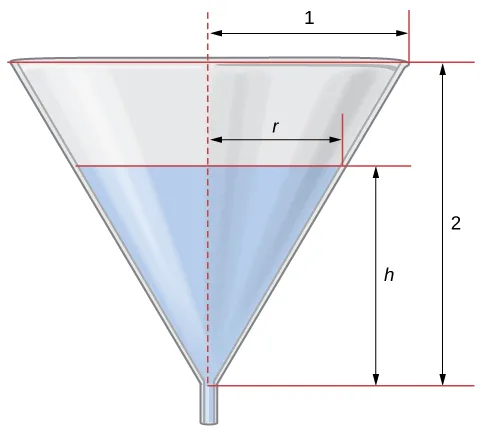
Figure 4.6Water is draining from a funnel of height 2 ft and radius 1 ft. The height of the water and the radius of water are changing over time. We denote these quantities with the variables h and r, respectively.
Let h denote the height of the water in the funnel, r denote the radius of the water at its surface, and V denote the volume of the water.
Step 2: We need to determine dtdh when h=21ft. We know that dtdV=−0.03ft3/sec.
Step 3: The volume of water in the cone is
V=31πr2h.
From the figure, we see that we have similar triangles. Therefore, the ratio of the sides in the two triangles is the same. Therefore, hr=21 or r=2h. Using this fact, the equation for volume can be simplified to
V=31π(2h)2h=12πh3.
Step 4: Applying the chain rule while differentiating both sides of this equation with respect to time t, we obtain
dtdV=4πh2dtdh.
Step 5: We want to find dtdh when h=21ft. Since water is leaving at the rate of 0.03ft3/sec, we know that Therefore,