For the following exercises, find the quantities for the given equation.
Find at and if
Preparing your lesson…正在准备你的课程…正在準備你的課程…Preparando tu lección…Préparation de votre leçon…Deine Lektion wird vorbereitet…Sto preparando la tua lezione…Preparando sua aula…レッスンを準備しています…수업을 준비하고 있어요…Menyediakan pelajaran anda…Menyiapkan pelajaranmu…
Preparing your lesson…正在准备你的课程…正在準備你的課程…Preparando tu lección…Préparation de votre leçon…Deine Lektion wird vorbereitet…Sto preparando la tua lezione…Preparando sua aula…レッスンを準備しています…수업을 준비하고 있어요…Menyediakan pelajaran anda…Menyiapkan pelajaranmu…
Calculus Volume 1 · 4.1 Related Rates
24 problems from the book, with its answers. Check your working, or have any of them explained to you on the whiteboard.
Draw the situation and give every quantity that changes a letter, not a number. Write the rate you know and the rate you want as derivatives with respect to time. Find an equation that links the quantities (Pythagoras, similar triangles, a volume or area formula); if one quantity can be eliminated first, as a cone's radius can through similar triangles, do it now. Only then differentiate both sides with respect to t, using the chain rule on every variable, and substitute the numbers for the moment in question last. The usual mistakes: plugging in values before differentiating, the wrong sign for a quantity that is shrinking, and mixing units such as inches and feet.
Exercises 1
For the following exercises, find the quantities for the given equation.
Find at and if
Exercises 3
For the following exercises, find the quantities for the given equation.
Find at and if and
Exercises 5
For the following exercises, sketch the situation if necessary and used related rates to solve for the quantities.
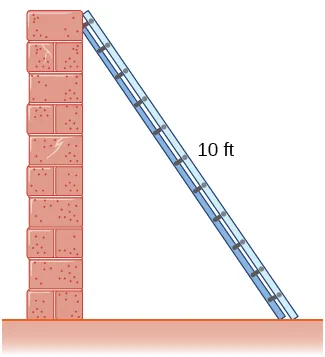
A 10-ft ladder is leaning against a wall. If the top of the ladder slides down the wall at a rate of 2 ft/sec, how fast is the bottom moving along the ground when the bottom of the ladder is 5 ft from the wall?
Exercises 7
For the following exercises, sketch the situation if necessary and used related rates to solve for the quantities.
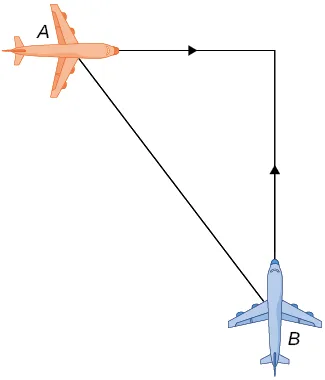
Two airplanes are flying in the air at the same height: airplane A is flying east at 250 mi/h and airplane B is flying north at If they are both heading to the same airport, located 30 miles east of airplane A and 40 miles north of airplane B, at what rate is the distance between the airplanes changing?
Exercises 9
For the following exercises, sketch the situation if necessary and used related rates to solve for the quantities.
Two buses are driving along parallel freeways that are apart, one heading east and the other heading west. Assuming that each bus drives a constant find the rate at which the distance between the buses is changing when they are apart, heading toward each other.
Exercises 11
For the following exercises, sketch the situation if necessary and used related rates to solve for the quantities.
Using the previous problem, what is the rate at which the tip of the shadow moves away from the person when the person is 10 ft from the pole?
Exercises 13
For the following exercises, sketch the situation if necessary and used related rates to solve for the quantities.
Using the previous problem, what is the rate at which the shadow changes when the person is 10 ft from the wall, if the person is walking away from the wall at a rate of 2 ft/sec?
Exercises 15
For the following exercises, sketch the situation if necessary and used related rates to solve for the quantities.
Using the previous problem, what is the rate at which the distance between you and the helicopter is changing when the helicopter has risen to a height of 60 ft in the air, assuming that, initially, it was 30 ft above you?
Exercises 17
For the following exercises, draw and label diagrams to help solve the related-rates problems.
The volume of a cube decreases at a rate of 10 m³/s. Find the rate at which the side of the cube changes when the side of the cube is 2 m.
Exercises 19
For the following exercises, draw and label diagrams to help solve the related-rates problems.
The radius of a sphere decreases at a rate of m/sec. Find the rate at which the surface area decreases when the radius is 10 m.
Exercises 21
For the following exercises, draw and label diagrams to help solve the related-rates problems.
The radius of a sphere is increasing at a rate of 9 cm/sec. Find the radius of the sphere when the volume and the radius of the sphere are increasing at the same numerical rate.
Exercises 23
For the following exercises, draw and label diagrams to help solve the related-rates problems.
A triangle has two constant sides of length 3 ft and 5 ft. The angle between these two sides is increasing at a rate of 0.1 rad/sec. Find the rate at which the area of the triangle is changing when the angle between the two sides is
Exercises 25
For the following exercises, consider a right cone that is leaking water. The dimensions of the conical tank are a height of 16 ft and a radius of 5 ft.
How fast does the depth of the water change when the water is 10 ft high if the cone leaks water at a rate of 10 ft³/min?
Exercises 27
For the following exercises, consider a right cone that is leaking water. The dimensions of the conical tank are a height of 16 ft and a radius of 5 ft.
If the water level is decreasing at a rate of 3 in/min when the depth of the water is 8 ft, determine the rate at which water is leaking out of the cone.
Exercises 29
For the following exercises, consider a right cone that is leaking water. The dimensions of the conical tank are a height of 16 ft and a radius of 5 ft.
A vertical cylinder is leaking water but you are unable to determine at what rate. The cylinder has a height of 2 m and a radius of 2 m. Find the rate at which the water is leaking out of the cylinder if the rate at which the height is decreasing is 10 cm/min when the height is 1 m.
Exercises 31
For the following exercises, consider a right cone that is leaking water. The dimensions of the conical tank are a height of 16 ft and a radius of 5 ft.
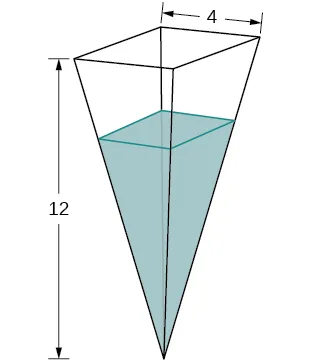
A tank is shaped like an upside-down square pyramid, with base of 4 m by 4 m and a height of 12 m (see the following figure). How fast does the height increase when the water is 2 m deep if water is being pumped in at a rate of m³/sec?
Exercises 33
For the following problems, consider a pool shaped like the bottom half of a sphere, that is being filled at a rate of 25 ft³/min. The radius of the pool is 10 ft. The formula for the volume of a partial hemisphere is where is the height of the water and is the radius of the water.
Exercises 35
For the following problems, consider a pool shaped like the bottom half of a sphere, that is being filled at a rate of 25 ft³/min. The radius of the pool is 10 ft. The formula for the volume of a partial hemisphere is where is the height of the water and is the radius of the water.
Exercises 37
For the following exercises, solve the related-rates problems. Consider making a sketch that represents the situation to help you understand each problem.
You are stationary on the ground and are watching a bird fly horizontally at a rate of m/sec. The bird is located 40 m above your head. How fast does the angle of elevation change when the horizontal distance between you and the bird is 9 m?
Exercises 39
For the following exercises, solve the related-rates problems. Consider making a sketch that represents the situation to help you understand each problem.
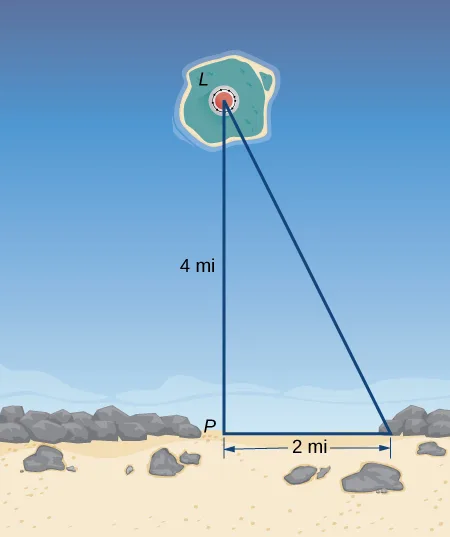
A lighthouse, L, is on an island 4 mi away from the closest point, P, on the beach (see the following image). If the lighthouse light rotates clockwise at a constant rate of 10 revolutions/min, how fast does the beam of light move across the beach 2 mi away from the closest point on the beach?
Exercises 41
For the following exercises, solve the related-rates problems. Consider making a sketch that represents the situation to help you understand each problem.
You are walking to a bus stop at a right-angle corner. You move north at a rate of 2 m/sec and are 20 m south of the intersection. The bus travels west at a rate of 10 m/sec away from the intersection – you have missed the bus! What is the rate at which the angle between you and the bus is changing when you are 20 m south of the intersection and the bus is 10 m west of the intersection?
Exercises 43
For the following exercises, refer to the figure of baseball diamond, which has sides of 90 ft.
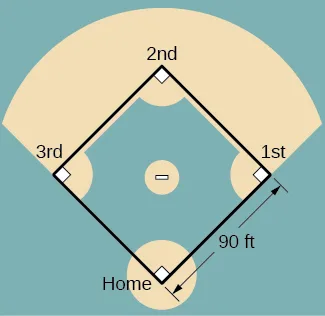
[T] A batter hits a ball toward second base at 80 ft/sec and runs toward first base at a rate of 30 ft/sec. At what rate does the distance between the ball and the batter change when the runner has covered one-third of the distance to first base? (Hint: Recall the law of cosines.)
Exercises 45
For the following exercises, refer to the figure of baseball diamond, which has sides of 90 ft.
[T] Runners start at first and second base. When the baseball is hit, the runner at first base runs at a speed of 18 ft/sec toward second base and the runner at second base runs at a speed of 20 ft/sec toward third base. How fast is the distance between runners changing 1 sec after the ball is hit?
Review Exercises 549
Graph the following functions by hand. Make sure to label the inflection points, critical points, zeros, and asymptotes.
A car is being compacted into a rectangular solid. The volume is decreasing at a rate of m³/sec. The length and width of the compactor are square, but the height is not the same length as the length and width. If the length and width walls move toward each other at a rate of m/sec, find the rate at which the height is changing when the length and width are m and the height is m.
The tutor teaches the whole section, drawing it out step by step and answering your questions as you go.
Find the rate at which the depth of the water is changing when the water has a depth of 1 ft.
Gravel is being unloaded from a truck and falls into a pile shaped like a cone at a rate of 10 ft³/min. The radius of the cone base is three times the height of the cone. Find the rate at which the height of the gravel changes when the pile has a height of 5 ft.