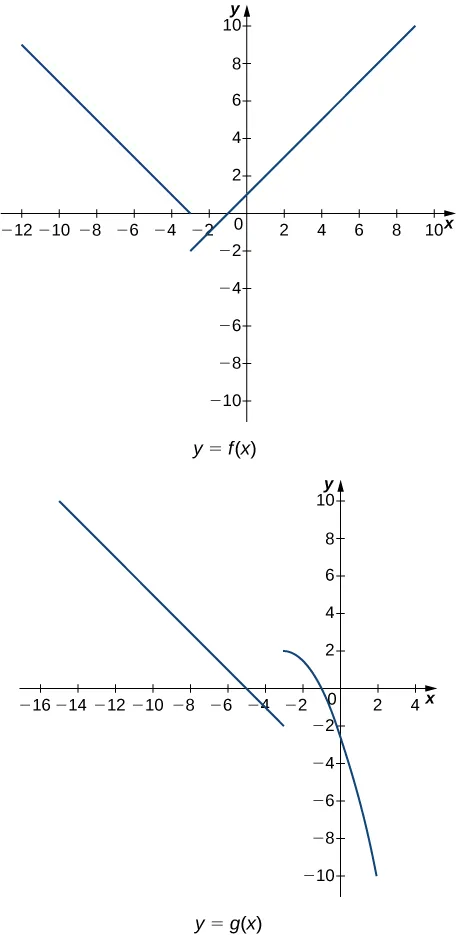
In the following exercises, use the limit laws to evaluate each limit. Justify each step by indicating the appropriate limit law(s).
← Back to Calculus Volume 1
Calculus Volume 1 · 2.3 The Limit Laws
Limits: practice problems on the limit laws
27 problems from the book, with its answers. Check your working, or have any of them explained to you on the whiteboard.
How to approach these problems
Always try direct substitution first: for polynomials, roots and rational functions whose denominator isn't zero, the limit is just the value. If you get 0/0, the limit may still exist: factor and cancel the common factor, multiply by the conjugate when there is a square root, or combine fractions, then substitute again. If you get a nonzero number over 0, look at the one-sided limits: the function grows without bound. When a function is trapped between two others with the same limit, the squeeze theorem gives the answer. The usual mistakes: writing 0/0 as the answer, cancelling terms that are added rather than multiplied, and forgetting to check both sides of a piecewise function.
Exercises 85
Exercises 87
Exercises 89
Exercises 91
Exercises 93
Exercises 95
Exercises 97
Exercises 99
Exercises 101
Exercises 103
Exercises 105
Exercises 107
Exercises 109
Exercises 111
Exercises 113
Exercises 115
Exercises 117
Exercises 119
Exercises 121
Exercises 123
Exercises 125
Exercises 127
Exercises 129
Review Exercises 209
Review Exercises 223
Review Exercises 225
Key terms · 9
- constant multiple law for limits
- the limit law $\lim_{x \to a} c f (x) = c \cdot \lim_{x \to a} f (x) = c L$
- difference law for limits
- the limit law $\lim_{x \to a} (f (x) - g (x)) = \lim_{x \to a} f (x) - \lim_{x \to a} g (x) = L - M$
- limit laws
- the individual properties of limits; for each of the individual laws, let $f (x)$ and $g (x)$ be defined for all $x \ne a$ over some open interval containing a; assume that L and M are real numbers so that $\lim_{x \to a} f (x) = L$ and $\lim_{x \to a} g (x) = M;$ let c be a constant
- power law for limits
- the limit law $\lim_{x \to a} {(f (x))}^n = {(\lim_{x \to a} f (x))}^n = L^n$ for every positive integer n
- product law for limits
- the limit law $\lim_{x \to a} (f (x) \cdot g (x)) = \lim_{x \to a} f (x) \cdot \lim_{x \to a} g (x) = L \cdot M$
- quotient law for limits
- the limit law $\lim_{x \to a} \frac{f (x)}{g (x)} = \frac{\lim_{x \to a} f (x)}{\lim_{x \to a} g (x)} = \frac{L}{M}$ for $M \ne 0$
- root law for limits
- the limit law $\lim_{x \to a} \sqrt[n]{f (x)} = \sqrt[n]{\lim_{x \to a} f (x)} = \sqrt[n]{L}$ for all L if n is odd and for $L \ge 0$ if n is even
- squeeze theorem
- states that if $f (x) \le g (x) \le h (x)$ for all $x \ne a$ over an open interval containing a and $\lim_{x \to a} f (x) = L = \lim_{x \to a} h (x)$ where L is a real number, then $\lim_{x \to a} g (x) = L$
- sum law for limits
- The limit law $\lim_{x \to a} (f (x) + g (x)) = \lim_{x \to a} f (x) + \lim_{x \to a} g (x) = L + M$
Learn 2.3 on the whiteboard
The tutor teaches the whole section, drawing it out step by step and answering your questions as you go.