Preparing your lesson…正在准备你的课程…正在準備你的課程…Preparando tu lección…Préparation de votre leçon…Deine Lektion wird vorbereitet…Sto preparando la tua lezione…Preparando sua aula…レッスンを準備しています…수업을 준비하고 있어요…Menyediakan pelajaran anda…Menyiapkan pelajaranmu…
Preparing your lesson…正在准备你的课程…正在準備你的課程…Preparando tu lección…Préparation de votre leçon…Deine Lektion wird vorbereitet…Sto preparando la tua lezione…Preparando sua aula…レッスンを準備しています…수업을 준비하고 있어요…Menyediakan pelajaran anda…Menyiapkan pelajaranmu…
3.5 Derivatives of Trigonometric Functions | ahaboard
One of the most important types of motion in physics is simple harmonic motion, which is associated with such systems as an object with mass oscillating on a spring. Simple harmonic motion can be described by using either sine or cosine functions. In this section we expand our knowledge of derivative formulas to include derivatives of these and other trigonometric functions. We begin with the derivatives of the sine and cosine functions and then use them to obtain formulas for the derivatives of the remaining four trigonometric functions. Being able to calculate the derivatives of the sine and cosine functions will enable us to find the velocity and acceleration of simple harmonic motion.
Derivatives of the Sine and Cosine Functions
We begin our exploration of the derivative for the sine function by using the formula to make a reasonable guess at its derivative. Recall that for a function f(x),
f′(x)=h→0limhf(x+h)−f(x).
Consequently, for values of h very close to 0, f′(x)≈hf(x+h)−f(x). We see that by using h=0.01,
dxd(sinx)≈0.01sin(x+0.01)−sinx
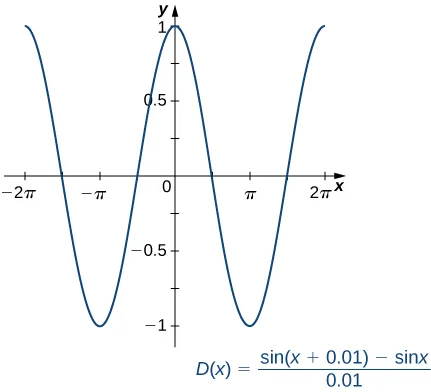
By setting D(x)=0.01sin(x+0.01)−sinx and using a graphing utility, we can get a graph of an approximation to the derivative of sinx (Figure 3.25).
Figure 3.25The graph of the function D(x) looks a lot like a cosine curve.
Upon inspection, the graph of D(x) appears to be very close to the graph of the cosine function. Indeed, we will show that
dxd(sinx)=cosx.
If we were to follow the same steps to approximate the derivative of the cosine function, we would find that
dxd(cosx)=-sinx.
Proof
Because the proofs for dxd(sinx)=cosx and dxd(cosx)=-sinx use similar techniques, we provide only the proof for Before beginning, recall two important trigonometric limits we learned in Introduction to Limits:
h→0limhsinh=1andh→0limhcosh−1=0.
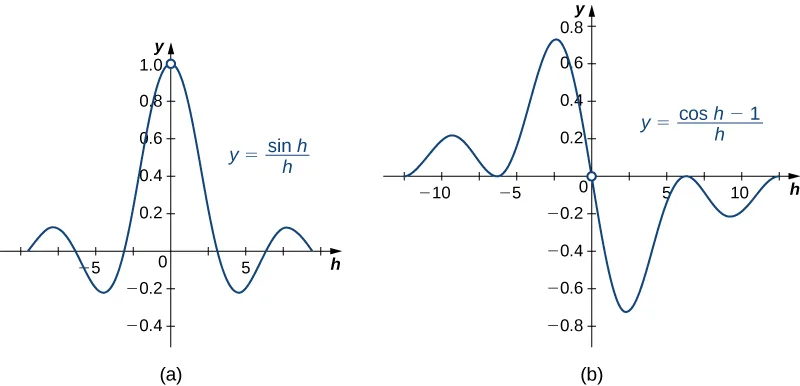
The graphs of y=h(sinh) and y=h(cosh−1) are shown in Figure 3.26.
Figure 3.26These graphs show two important limits needed to establish the derivative formulas for the sine and cosine functions.
We also recall the following trigonometric identity for the sine of the sum of two angles:
sin(x+h)=sinxcosh+cosxsinh.
Now that we have gathered all the necessary equations and identities, we proceed with the proof.
dxdsinx=limh→0hsin(x+h)−sinx=limh→0hsinxcosh+cosxsinh−sinx=limh→0(hsinxcosh−sinx+hcosxsinh)=limh→0(sinx(hcosh−1)+cosx(hsinh))=sinx⋅0+cosx⋅1=cosxApply the definitionof the derivative.Use trig identity for the sine of the sum of two angles.Regroup.Factor outsinxandcosx.Apply trig limit formulas.Simplify.
□
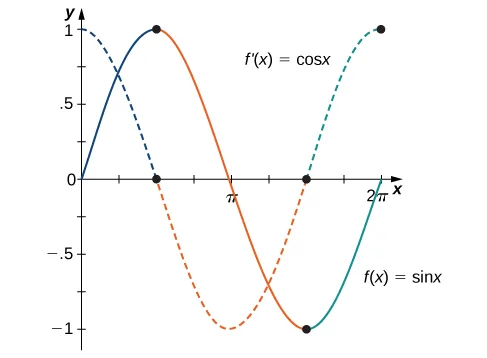
Figure 3.27 shows the relationship between the graph of f(x)=sinx and its derivative f′(x)=cosx. Notice that at the points where f(x)=sinx has a horizontal tangent, its derivative f′(x)=cosx takes on the value zero. We also see that where is increasing, and where is decreasing,
Figure 3.27Where f(x) has a maximum or a minimum, f′(x)=0 that is, f′(x)=0 where f(x) has a horizontal tangent. These points are noted with dots on the graphs.
Derivatives of Other Trigonometric Functions
Since the remaining four trigonometric functions may be expressed as quotients involving sine, cosine, or both, we can use the quotient rule to find formulas for their derivatives.
The derivatives of the remaining trigonometric functions may be obtained by using similar techniques. We provide these formulas in the following theorem.
Higher-Order Derivatives
The higher-order derivatives of sinx and cosx follow a repeating pattern. By following the pattern, we can find any higher-order derivative of sinx and cosx.
Key Concepts
We can find the derivatives of sin x and cos x by using the definition of derivative and the limit formulas found earlier. The results are dxdsinx=cosxdxdcosx=-sinx.
Key Equations
Derivative of sine function
dxd(sinx)=cosx
Derivative of cosine function
dxd(cosx)=-sinx
dxd(sinx)=cosx.
f(x)=sinx
f′(x)=cosx>0
f(x)=sinx
f′(x)=cosx<0.
After simplifying, we obtain
f′(x)=15x2sinx+5x3cosx.
Simplifying, we obtain
g′(x)=16x4−4x2sinx−8xcosx=4x3-xsinx−2cosx.
s′(t)=v(t)=0.
s′(t).
s′(t)=2cost−1,
so we must solve
2cost−1=0for0≤t≤2π.
The solutions to this equation are t=3π and t=35π. Thus the particle is at rest at times t=3π and t=35π.
Hint
Use the previous example as a guide.
Answer
t=3π,t=32π
Now apply the quotient rule to obtain
f′(x)=(cosx)2cosxcosx−(-sinx)sinx.
Simplifying, we obtain
f′(x)=cos2xcos2x+sin2x.
Recognizing that cos2x+sin2x=1, by the Pythagorean theorem, we now have
f′(x)=cos2x1.
Finally, use the identity secx=cosx1 to obtain
f′(x)=sec2x.
Answer
f′(x)=-csc2x
dxd(cotx)=-csc2x
dxd(secx)=secxtanx
dxd(cscx)=-cscxcotx.
Thus the tangent line passes through the point (4π,1). Next, find the slope by finding the derivative of f(x)=cotx and evaluating it at 4π:
f′(x)=-csc2xandf′(4π)=-csc2(4π)=−2.
Using the point-slope equation of the line, we obtain
y−1=−2(x−4π)
or equivalently,
y=−2x+1+2π.
In the first term, dxd(cscx)=-cscxcotx, and by applying the product rule to the second term we obtain
dxd(xtanx)=(1)(tanx)+(sec2x)(x).
Therefore, we have
f′(x)=-cscxcotx+tanx+xsec2x.
Answer
34
Hint
See the previous example.
Answer
cosx
Solution
We can see right away that for the 74th derivative of sinx,74=4(18)+2, so
Next, find a(t)=v′(t). Thus, a(t)=v′(t)=sint and we have
a(4π)=21.
Since v(4π)=−21<0 and a(4π)=21>0, we see that velocity and acceleration are acting in opposite directions; that is, the object is being accelerated in the direction opposite to the direction in which it is travelling. Consequently, the particle is slowing down.
Hint
Use Example 3.47 as a guide.
Answer
v(65π)=-3<0 and a(65π)=−1<0. The block is speeding up.
With these two formulas, we can determine the derivatives of all six basic trigonometric functions.