In this section we look at some applications of the derivative by focusing on the interpretation of the derivative as the rate of change of a function. These applications include acceleration and velocity in physics, population growth rates in biology, and marginal functions in economics.
Amount of Change Formula
One application for derivatives is to estimate an unknown value of a function at a point by using a known value of a function at some given point together with its rate of change at the given point. If is a function defined on an interval then the amount of change of over the interval is the change in the values of the function over that interval and is given by
The average rate of change of the function over that same interval is the ratio of the amount of change over that interval to the corresponding change in the values. It is given by
As we already know, the instantaneous rate of change of at is its derivative
For small enough values of We can then solve for to get the amount of change formula:
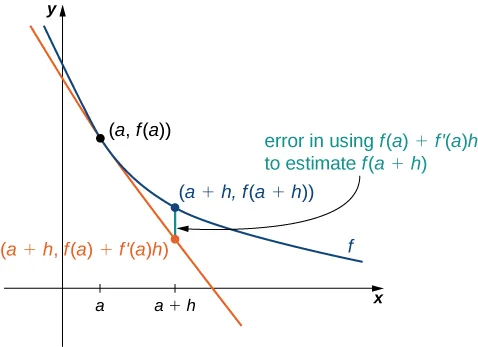
We can use this formula if we know only and and wish to estimate the value of For example, we may use the current population of a city and the rate at which it is growing to estimate its population in the near future. As we can see in Figure 3.22, we are approximating by the coordinate at on the line tangent to at Observe that the accuracy of this estimate depends on the value of as well as the value of
Motion along a Line
Another use for the derivative is to analyze motion along a line. We have described velocity as the rate of change of position. If we take the derivative of the velocity, we can find the acceleration, or the rate of change of velocity. It is also important to introduce the idea of speed, which is the magnitude of velocity. Thus, we can state the following mathematical definitions.
Population Change
In addition to analyzing velocity, speed, acceleration, and position, we can use derivatives to analyze various types of populations, including those as diverse as bacteria colonies and cities. We can use a current population, together with a growth rate, to estimate the size of a population in the future. The population growth rate is the rate of change of a population and consequently can be represented by the derivative of the size of the population.
Changes in Cost and Revenue
In addition to analyzing motion along a line and population growth, derivatives are useful in analyzing changes in cost, revenue, and profit. The concept of a marginal function is common in the fields of business and economics and implies the use of derivatives. The marginal cost is the derivative of the cost function. The marginal revenue is the derivative of the revenue function. The marginal profit is the derivative of the profit function, which is based on the cost function and the revenue function.
We can roughly approximate
by choosing an appropriate value for Since x represents objects, a reasonable and small value for is 1. Thus, by substituting we get the approximation Consequently, for a given value of can be thought of as the change in cost associated with producing one additional item. In a similar way, approximates the revenue obtained by selling one additional item, and approximates the profit obtained by producing and selling one additional item.
Key Concepts
- Using it is possible to estimate given and