For the following exercises, the given functions represent the position of a particle traveling along a horizontal line; .
- Find the velocity and acceleration functions.
- Determine the time intervals when the object is slowing down or speeding up.
Preparing your lesson…正在准备你的课程…正在準備你的課程…Preparando tu lección…Préparation de votre leçon…Deine Lektion wird vorbereitet…Sto preparando la tua lezione…Preparando sua aula…レッスンを準備しています…수업을 준비하고 있어요…Menyediakan pelajaran anda…Menyiapkan pelajaranmu…
Preparing your lesson…正在准备你的课程…正在準備你的課程…Preparando tu lección…Préparation de votre leçon…Deine Lektion wird vorbereitet…Sto preparando la tua lezione…Preparando sua aula…レッスンを準備しています…수업을 준비하고 있어요…Menyediakan pelajaran anda…Menyiapkan pelajaranmu…
Calculus Volume 1 · 3.4 Derivatives as Rates of Change
14 problems from the book, with its answers. Check your working, or have any of them explained to you on the whiteboard.
Exercises 151
For the following exercises, the given functions represent the position of a particle traveling along a horizontal line; .
Exercises 153
For the following exercises, the given functions represent the position of a particle traveling along a horizontal line; .
A model rocket is fired vertically upward from the ground. The distance in feet that the rocket travels from the ground after seconds is given by
Exercises 155
For the following exercises, the given functions represent the position of a particle traveling along a horizontal line; .
The position function represents the position of the back of a car backing out of a driveway and then driving in a straight line, where is in feet and is in seconds. In this case, represents the time at which the back of the car is at the garage door, so is the starting position of the car, 4 feet inside the garage.
Exercises 157
For the following exercises, the given functions represent the position of a particle traveling along a horizontal line; .
A potato is launched vertically upward with an initial velocity of 100 ft/s from a potato gun at the top of an 85-foot-tall building. The position of the potato relative to the ground after seconds is given by
Exercises 159
For the following exercises, the given functions represent the position of a particle traveling along a horizontal line; .
The following graph shows the position of an object moving along a straight line.
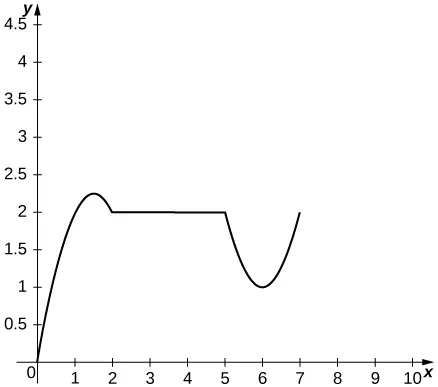
Exercises 161
For the following exercises, the given functions represent the position of a particle traveling along a horizontal line; .
The price (in dollars) and the demand for a certain digital clock radio is given by the price–demand function
Exercises 163
For the following exercises, the given functions represent the position of a particle traveling along a horizontal line; .
[T] In general, the profit function is the difference between the revenue and cost functions:
Suppose the price-demand and cost functions for the production of cordless drills is given respectively by and where is the number of cordless drills that are sold at a price of dollars per drill and is the cost of producing cordless drills.
Exercises 165
For the following exercises, the given functions represent the position of a particle traveling along a horizontal line; .
[T] A culture of bacteria grows in number according to the function where is measured in hours.
Exercises 167
The following questions concern the population (in millions) of London by decade in the 19th century, which is listed in the following table.
| Years since 1800 | Population (millions) |
| 1 | 0.8795 |
| 11 | 1.040 |
| 21 | 1.264 |
| 31 | 1.516 |
| 41 | 1.661 |
| 51 | 2.000 |
| 61 | 2.634 |
| 71 | 3.272 |
| 81 | 3.911 |
| 91 | 4.422 |
[T]
Exercises 169
For the following exercises, consider an astronaut on a large planet in another galaxy. To learn more about the composition of this planet, the astronaut drops an electronic sensor into a deep trench. The sensor transmits its vertical position every second in relation to the astronaut’s position. The summary of the falling sensor data is displayed in the following table.
| Time after dropping (s) | Position (m) |
| 0 | 0 |
| 1 | −1 |
| 2 | −2 |
| 3 | −5 |
| 4 | −7 |
| 5 | −14 |
[T]
Exercises 171
The following problems deal with the Holling type I, II, and III equations. These equations describe the ecological event of growth of a predator population given the amount of prey available for consumption.
[T] The Holling type I equation is described by where is the amount of prey available and is the rate at which the predator meets the prey for consumption.
Exercises 173
The following problems deal with the Holling type I, II, and III equations. These equations describe the ecological event of growth of a predator population given the amount of prey available for consumption.
[T] The Holling type III equation is described by where is the amount of prey available and is the maximum consumption rate of the predator.
Review Exercises 389
The following questions concern the water level in Ocean City, New Jersey, in January, which can be approximated by where t is measured in hours after midnight, and the height is measured in feet.
Find What is the physical meaning of this value?
Review Exercises 391
The following questions consider the wind speeds of Hurricane Katrina, which affected New Orleans, Louisiana, in August 2005. The data are displayed in a table.
| Hours after Midnight, August 26 | Wind Speed (mph) |
| 1 | 45 |
| 5 | 75 |
| 11 | 100 |
| 29 | 115 |
| 49 | 145 |
| 58 | 175 |
| 73 | 155 |
| 81 | 125 |
| 85 | 95 |
| 107 | 35 |
Estimate the derivative of the wind speed at hour 83. What is the physical meaning?
The tutor teaches the whole section, drawing it out step by step and answering your questions as you go.