In the preceding section, we used definite integrals to find the area between two curves. In this section, we use definite integrals to find volumes of three-dimensional solids. We consider three approaches—slicing, disks, and washers—for finding these volumes, depending on the characteristics of the solid.
Volume and the Slicing Method
Just as area is the numerical measure of a two-dimensional region, volume is the numerical measure of a three-dimensional solid. Most of us have computed volumes of solids by using basic geometric formulas. The volume of a rectangular solid, for example, can be computed by multiplying length, width, and height: The formulas for the volume of a sphere a cone and a pyramid have also been introduced. Although some of these formulas were derived using geometry alone, all these formulas can be obtained by using integration.
We can also calculate the volume of a cylinder. Although most of us think of a cylinder as having a circular base, such as a soup can or a metal rod, in mathematics the word cylinder has a more general meaning. To discuss cylinders in this more general context, we first need to define some vocabulary.
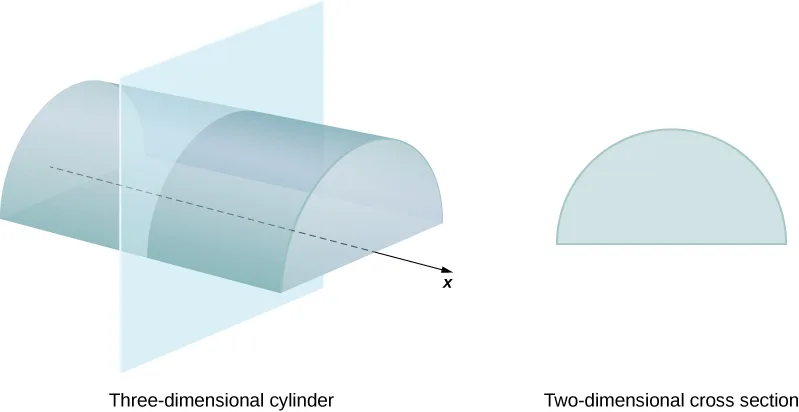
We define the cross-section of a solid to be the intersection of a plane with the solid. A cylinder is defined as any solid that can be generated by translating a plane region along a line perpendicular to the region, called the axis of the cylinder. Thus, all cross-sections perpendicular to the axis of a cylinder are identical. The solid shown in Figure 6.11 is an example of a cylinder with a noncircular base. To calculate the volume of a cylinder, then, we simply multiply the area of the cross-section by the height of the cylinder: In the case of a right circular cylinder (soup can), this becomes
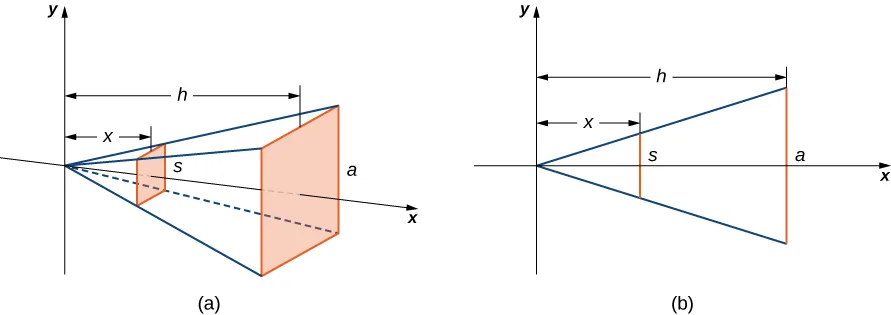
If a solid does not have a constant cross-section (and it is not one of the other basic solids), we may not have a formula for its volume. In this case, we can use a definite integral to calculate the volume of the solid. We do this by slicing the solid into pieces, estimating the volume of each slice, and then adding those estimated volumes together. The slices should all be parallel to one another, and when we put all the slices together, we should get the whole solid. Consider, for example, the solid S shown in Figure 6.12, extending along the
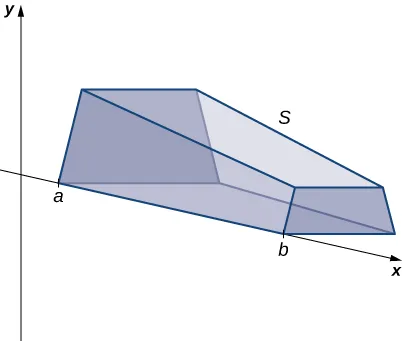
We want to divide into slices perpendicular to the As we see later in the chapter, there may be times when we want to slice the solid in some other direction—say, with slices perpendicular to the y-axis. The decision of which way to slice the solid is very important. If we make the wrong choice, the computations can get quite messy. Later in the chapter, we examine some of these situations in detail and look at how to decide which way to slice the solid. For the purposes of this section, however, we use slices perpendicular to the
Because the cross-sectional area is not constant, we let represent the area of the cross-section at point Now let be a regular partition of and for let represent the slice of stretching from The following figure shows the sliced solid with
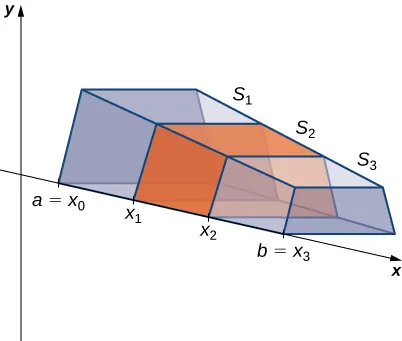
Finally, for let be an arbitrary point in Then the volume of slice can be estimated by Adding these approximations together, we see the volume of the entire solid can be approximated by
By now, we can recognize this as a Riemann sum, and our next step is to take the limit as Then we have
The technique we have just described is called the slicing method. To apply it, we use the following strategy.
Recall that in this section, we assume the slices are perpendicular to the Therefore, the area formula is in terms of x and the limits of integration lie on the However, the problem-solving strategy shown here is valid regardless of how we choose to slice the solid.
Solids of Revolution
If a region in a plane is revolved around a line in that plane, the resulting solid is called a solid of revolution, as shown in the following figure.
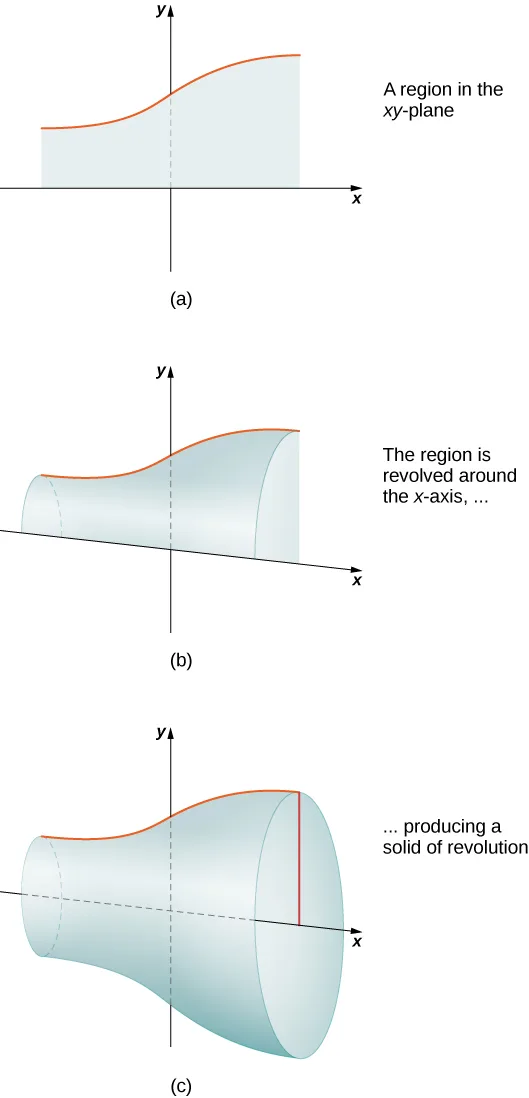
Solids of revolution are common in mechanical applications, such as machine parts produced by a lathe. We spend the rest of this section looking at solids of this type. The next example uses the slicing method to calculate the volume of a solid of revolution.
The Disk Method
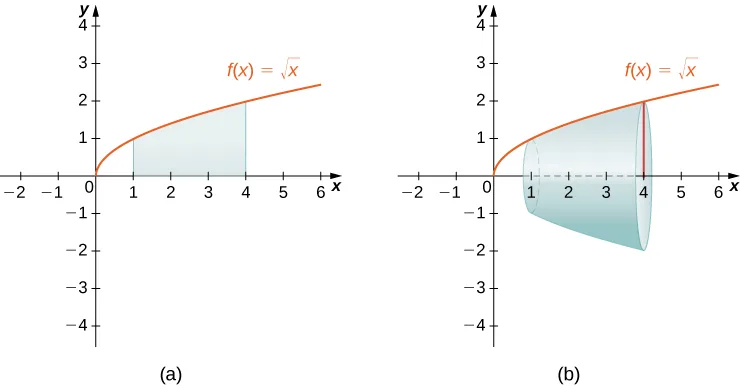
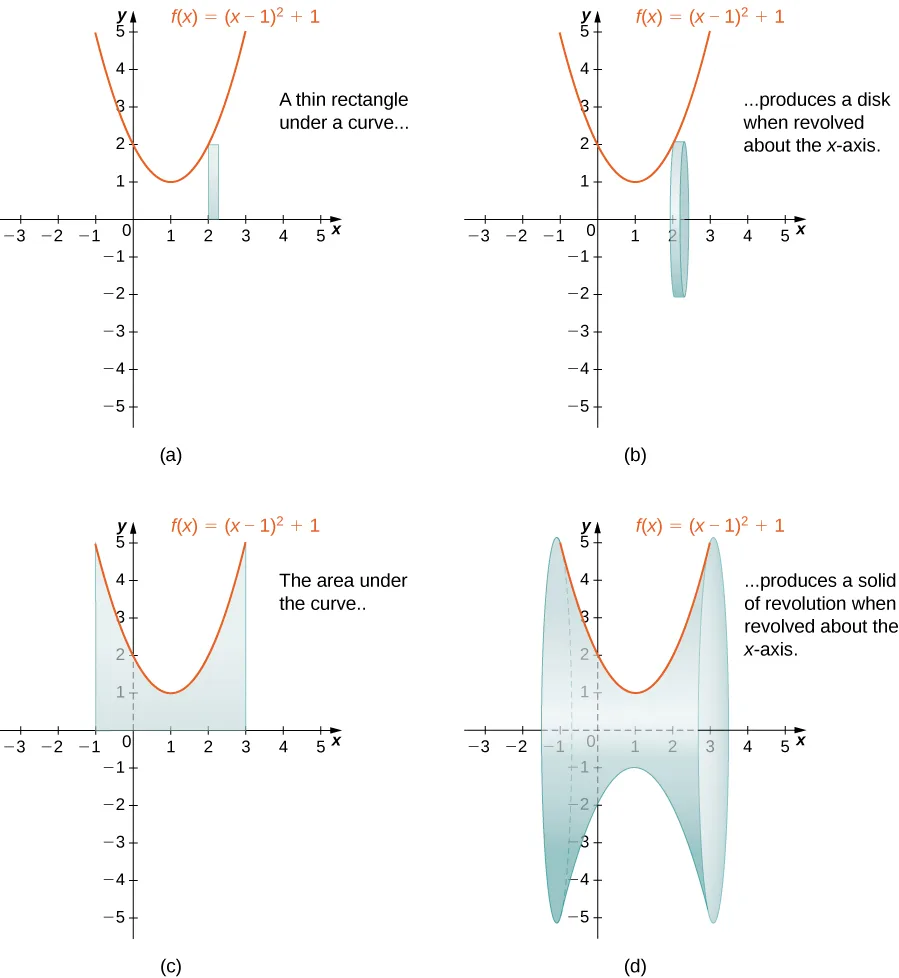
When we use the slicing method with solids of revolution, it is often called the disk method because, for solids of revolution, the slices used to over approximate the volume of the solid are disks. To see this, consider the solid of revolution generated by revolving the region between the graph of the function and the over the interval around the The graph of the function and a representative disk are shown in Figure 6.18(a) and (b). The region of revolution and the resulting solid are shown in Figure 6.18(c) and (d).
We already used the formal Riemann sum development of the volume formula when we developed the slicing method. We know that
The only difference with the disk method is that we know the formula for the cross-sectional area ahead of time; it is the area of a circle. This gives the following rule.
The volume of the solid we have been studying (Figure 6.18) is given by
Let’s look at some examples.
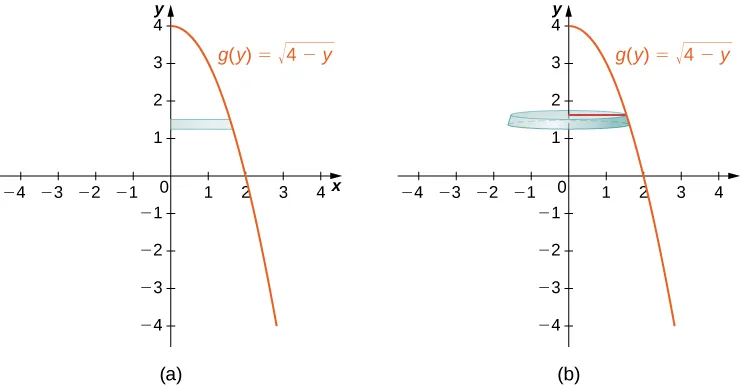
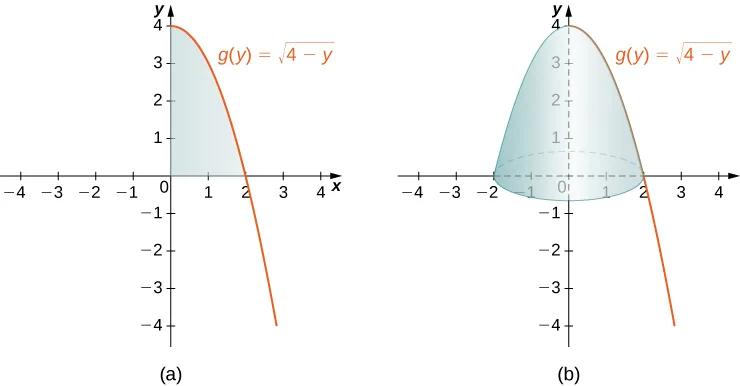
So far, our examples have all concerned regions revolved around the but we can generate a solid of revolution by revolving a plane region around any horizontal or vertical line. In the next example, we look at a solid of revolution that has been generated by revolving a region around the The mechanics of the disk method are nearly the same as when the is the axis of revolution, but we express the function in terms of and we integrate with respect to y as well. This is summarized in the following rule.
The next example shows how this rule works in practice.
The Washer Method
Some solids of revolution have cavities in the middle; they are not solid all the way to the axis of revolution. Sometimes, this is just a result of the way the region of revolution is shaped with respect to the axis of revolution. In other cases, cavities arise when the region of revolution is defined as the region between the graphs of two functions. A third way this can happen is when an axis of revolution other than the or is selected.
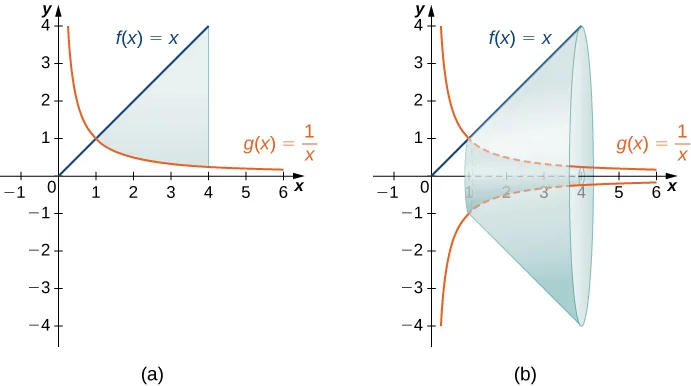
When the solid of revolution has a cavity in the middle, the slices used to approximate the volume are not disks, but washers (disks with holes in the center). For example, consider the region bounded above by the graph of the function and below by the graph of the function over the interval When this region is revolved around the the result is a solid with a cavity in the middle, and the slices are washers. The graph of the function and a representative washer are shown in Figure 6.22(a) and (b). The region of revolution and the resulting solid are shown in Figure 6.22(c) and (d).
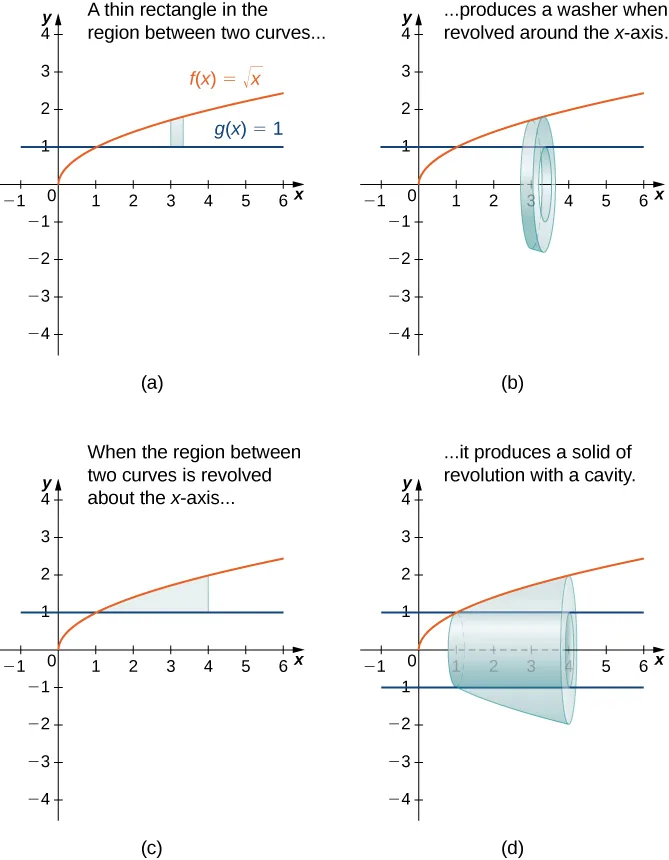
The cross-sectional area, then, is the area of the outer circle less the area of the inner circle. In this case,
Then the volume of the solid is
Generalizing this process gives the washer method.
As with the disk method, we can also apply the washer method to solids of revolution that result from revolving a region around the y-axis. In this case, the following rule applies.
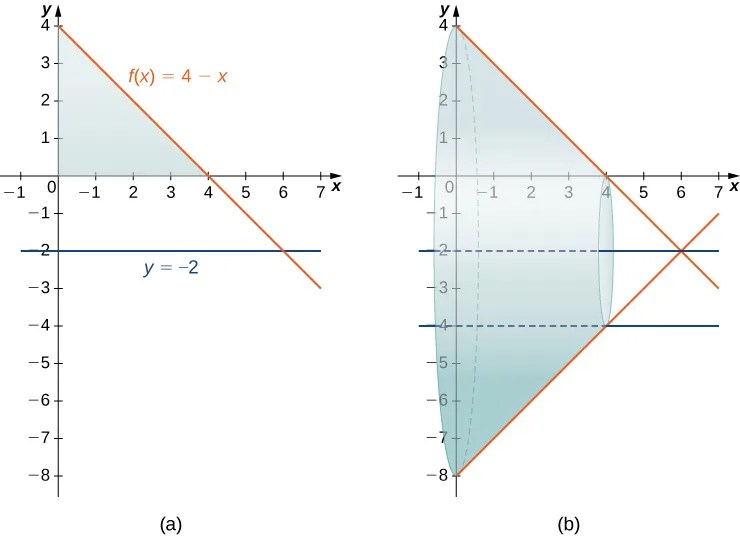
Rather than looking at an example of the washer method with the as the axis of revolution, we now consider an example in which the axis of revolution is a line other than one of the two coordinate axes. The same general method applies, but you may have to visualize just how to describe the cross-sectional area of the volume.
Key Concepts
- Definite integrals can be used to find the volumes of solids. Using the slicing method, we can find a volume by integrating the cross-sectional area.
- For solids of revolution, the volume slices are often disks and the cross-sections are circles. The method of disks involves applying the method of slicing in the particular case in which the cross-sections are circles, and using the formula for the area of a circle.
- If a solid of revolution has a cavity in the center, the volume slices are washers. With the method of washers, the area of the inner circle is subtracted from the area of the outer circle before integrating.
Key Equations
| Disk Method along the x-axis | |
| Disk Method along the y-axis |