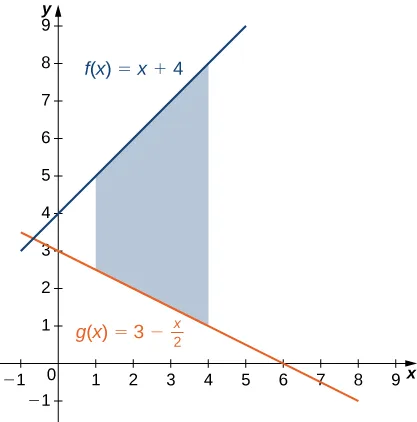
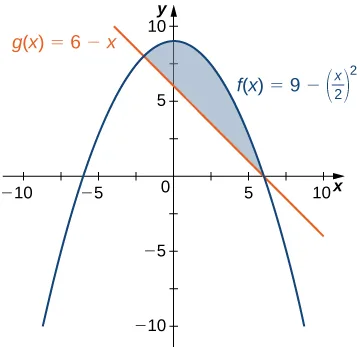
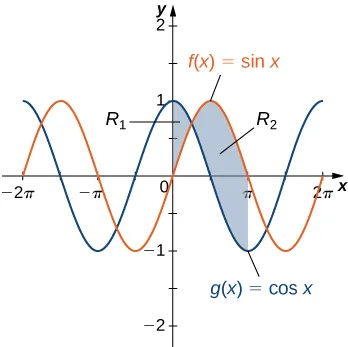
In Introduction to Integration, we developed the concept of the definite integral to calculate the area below a curve on a given interval. In this section, we expand that idea to calculate the area of more complex regions. We start by finding the area between two curves that are functions of beginning with the simple case in which one function value is always greater than the other. We then look at cases when the graphs of the functions cross. Last, we consider how to calculate the area between two curves that are functions of
Area of a Region between Two Curves
Let and be continuous functions over an interval such that on We want to find the area between the graphs of the functions, as shown in the following figure.
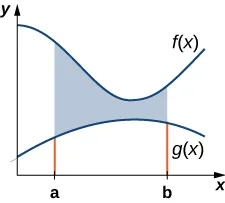
As we did before, we are going to partition the interval on the and approximate the area between the graphs of the functions with rectangles. So, for let be a regular partition of Then, for choose a point and on each interval construct a rectangle that extends vertically from to Figure 6.3(a) shows the rectangles when is selected to be the left endpoint of the interval and Figure 6.3(b) shows a representative rectangle in detail.
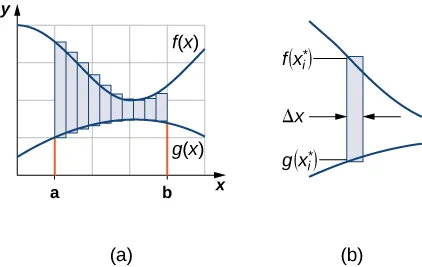
The height of each individual rectangle is and the width of each rectangle is Adding the areas of all the rectangles, we see that the area between the curves is approximated by
This is a Riemann sum, so we take the limit as and we get
These findings are summarized in the following theorem.
We apply this theorem in the following example.
In Example 6.1, we defined the interval of interest as part of the problem statement. Quite often, though, we want to define our interval of interest based on where the graphs of the two functions intersect. This is illustrated in the following example.
Areas of Compound Regions
So far, we have required over the entire interval of interest, but what if we want to look at regions bounded by the graphs of functions that cross one another? In that case, we modify the process we just developed by using the absolute value function.
In practice, applying this theorem requires us to break up the interval and evaluate several integrals, depending on which of the function values is greater over a given part of the interval. We study this process in the following example.
Regions Defined with Respect to y
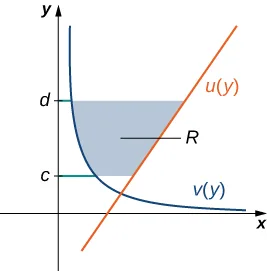
In Example 6.4, we had to evaluate two separate integrals to calculate the area of the region. However, there is another approach that requires only one integral. What if we treat the curves as functions of instead of as functions of Review Figure 6.7. Note that the left graph, shown in red, is represented by the function We could just as easily solve this for and represent the curve by the function (Note that is also a valid representation of the function as a function of However, based on the graph, it is clear we are interested in the positive square root.) Similarly, the right graph is represented by the function but could just as easily be represented by the function When the graphs are represented as functions of we see the region is bounded on the left by the graph of one function and on the right by the graph of the other function. Therefore, if we integrate with respect to we need to evaluate one integral only. Let’s develop a formula for this type of integration.
Let and be continuous functions over an interval such that for all We want to find the area between the graphs of the functions, as shown in the following figure.
This time, we are going to partition the interval on the and use horizontal rectangles to approximate the area between the functions. So, for let be a regular partition of Then, for choose a point then over each interval construct a rectangle that extends horizontally from to Figure 6.9(a) shows the rectangles when is selected to be the lower endpoint of the interval and Figure 6.9(b) shows a representative rectangle in detail.
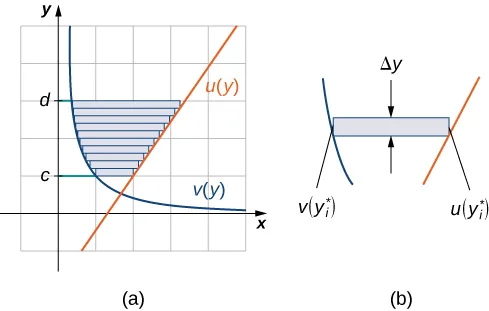
The height of each individual rectangle is and the width of each rectangle is Therefore, the area between the curves is approximately
This is a Riemann sum, so we take the limit as obtaining
These findings are summarized in the following theorem.
Key Concepts
- Just as definite integrals can be used to find the area under a curve, they can also be used to find the area between two curves.
- To find the area between two curves defined by functions, integrate the difference of the functions.
- If the graphs of the functions cross, or if the region is complex, use the absolute value of the difference of the functions. In this case, it may be necessary to evaluate two or more integrals and add the results to find the area of the region.
- Sometimes it can be easier to integrate with respect to y to find the area. The principles are the same regardless of which variable is used as the variable of integration.
Key Equations
| Area between two curves, integrating on the x-axis | |
| Area between two curves, integrating on the y-axis |