For the following exercises, determine the area of the region between the two curves in the given figure by integrating over the
Preparing your lesson…正在准备你的课程…正在準備你的課程…Preparando tu lección…Préparation de votre leçon…Deine Lektion wird vorbereitet…Sto preparando la tua lezione…Preparando sua aula…レッスンを準備しています…수업을 준비하고 있어요…Menyediakan pelajaran anda…Menyiapkan pelajaranmu…
Preparing your lesson…正在准备你的课程…正在準備你的課程…Preparando tu lección…Préparation de votre leçon…Deine Lektion wird vorbereitet…Sto preparando la tua lezione…Preparando sua aula…レッスンを準備しています…수업을 준비하고 있어요…Menyediakan pelajaran anda…Menyiapkan pelajaranmu…
Calculus Volume 1 · 6.1 Areas between Curves
30 problems from the book, with its answers. Check your working, or have any of them explained to you on the whiteboard.
Exercises 1
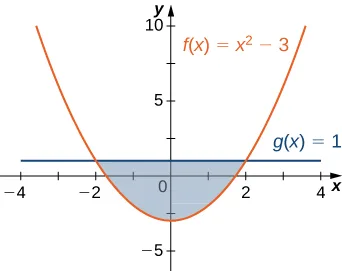
For the following exercises, determine the area of the region between the two curves in the given figure by integrating over the
Exercises 3
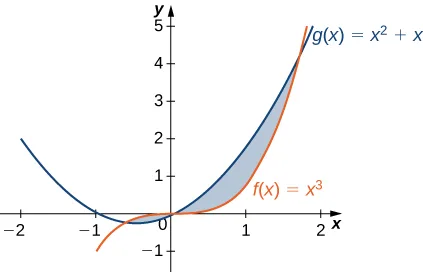
For the following exercises, split the region between the two curves into two smaller regions, then determine the area by integrating over the Note that you will have two integrals to solve.
and
Exercises 5
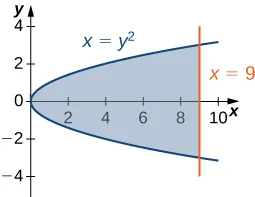
For the following exercises, determine the area of the region between the two curves by integrating over the
Exercises 7
For the following exercises, graph the equations and shade the area of the region between the curves. Determine its area by integrating over the
Exercises 9
For the following exercises, graph the equations and shade the area of the region between the curves. Determine its area by integrating over the
and on
Exercises 11
For the following exercises, graph the equations and shade the area of the region between the curves. Determine its area by integrating over the
Exercises 13
For the following exercises, graph the equations and shade the area of the region between the curves. Determine its area by integrating over the
Exercises 15
For the following exercises, graph the equations and shade the area of the region between the curves. If necessary, break the region into sub-regions to determine its entire area.
Exercises 17
For the following exercises, graph the equations and shade the area of the region between the curves. If necessary, break the region into sub-regions to determine its entire area.
over
Exercises 19
For the following exercises, graph the equations and shade the area of the region between the curves. If necessary, break the region into sub-regions to determine its entire area.
and
Exercises 21
For the following exercises, graph the equations and shade the area of the region between the curves. Determine its area by integrating over the
Exercises 23
For the following exercises, graph the equations and shade the area of the region between the curves. Determine its area by integrating over the
Exercises 25
For the following exercises, graph the equations and shade the area of the region between the curves. Determine its area by integrating over the
Exercises 27
For the following exercises, graph the equations and shade the area of the region between the curves. Determine its area by integrating over the x-axis or y-axis, whichever seems more convenient.
Exercises 29
For the following exercises, graph the equations and shade the area of the region between the curves. Determine its area by integrating over the x-axis or y-axis, whichever seems more convenient.
Exercises 31
For the following exercises, graph the equations and shade the area of the region between the curves. Determine its area by integrating over the x-axis or y-axis, whichever seems more convenient.
Exercises 33
For the following exercises, graph the equations and shade the area of the region between the curves. Determine its area by integrating over the x-axis or y-axis, whichever seems more convenient.
Exercises 35
For the following exercises, graph the equations and shade the area of the region between the curves. Determine its area by integrating over the x-axis or y-axis, whichever seems more convenient.
Exercises 37
For the following exercises, graph the equations and shade the area of the region between the curves. Determine its area by integrating over the x-axis or y-axis, whichever seems more convenient.
Exercises 39
For the following exercises, find the exact area of the region bounded by the given equations if possible. If you are unable to determine the intersection points analytically, use a calculator to approximate the intersection points with three decimal places and determine the approximate area of the region.
[T]
Exercises 41
For the following exercises, find the exact area of the region bounded by the given equations if possible. If you are unable to determine the intersection points analytically, use a calculator to approximate the intersection points with three decimal places and determine the approximate area of the region.
[T]
Exercises 43
For the following exercises, find the exact area of the region bounded by the given equations if possible. If you are unable to determine the intersection points analytically, use a calculator to approximate the intersection points with three decimal places and determine the approximate area of the region.
[T]
Exercises 45
For the following exercises, find the exact area of the region bounded by the given equations if possible. If you are unable to determine the intersection points analytically, use a calculator to approximate the intersection points with three decimal places and determine the approximate area of the region.
[T]
Exercises 47
For the following exercises, find the exact area of the region bounded by the given equations if possible. If you are unable to determine the intersection points analytically, use a calculator to approximate the intersection points with three decimal places and determine the approximate area of the region.
[T]
Exercises 49
For the following exercises, find the exact area of the region bounded by the given equations if possible. If you are unable to determine the intersection points analytically, use a calculator to approximate the intersection points with three decimal places and determine the approximate area of the region.
A factory selling cell phones has a marginal cost function where represents the number of cell phones, is the marginal cost, in dollars, of selling phones, and a marginal revenue function given by , where is the revenue, in dollars, earned by selling cell phonesFind the area between the graphs of these curves and What does this area represent?
Exercises 50
For the following exercises, find the exact area of the region bounded by the given equations if possible. If you are unable to determine the intersection points analytically, use a calculator to approximate the intersection points with three decimal places and determine the approximate area of the region.
An amusement park has a marginal cost function where represents the number of tickets sold, and a marginal revenue function given by Find the total profit generated when selling tickets. Use a calculator to determine intersection points, if necessary, to two decimal places.
Exercises 51
For the following exercises, find the exact area of the region bounded by the given equations if possible. If you are unable to determine the intersection points analytically, use a calculator to approximate the intersection points with three decimal places and determine the approximate area of the region.
The tortoise versus the hare: The speed of the hare is given by the sinusoidal function whereas the speed of the tortoise is where is time measured in hours and the speed is measured in miles per hour. Find the area between the curves from time to the first time after one hour when the tortoise and hare are traveling at the same speed. What does it represent? Use a calculator to determine the intersection points, if necessary, accurate to three decimal places.
Exercises 53
For the following exercises, find the area between the curves by integrating with respect to and then with respect to Is one method easier than the other? Do you obtain the same answer?
Exercises 55
For the following exercises, find the area between the curves by integrating with respect to and then with respect to Is one method easier than the other? Do you obtain the same answer?
Exercises 57
For the following exercises, solve using calculus, then check your answer with geometry.
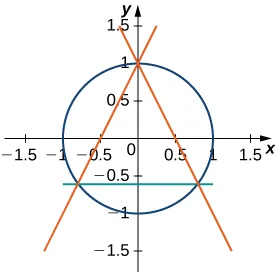
Find the area between the perimeter of the unit circle and the triangle created from and as seen in the following figure. Is there a way to solve this without using calculus?
The tutor teaches the whole section, drawing it out step by step and answering your questions as you go.