2. If when reversing the chain rule, should you take or
← Back to Calculus Volume 1
Calculus Volume 1 · 5.7 Integrals Resulting in Inverse Trigonometric Functions
Integrals Resulting in Inverse Trigonometric Functions: practice problems
60 problems from the book, with its answers. Check your working, or have any of them explained to you on the whiteboard.
Exercises 257
In the following exercises, verify each identity using differentiation. Then, using the indicated u-substitution, identify f such that the integral takes the form
For
Exercises 259
In the following exercises, verify each identity using differentiation. Then, using the indicated u-substitution, identify f such that the integral takes the form
Exercises 261
In the following exercises, find the antiderivative using the indicated substitution.
Exercises 263
In the following exercises, find the antiderivative using the indicated substitution.
Exercises 265
In the following exercises, find the antiderivative using the indicated substitution.
Exercises 267
In the following exercises, find the antiderivative using the indicated substitution.
Exercises 269
In the following exercises, find the antiderivative using the indicated substitution.
Exercises 271
In the following exercises, use a suitable change of variables to determine the indefinite integral.
Exercises 273
In the following exercises, use a suitable change of variables to determine the indefinite integral.
Exercises 275
In the following exercises, use a suitable change of variables to determine the indefinite integral.
Exercises 277
In the following exercises, use a suitable change of variables to determine the indefinite integral.
Exercises 279
In the following exercises, use a suitable change of variables to determine the indefinite integral.
Exercises 281
In the following exercises, use a suitable change of variables to determine the indefinite integral.
Exercises 283
In the following exercises, use a suitable change of variables to determine the indefinite integral.
Exercises 285
In the following exercises, use a suitable change of variables to determine the indefinite integral.
Exercises 287
In the following exercises, use a suitable change of variables to determine the indefinite integral.
Exercises 289
In the following exercises, use a calculator to estimate the area under the curve using left Riemann sums with 50 terms, then use substitution to solve for the exact answer.
[T] over
Exercises 291
In the following exercises, use a calculator to estimate the area under the curve using left Riemann sums with 50 terms, then use substitution to solve for the exact answer.
[T] over
Exercises 293
In the following exercises, use a change of variables to evaluate the definite integral.
Exercises 295
In the following exercises, use a change of variables to evaluate the definite integral.
Exercises 297
In the following exercises, use a change of variables to evaluate the definite integral.
Exercises 299
In the following exercises, evaluate the indefinite integral with constant using u-substitution. Then, graph the function and the antiderivative over the indicated interval. If possible, estimate a value of C that would need to be added to the antiderivative to make it equal to the definite integral with the left endpoint of the given interval.
Exercises 301
In the following exercises, evaluate the indefinite integral with constant using u-substitution. Then, graph the function and the antiderivative over the indicated interval. If possible, estimate a value of C that would need to be added to the antiderivative to make it equal to the definite integral with the left endpoint of the given interval.
Exercises 303
In the following exercises, evaluate the indefinite integral with constant using u-substitution. Then, graph the function and the antiderivative over the indicated interval. If possible, estimate a value of C that would need to be added to the antiderivative to make it equal to the definite integral with the left endpoint of the given interval.
Exercises 305
In the following exercises, evaluate the indefinite integral with constant using u-substitution. Then, graph the function and the antiderivative over the indicated interval. If possible, estimate a value of C that would need to be added to the antiderivative to make it equal to the definite integral with the left endpoint of the given interval.
Exercises 307
In the following exercises, use a change of variables to show that each definite integral is equal to zero.
Exercises 309
In the following exercises, use a change of variables to show that each definite integral is equal to zero.
Exercises 311
In the following exercises, use a change of variables to show that each definite integral is equal to zero.
Exercises 313
In the following exercises, use a change of variables to show that each definite integral is equal to zero.
Show that the average value of over an interval is the same as the average value of over the interval for
Exercises 315
In the following exercises, use a change of variables to show that each definite integral is equal to zero.
Find the area under the graph of between and where and is fixed. Evaluate the limit as
Exercises 317
In the following exercises, use a change of variables to show that each definite integral is equal to zero.
The area of the top half of an ellipse with a major axis that is the x-axis from to and with a minor axis that is the y-axis from to can be written as Use the substitution to express this area in terms of an integral of a trigonometric function. You do not need to compute the integral.
Exercises 319
In the following exercises, use a change of variables to show that each definite integral is equal to zero.
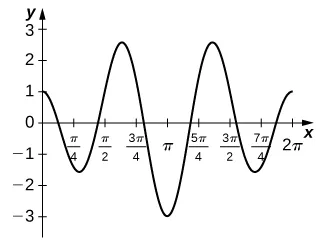
[T] The following graph is of a function of the form Estimate the coefficients a and b and the frequency parameters n and m. Use these estimates to approximate
Exercises 391
In the following exercises, evaluate each integral in terms of an inverse trigonometric function.
Exercises 393
In the following exercises, evaluate each integral in terms of an inverse trigonometric function.
Exercises 395
In the following exercises, evaluate each integral in terms of an inverse trigonometric function.
Exercises 397
In the following exercises, find each indefinite integral, using appropriate substitutions.
Exercises 399
In the following exercises, find each indefinite integral, using appropriate substitutions.
Exercises 401
In the following exercises, find each indefinite integral, using appropriate substitutions.
Exercises 403
In the following exercises, find each indefinite integral, using appropriate substitutions.
Explain the relationship Is it true, in general, that
Exercises 405
In the following exercises, find each indefinite integral, using appropriate substitutions.
Explain what is wrong with the following integral:
Exercises 407
In the following exercises, solve for the antiderivative of f with then use a calculator to graph f and the antiderivative over the given interval Identify a value of C such that adding C to the antiderivative recovers the definite integral
Exercises 409
In the following exercises, solve for the antiderivative of f with then use a calculator to graph f and the antiderivative over the given interval Identify a value of C such that adding C to the antiderivative recovers the definite integral
Exercises 411
In the following exercises, compute the antiderivative using appropriate substitutions.
Exercises 413
In the following exercises, compute the antiderivative using appropriate substitutions.
Exercises 415
In the following exercises, compute the antiderivative using appropriate substitutions.
Exercises 417
In the following exercises, use a calculator to graph the antiderivative with over the given interval Approximate a value of C, if possible, such that adding C to the antiderivative gives the same value as the definite integral
Exercises 419
In the following exercises, use a calculator to graph the antiderivative with over the given interval Approximate a value of C, if possible, such that adding C to the antiderivative gives the same value as the definite integral
Exercises 421
In the following exercises, use a calculator to graph the antiderivative with over the given interval Approximate a value of C, if possible, such that adding C to the antiderivative gives the same value as the definite integral
Exercises 423
In the following exercises, compute each integral using appropriate substitutions.
Exercises 425
In the following exercises, compute each integral using appropriate substitutions.
Exercises 427
In the following exercises, compute each integral using appropriate substitutions.
Exercises 429
In the following exercises, compute each definite integral.
Exercises 431
In the following exercises, compute each definite integral.
Exercises 432
In the following exercises, compute each definite integral.
Exercises 433
In the following exercises, compute each definite integral.
For compute and evaluate the area under the graph of on
Exercises 435
In the following exercises, compute each definite integral.
Use the substitution and the identity to evaluate ( Multiply the top and bottom of the integrand by
Exercises 437
In the following exercises, compute each definite integral.
[T] Approximate the points at which the graphs of and intersect to four decimal places, and approximate the area between their graphs to three decimal places.
Learn 5.7 on the whiteboard
The tutor teaches the whole section, drawing it out step by step and answering your questions as you go.