In this section we examine exponential and logarithmic functions. We use the properties of these functions to solve equations involving exponential or logarithmic terms, and we study the meaning and importance of the number We also define hyperbolic and inverse hyperbolic functions, which involve combinations of exponential and logarithmic functions. (Note that we present alternative definitions of exponential and logarithmic functions in the chapter Applications of Integrations, and prove that the functions have the same properties with either definition.)
Exponential Functions
Exponential functions arise in many applications. One common example is population growth.
For example, if a population starts with individuals and then grows at an annual rate of its population after 1 year is
Its population after 2 years is
In general, its population after years is
which is an exponential function. More generally, any function of the form where is an exponential function with base and exponent x. Exponential functions have constant bases and variable exponents. Note that a function of the form for some constant is not an exponential function but a power function.
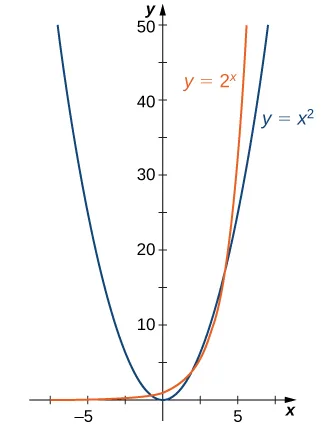
To see the difference between an exponential function and a power function, we compare the functions and In Table 1.10, we see that both and approach infinity as Eventually, however, becomes larger than and grows more rapidly as In the opposite direction, as whereas The line is a horizontal asymptote for
In Figure 1.43, we graph both and to show how the graphs differ.
Evaluating Exponential Functions
Recall the properties of exponents: If is a positive integer, then we define (with factors of If is a negative integer, then for some positive integer and we define Also, is defined to be If is a rational number, then where and are integers and For example, However, how is defined if is an irrational number? For example, what do we mean by This is too complex a question for us to answer fully right now; however, we can make an approximation. In Table 1.11, we list some rational numbers approaching and the values of for each rational number are presented as well. We claim that if we choose rational numbers getting closer and closer to the values of get closer and closer to some number We define that number to be
Graphing Exponential Functions
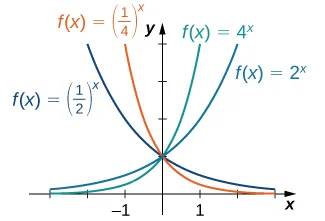
For any base the exponential function is defined for all real numbers and Therefore, the domain of is and the range is To graph we note that for is increasing on and as whereas as On the other hand, if is decreasing on and as whereas as (Figure 1.44).
Note that exponential functions satisfy the general laws of exponents. To remind you of these laws, we state them as rules.
The Number e
A special type of exponential function appears frequently in real-world applications. To describe it, consider the following example of exponential growth, which arises from compounding interest in a savings account. Suppose a person invests dollars in a savings account with an annual interest rate compounded annually. The amount of money after 1 year is
The amount of money after years is
More generally, the amount after years is
If the money is compounded 2 times per year, the amount of money after half a year is
The amount of money after year is
After years, the amount of money in the account is
More generally, if the money is compounded times per year, the amount of money in the account after years is given by the function
What happens as To answer this question, we let and write
and examine the behavior of as using a table of values (Table 1.12).
Looking at this table, it appears that is approaching a number between and as In fact, does approach some number as We call this . To six decimal places of accuracy,
The letter was first used to represent this number by the Swiss mathematician Leonhard Euler during the 1720s. Although Euler did not discover the number, he showed many important connections between and logarithmic functions. We still use the notation today to honor Euler’s work because it appears in many areas of mathematics and because we can use it in many practical applications.
Returning to our savings account example, we can conclude that if a person puts dollars in an account at an annual interest rate compounded continuously, then This function may be familiar. Since functions involving base arise often in applications, we call the function the . Not only is this function interesting because of the definition of the number but also, as discussed next, its graph has an important property.
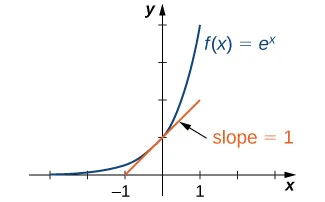
Since we know is increasing on In Figure 1.45, we show a graph of along with a tangent line to the graph of at We give a precise definition of tangent line in the next chapter; but, informally, we say a tangent line to a graph of at is a line that passes through the point and has the same “slope” as at that point The function is the only exponential function with tangent line at that has a slope of 1. As we see later in the text, having this property makes the natural exponential function the most simple exponential function to use in many instances.
Logarithmic Functions
Using our understanding of exponential functions, we can discuss their inverses, which are the logarithmic functions. These come in handy when we need to consider any phenomenon that varies over a wide range of values, such as pH in chemistry or decibels in sound levels.
The exponential function is one-to-one, with domain and range Therefore, it has an inverse function, called the logarithmic function with base For any the logarithmic function with base , denoted has domain and range and satisfies
For example,
Furthermore, since and are inverse functions,
The most commonly used logarithmic function is the function Since this function uses natural as its base, it is called the natural logarithm. Here we use the notation or to mean For example,
Since the functions and are inverses of each other,
and their graphs are symmetric about the line (Figure 1.46).
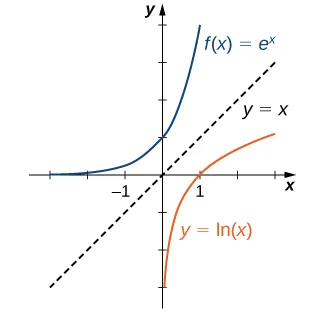
In general, for any base the function is symmetric about the line with the function Using this fact and the graphs of the exponential functions, we graph functions for several values of (Figure 1.47).
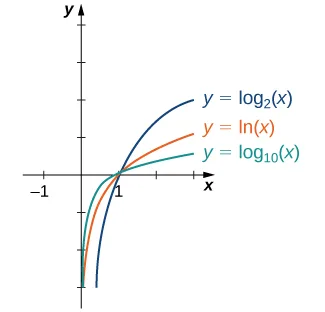
Before solving some equations involving exponential and logarithmic functions, let’s review the basic properties of logarithms.
When evaluating a logarithmic function with a calculator, you may have noticed that the only options are or log, called the common logarithm, or ln, which is the natural logarithm. However, exponential functions and logarithm functions can be expressed in terms of any desired base If you need to use a calculator to evaluate an expression with a different base, you can apply the change-of-base formulas first. Using this change of base, we typically write a given exponential or logarithmic function in terms of the natural exponential and natural logarithmic functions.
Proof
For the first change-of-base formula, we begin by making use of the power property of logarithmic functions. We know that for any base Therefore,
In addition, we know that and are inverse functions. Therefore,
Combining these last two equalities, we conclude that
To prove the second property, we show that
Let and We will show that By the definition of logarithmic functions, we know that and From the previous equations, we see that
Therefore, Since exponential functions are one-to-one, we can conclude that
□
Hyperbolic Functions
The hyperbolic functions are defined in terms of certain combinations of and These functions arise naturally in various engineering and physics applications, including the study of water waves and vibrations of elastic membranes. Another common use for a hyperbolic function is the representation of a hanging chain or cable, also known as a catenary (Figure 1.49). If we introduce a coordinate system so that the low point of the chain lies along the -axis, we can describe the height of the chain in terms of a hyperbolic function. First, we define the hyperbolic functions.

The name cosh rhymes with “gosh,” whereas the name sinh is pronounced “cinch.” Tanh, sech, csch, and coth are pronounced “tanch,” “seech,” “coseech,” and “cotanch,” respectively.
Using the definition of and principles of physics, it can be shown that the height of a hanging chain, such as the one in Figure 1.49, can be described by the function for certain constants and
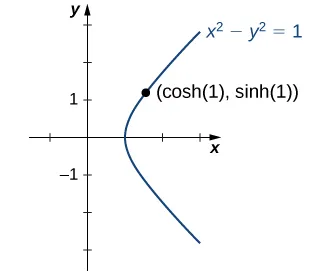
But why are these functions called hyperbolic functions? To answer this question, consider the quantity Using the definition of and we see that
This identity is the analog of the trigonometric identity Here, given a value the point lies on the unit hyperbola (Figure 1.50).
Graphs of Hyperbolic Functions
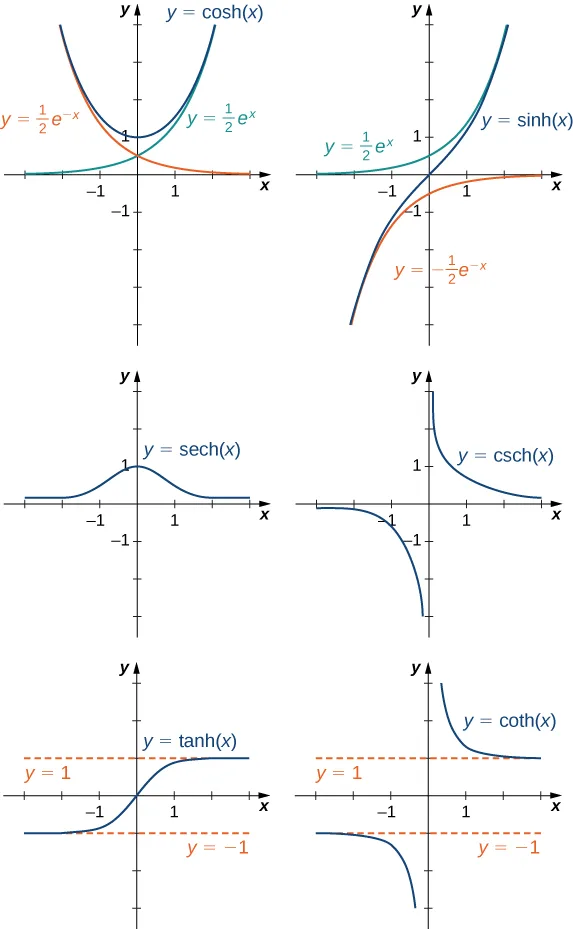
To graph and we make use of the fact that both functions approach as since as As approaches whereas approaches Therefore, using the graphs of and as guides, we graph and To graph we use the fact that for all as and as The graphs of the other three hyperbolic functions can be sketched using the graphs of and (Figure 1.51).
Identities Involving Hyperbolic Functions
The identity shown in Figure 1.50, is one of several identities involving the hyperbolic functions, some of which are listed next. The first four properties follow easily from the definitions of hyperbolic sine and hyperbolic cosine. Except for some differences in signs, most of these properties are analogous to identities for trigonometric functions.
Inverse Hyperbolic Functions
From the graphs of the hyperbolic functions, we see that all of them are one-to-one except and If we restrict the domains of these two functions to the interval then all the hyperbolic functions are one-to-one, and we can define the inverse hyperbolic functions. Since the hyperbolic functions themselves involve exponential functions, the inverse hyperbolic functions involve logarithmic functions.
Let’s look at how to derive the first equation. The others follow similarly. Suppose Then, and, by the definition of the hyperbolic sine function, Therefore,
Multiplying this equation by we obtain
This can be solved like a quadratic equation, with the solution
Since the only solution is the one with the positive sign. Applying the natural logarithm to both sides of the equation, we conclude that
Key Concepts
- The exponential function is increasing if and decreasing if Its domain is and its range is