We already examined exponential functions and logarithms in earlier chapters. However, we glossed over some key details in the previous discussions. For example, we did not study how to treat exponential functions with exponents that are irrational. The definition of the number e is another area where the previous development was somewhat incomplete. We now have the tools to deal with these concepts in a more mathematically rigorous way, and we do so in this section.
For purposes of this section, assume we have not yet defined the natural logarithm, the number e, or any of the integration and differentiation formulas associated with these functions. By the end of the section, we will have studied these concepts in a mathematically rigorous way (and we will see they are consistent with the concepts we learned earlier).
We begin the section by defining the natural logarithm in terms of an integral. This definition forms the foundation for the section. From this definition, we derive differentiation formulas, define the number and expand these concepts to logarithms and exponential functions of any base.
The Natural Logarithm as an Integral
Recall the power rule for integrals:
Clearly, this does not work when as it would force us to divide by zero. So, what do we do with Recall from the Fundamental Theorem of Calculus that is an antiderivative of Therefore, we can make the following definition.
For this is just the area under the curve from to For we have so in this case it is the negative of the area under the curve from (see the following figure).
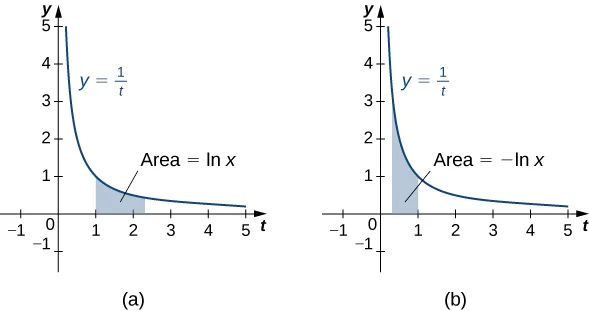
Notice that Furthermore, the function for Therefore, by the properties of integrals, it is clear that is increasing for
Properties of the Natural Logarithm
Because of the way we defined the natural logarithm, the following differentiation formula falls out immediately as a result of to the Fundamental Theorem of Calculus.
A graph of is shown in Figure 6.76. Notice that it is continuous throughout its domain of
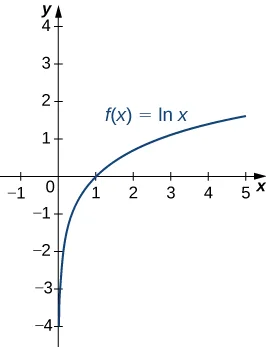
Note that if we use the absolute value function and create a new function we can extend the domain of the natural logarithm to include Then This gives rise to the familiar integration formula.
Although we have called our function a “logarithm,” we have not actually proved that any of the properties of logarithms hold for this function. We do so here.
Proof
i. By definition,
ii. We have
Use on the last integral in this expression. Let Then Furthermore, when and when So we get
iv. Note that
Furthermore,
Since the derivatives of these two functions are the same, by the Fundamental Theorem of Calculus, they must differ by a constant. So we have
for some constant Taking we get
Thus and the proof is complete. Note that we can extend this property to irrational values of later in this section.
Part iii. follows from parts ii. and iv. and the proof is left to you.
□
Defining the Number e
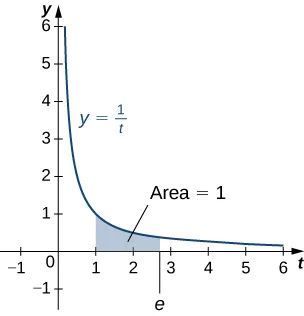
Now that we have the natural logarithm defined, we can use that function to define the number
To put it another way, the area under the curve between and is (Figure 6.77). The proof that such a number exists and is unique is left to you. (Hint: Use the Intermediate Value Theorem to prove existence and the fact that is increasing to prove uniqueness.)
The number can be shown to be irrational, although we won’t do so here (see the Student Project in Taylor and Maclaurin Series). Its approximate value is given by
The Exponential Function
We now turn our attention to the function Note that the natural logarithm is one-to-one and therefore has an inverse function. For now, we denote this inverse function by Then,
The following figure shows the graphs of and
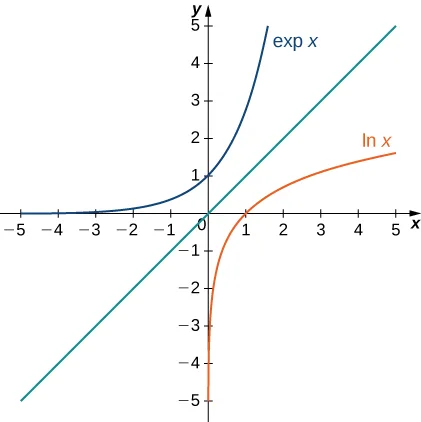
We hypothesize that For rational values of this is easy to show. If is rational, then we have Thus, when is rational, For irrational values of we simply define as the inverse function of
Then we have for all and thus
for all
Properties of the Exponential Function
Since the exponential function was defined in terms of an inverse function, and not in terms of a power of we must verify that the usual laws of exponents hold for the function
Proof
Note that if and are rational, the properties hold. However, if or are irrational, we must apply the inverse function definition of and verify the properties. Only the first property is verified here; the other two are left to you. We have
Since is one-to-one, then
□
As with part iv. of the logarithm properties, we can extend property iii. to irrational values of and we do so by the end of the section.
We also want to verify the differentiation formula for the function To do this, we need to use implicit differentiation. Let Then
Thus, we see
as desired, which leads immediately to the integration formula
We apply these formulas in the following examples.
General Logarithmic and Exponential Functions
We close this section by looking at exponential functions and logarithms with bases other than Exponential functions are functions of the form Note that unless we still do not have a mathematically rigorous definition of these functions for irrational exponents. Let’s rectify that here by defining the function in terms of the exponential function We then examine logarithms with bases other than as inverse functions of exponential functions.
Now is defined rigorously for all values of x. This definition also allows us to generalize property iv. of logarithms and property iii. of exponential functions to apply to both rational and irrational values of It is straightforward to show that properties of exponents hold for general exponential functions defined in this way.
Let’s now apply this definition to calculate a differentiation formula for We have
The corresponding integration formula follows immediately.
If then the function is one-to-one and has a well-defined inverse. Its inverse is denoted by Then,
Note that general logarithm functions can be written in terms of the natural logarithm. Let Then, Taking the natural logarithm of both sides of this second equation, we get
Thus, we see that all logarithmic functions are constant multiples of one another. Next, we use this formula to find a differentiation formula for a logarithm with base Again, let Then,
Key Concepts
- The earlier treatment of logarithms and exponential functions did not define the functions precisely and formally. This section develops the concepts in a mathematically rigorous way.
- The cornerstone of the development is the definition of the natural logarithm in terms of an integral.
- The function is then defined as the inverse of the natural logarithm.
- General exponential functions are defined in terms of and the corresponding inverse functions are general logarithms.
- Familiar properties of logarithms and exponents still hold in this more rigorous context.
Key Equations
| Natural logarithm function | Z |
| Exponential function |