In this section, we consider centers of mass (also called centroids, under certain conditions) and moments. The basic idea of the center of mass is the notion of a balancing point. Many of us have seen performers who spin plates on the ends of sticks. The performers try to keep several of them spinning without allowing any of them to drop. If we look at a single plate (without spinning it), there is a sweet spot on the plate where it balances perfectly on the stick. If we put the stick anywhere other than that sweet spot, the plate does not balance and it falls to the ground. (That is why performers spin the plates; the spin helps keep the plates from falling even if the stick is not exactly in the right place.) Mathematically, that sweet spot is called the center of mass of the plate.
In this section, we first examine these concepts in a one-dimensional context, then expand our development to consider centers of mass of two-dimensional regions and symmetry. Last, we use centroids to find the volume of certain solids by applying the theorem of Pappus.
Center of Mass and Moments
Let’s begin by looking at the center of mass in a one-dimensional context. Consider a long, thin wire or rod of negligible mass resting on a fulcrum, as shown in Figure 6.62(a). Now suppose we place objects having masses and at distances and from the fulcrum, respectively, as shown in Figure 6.62(b).
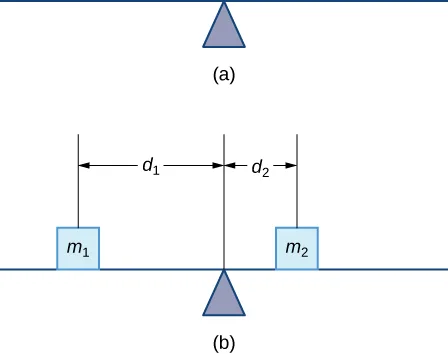
The most common real-life example of a system like this is a playground seesaw, or teeter-totter, with children of different weights sitting at different distances from the center. On a seesaw, if one child sits at each end, the heavier child sinks down and the lighter child is lifted into the air. If the heavier child slides in toward the center, though, the seesaw balances. Applying this concept to the masses on the rod, we note that the masses balance each other if and only if
In the seesaw example, we balanced the system by moving the masses (children) with respect to the fulcrum. However, we are really interested in systems in which the masses are not allowed to move, and instead we balance the system by moving the fulcrum. Suppose we have two point masses, and located on a number line at points and respectively (Figure 6.63). The center of mass, is the point where the fulcrum should be placed to make the system balance.
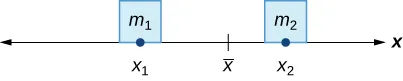
Thus, we have
The expression in the numerator, is called the first moment of the system with respect to the origin. If the context is clear, we often drop the word first and just refer to this expression as the moment of the system. The expression in the denominator, is the total mass of the system. Thus, the of the system is the point at which the total mass of the system could be concentrated without changing the moment.
This idea is not limited just to two point masses. In general, if n masses, are placed on a number line at points respectively, then the center of mass of the system is given by
We apply this theorem in the following example.
We can generalize this concept to find the center of mass of a system of point masses in a plane. Let be a point mass located at point in the plane. Then the moment of the mass with respect to the -axis is given by Similarly, the moment with respect to the -axis is given by Notice that the -coordinate of the point is used to calculate the moment with respect to the -axis, and vice versa. The reason is that the -coordinate gives the distance from the point mass to the -axis, and the -coordinate gives the distance to the -axis (see the following figure).
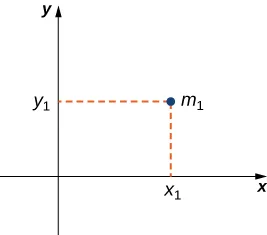
If we have several point masses in the xy-plane, we can use the moments with respect to the x- and y-axes to calculate the x- and y-coordinates of the center of mass of the system.
The next example demonstrates how to apply this theorem.
Center of Mass of Thin Plates
So far we have looked at systems of point masses on a line and in a plane. Now, instead of having the mass of a system concentrated at discrete points, we want to look at systems in which the mass of the system is distributed continuously across a thin sheet of material. For our purposes, we assume the sheet is thin enough that it can be treated as if it is two-dimensional. Such a sheet is called a lamina. Next we develop techniques to find the center of mass of a lamina. In this section, we also assume the density of the lamina is constant.
Laminas are often represented by a two-dimensional region in a plane. The geometric center of such a region is called its centroid. Since we have assumed the density of the lamina is constant, the center of mass of the lamina depends only on the shape of the corresponding region in the plane; it does not depend on the density. In this case, the center of mass of the lamina corresponds to the centroid of the delineated region in the plane. As with systems of point masses, we need to find the total mass of the lamina, as well as the moments of the lamina with respect to the x- and y-axes.
We first consider a lamina in the shape of a rectangle. Recall that the center of mass of a lamina is the point where the lamina balances. For a rectangle, that point is both the horizontal and vertical center of the rectangle. Based on this understanding, it is clear that the center of mass of a rectangular lamina is the point where the diagonals intersect, which is a result of the symmetry principle, and it is stated here without proof.
Let’s turn to more general laminas. Suppose we have a lamina bounded above by the graph of a continuous function below by the x-axis, and on the left and right by the lines and respectively, as shown in the following figure.
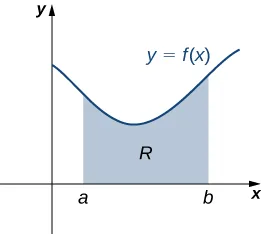
As with systems of point masses, to find the center of mass of the lamina, we need to find the total mass of the lamina, as well as the moments of the lamina with respect to the x- and y-axes. As we have done many times before, we approximate these quantities by partitioning the interval and constructing rectangles.
For let be a regular partition of Recall that we can choose any point within the interval as our In this case, we want to be the -coordinate of the centroid of our rectangles. Thus, for we select such that is the midpoint of the interval. That is, Now, for construct a rectangle of height on The center of mass of this rectangle is as shown in the following figure.
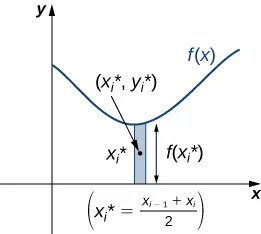
Next, we need to find the total mass of the rectangle. Let represent the density of the lamina (note that is a constant). In this case, is expressed in terms of mass per unit area. Thus, to find the total mass of the rectangle, we multiply the area of the rectangle by Then, the mass of the rectangle is given by
To get the approximate mass of the lamina, we add the masses of all the rectangles to get
This is a Riemann sum. Taking the limit as gives the exact mass of the lamina:
Next, we calculate the moment of the lamina with respect to the x-axis. Returning to the representative rectangle, recall its center of mass is Recall also that treating the rectangle as if it is a point mass located at the center of mass does not change the moment. Thus, the moment of the rectangle with respect to the x-axis is given by the mass of the rectangle, multiplied by the distance from the center of mass to the -axis: Therefore, the moment with respect to the -axis of the rectangle is Adding the moments of the rectangles and taking the limit of the resulting Riemann sum, we see that the moment of the lamina with respect to the -axis is
We derive the moment with respect to the y-axis similarly, noting that the distance from the center of mass of the rectangle to the y-axis is Then the moment of the lamina with respect to the y-axis is given by
We find the coordinates of the center of mass by dividing the moments by the total mass to give If we look closely at the expressions for we notice that the constant cancels out when and are calculated.
We summarize these findings in the following theorem.
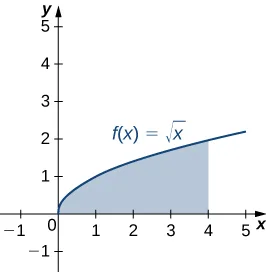
In the next example, we use this theorem to find the center of mass of a lamina.
We can adapt this approach to find centroids of more complex regions as well. Suppose our region is bounded above by the graph of a continuous function as before, but now, instead of having the lower bound for the region be the x-axis, suppose the region is bounded below by the graph of a second continuous function, as shown in the following figure.
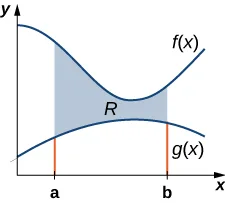
Again, we partition the interval and construct rectangles. A representative rectangle is shown in the following figure.
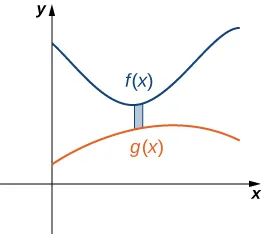
Note that the centroid of this rectangle is We won’t go through all the details of the Riemann sum development, but let’s look at some of the key steps. In the development of the formulas for the mass of the lamina and the moment with respect to the -axis, the height of each rectangle is given by which leads to the expression in the integrands.
In the development of the formula for the moment with respect to the x-axis, the moment of each rectangle is found by multiplying the area of the rectangle, by the distance of the centroid from the x-axis, which gives Summarizing these findings, we arrive at the following theorem.
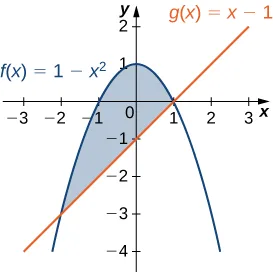
We illustrate this theorem in the following example.
The Symmetry Principle
We stated the symmetry principle earlier, when we were looking at the centroid of a rectangle. The symmetry principle can be a great help when finding centroids of regions that are symmetric. Consider the following example.
Theorem of Pappus
This section ends with a discussion of the theorem of Pappus for volume, which allows us to find the volume of particular kinds of solids by using the centroid. (There is also a theorem of Pappus for surface area, but it is much less useful than the theorem for volume.)
Proof
We can prove the case when the region is bounded above by the graph of a function and below by the graph of a function over an interval and for which the axis of revolution is the y-axis. In this case, the area of the region is Since the axis of rotation is the -axis, the distance traveled by the centroid of the region depends only on the -coordinate of the centroid, which is
where
Then,
and thus
However, using the method of cylindrical shells, we have
So,
and the proof is complete.
□
Key Concepts
- Mathematically, the center of mass of a system is the point at which the total mass of the system could be concentrated without changing the moment. Loosely speaking, the center of mass can be thought of as the balancing point of the system.
- For point masses distributed along a number line, the moment of the system with respect to the origin is For point masses distributed in a plane, the moments of the system with respect to the - and -axes, respectively, are and respectively.
Key Equations
| Mass of a lamina | |
| Moments of a lamina |