In this section, we examine some physical applications of integration. Let’s begin with a look at calculating mass from a density function. We then turn our attention to work, and close the section with a study of hydrostatic force.
Mass and Density
We can use integration to develop a formula for calculating mass based on a density function. First we consider a thin rod or wire. Orient the rod so it aligns with the with the left end of the rod at and the right end of the rod at (Figure 6.48). Note that although we depict the rod with some thickness in the figures, for mathematical purposes we assume the rod is thin enough to be treated as a one-dimensional object.
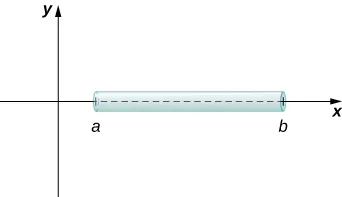
If the rod has constant density given in terms of mass per unit length, then the mass of the rod is just the product of the density and the length of the rod: If the density of the rod is not constant, however, the problem becomes a little more challenging. When the density of the rod varies from point to point, we use a linear density function, to denote the density of the rod at any point, Let be an integrable linear density function. Now, for let be a regular partition of the interval and for choose an arbitrary point Figure 6.49 shows a representative segment of the rod.
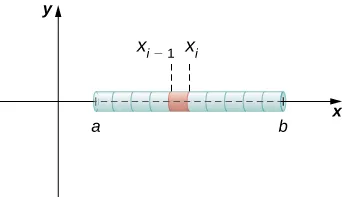
The mass of the segment of the rod from to is approximated by
Adding the masses of all the segments gives us an approximation for the mass of the entire rod:
This is a Riemann sum. Taking the limit as we get an expression for the exact mass of the rod:
We state this result in the following theorem.
We apply this theorem in the next example.
We now extend this concept to find the mass of a two-dimensional disk of radius As with the rod we looked at in the one-dimensional case, here we assume the disk is thin enough that, for mathematical purposes, we can treat it as a two-dimensional object. We assume the density is given in terms of mass per unit area (called area density), and further assume the density varies only along the disk’s radius (called radial density). We orient the disk in the with the center at the origin. Then, the density of the disk can be treated as a function of denoted We assume is integrable. Because density is a function of we partition the interval from along the For let be a regular partition of the interval and for choose an arbitrary point Now, use the partition to break up the disk into thin (two-dimensional) washers. A disk and a representative washer are depicted in the following figure.
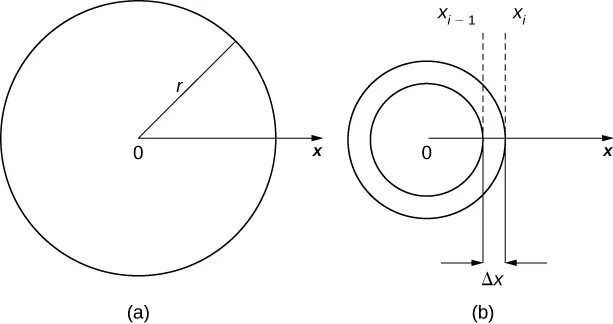
We now approximate the density and area of the washer to calculate an approximate mass, Note that the area of the washer is given by
You may recall that we had an expression similar to this when we were computing volumes by shells. As we did there, we use to approximate the average radius of the washer. We obtain
Using to approximate the density of the washer, we approximate the mass of the washer by
Adding up the masses of the washers, we see the mass of the entire disk is approximated by
We again recognize this as a Riemann sum, and take the limit as This gives us
We summarize these findings in the following theorem.
Work Done by a Force
We now consider work. In physics, work is related to force, which is often intuitively defined as a push or pull on an object. When a force moves an object, we say the force does work on the object. In other words, work can be thought of as the amount of energy it takes to move an object. According to physics, when we have a constant force, work can be expressed as the product of force and distance.
In the English system, the unit of force is the pound and the unit of distance is the foot, so work is given in foot-pounds. In the metric system, kilograms and meters are used. One newton is the force needed to accelerate kilogram of mass at the rate of m/sec². Thus, the most common unit of work is the newton-meter. This same unit is also called the joule. Both are defined as kilograms times meters squared over seconds squared
When we have a constant force, things are pretty easy. It is rare, however, for a force to be constant. The work done to compress (or elongate) a spring, for example, varies depending on how far the spring has already been compressed (or stretched). We look at springs in more detail later in this section.
Suppose we have a variable force that moves an object in a positive direction along the x-axis from point to point To calculate the work done, we partition the interval and estimate the work done over each subinterval. So, for let be a regular partition of the interval and for choose an arbitrary point To calculate the work done to move an object from point to point we assume the force is roughly constant over the interval, and use to approximate the force. The work done over the interval then, is given by
Therefore, the work done over the interval is approximately
Taking the limit of this expression as gives us the exact value for work:
Thus, we can define work as follows.
Note that if F is constant, the integral evaluates to which is the formula we stated at the beginning of this section.
Now let’s look at the specific example of the work done to compress or elongate a spring. Consider a block attached to a horizontal spring. The block moves back and forth as the spring stretches and compresses. Although in the real world we would have to account for the force of friction between the block and the surface on which it is resting, we ignore friction here and assume the block is resting on a frictionless surface. When the spring is at its natural length (at rest), the system is said to be at equilibrium. In this state, the spring is neither elongated nor compressed, and in this equilibrium position the block does not move until some force is introduced. We orient the system such that corresponds to the equilibrium position (see the following figure).
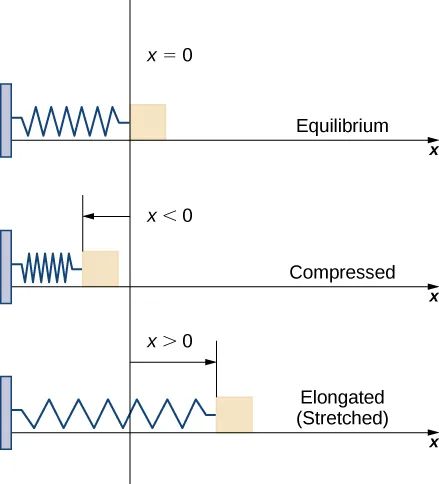
According to Hooke’s law, the force required to compress or stretch a spring from an equilibrium position is given by for some constant The value of depends on the physical characteristics of the spring. The constant is called the spring constant and is always positive. We can use this information to calculate the work done to compress or elongate a spring, as shown in the following example.
Work Done in Pumping
Consider the work done to pump water (or some other liquid) out of a tank. Pumping problems are a little more complicated than spring problems because many of the calculations depend on the shape and size of the tank. In addition, instead of being concerned about the work done to move a single mass, we are looking at the work done to move a volume of water, and it takes more work to move the water from the bottom of the tank than it does to move the water from the top of the tank.
We examine the process in the context of a cylindrical tank, then look at a couple of examples using tanks of different shapes. Assume a cylindrical tank of radius m and height m is filled to a depth of 8 m. How much work does it take to pump all the water over the top edge of the tank?
The first thing we need to do is define a frame of reference. We let represent the vertical distance below the top of the tank. That is, we orient the vertically, with the origin at the top of the tank and the downward direction being positive (see the following figure).
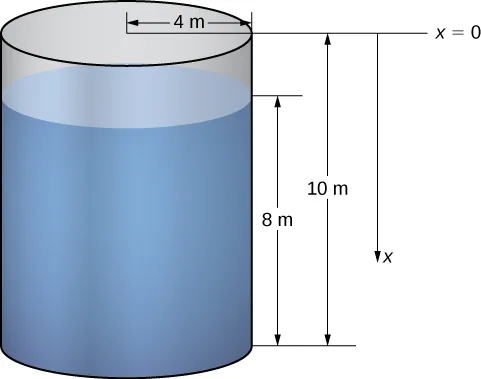
Using this coordinate system, the water extends from to Therefore, we partition the interval and look at the work required to lift each individual “layer” of water. So, for let be a regular partition of the interval and for choose an arbitrary point Figure 6.53 shows a representative layer.
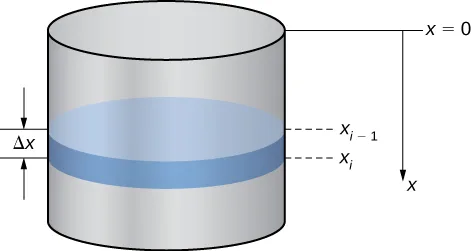
In pumping problems, the force required to lift the water to the top of the tank is the force required to overcome gravity, so it is equal to the weight of the water. Given that the weight-density of water is N/m³, or lb/ft³, calculating the volume of each layer gives us the weight. In this case, we have
Then, the force needed to lift each layer is
Note that this step becomes a little more difficult if we have a noncylindrical tank. We look at a noncylindrical tank in the next example.
We also need to know the distance the water must be lifted. Based on our choice of coordinate systems, we can use as an approximation of the distance the layer must be lifted. Then the work to lift the layer of water is approximately
Adding the work for each layer, we see the approximate work to empty the tank is given by
This is a Riemann sum, so taking the limit as we get
The work required to empty the tank is approximately 23,650,000 J.
For pumping problems, the calculations vary depending on the shape of the tank or container. The following problem-solving strategy lays out a step-by-step process for solving pumping problems.
We now apply this problem-solving strategy in an example with a noncylindrical tank.
Hydrostatic Force and Pressure
In this last section, we look at the force and pressure exerted on an object submerged in a liquid. In the English system, force is measured in pounds. In the metric system, it is measured in newtons. Pressure is force per unit area, so in the English system we have pounds per square foot (or, perhaps more commonly, pounds per square inch, denoted psi). In the metric system we have newtons per square meter, also called pascals.
Let’s begin with the simple case of a plate of area submerged horizontally in water at a depth s (Figure 6.56). Then, the force exerted on the plate is simply the weight of the water above it, which is given by where is the weight density of water (weight per unit volume). To find the hydrostatic pressure—that is, the pressure exerted by water on a submerged object—we divide the force by the area. So the pressure is
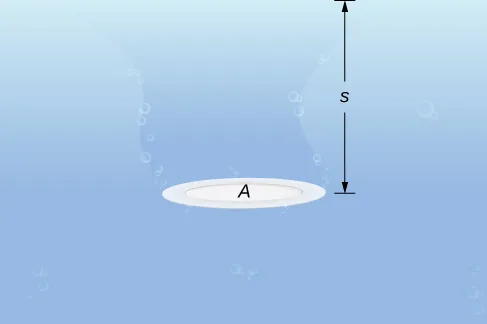
By Pascal’s principle, the pressure at a given depth is the same in all directions, so it does not matter if the plate is submerged horizontally or vertically. So, as long as we know the depth, we know the pressure. We can apply Pascal’s principle to find the force exerted on surfaces, such as dams, that are oriented vertically. We cannot apply the formula directly, because the depth varies from point to point on a vertically oriented surface. So, as we have done many times before, we form a partition, a Riemann sum, and, ultimately, a definite integral to calculate the force.
Suppose a thin plate is submerged in water. We choose our frame of reference such that the x-axis is oriented vertically, with the downward direction being positive, and point corresponding to a logical reference point. Let denote the depth at point x. Note we often let correspond to the surface of the water. In this case, depth at any point is simply given by However, in some cases we may want to select a different reference point for so we proceed with the development in the more general case. Last, let denote the width of the plate at the point
Assume the top edge of the plate is at point and the bottom edge of the plate is at point Then, for let be a regular partition of the interval and for choose an arbitrary point The partition divides the plate into several thin, rectangular strips (see the following figure).
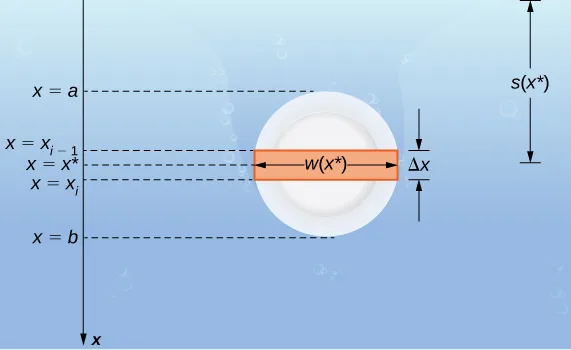
Let’s now estimate the force on a representative strip. If the strip is thin enough, we can treat it as if it is at a constant depth, We then have
Adding the forces, we get an estimate for the force on the plate:
This is a Riemann sum, so taking the limit gives us the exact force. We obtain
Evaluating this integral gives us the force on the plate. We summarize this in the following problem-solving strategy.
Key Concepts
- Several physical applications of the definite integral are common in engineering and physics.
- Definite integrals can be used to determine the mass of an object if its density function is known.
- Work can also be calculated from integrating a force function, or when counteracting the force of gravity, as in a pumping problem.
- Definite integrals can also be used to calculate the force exerted on an object submerged in a liquid.
Key Equations
| Mass of a one-dimensional object | |
| Mass of a circular object | |
| Work done on an object | |
| Hydrostatic force on a plate |