Given a particular function, we are often interested in determining the largest and smallest values of the function. This information is important in creating accurate graphs. Finding the maximum and minimum values of a function also has practical significance because we can use this method to solve optimization problems, such as maximizing profit, minimizing the amount of material used in manufacturing an aluminum can, or finding the maximum height a rocket can reach. In this section, we look at how to use derivatives to find the largest and smallest values for a function.
Absolute Extrema
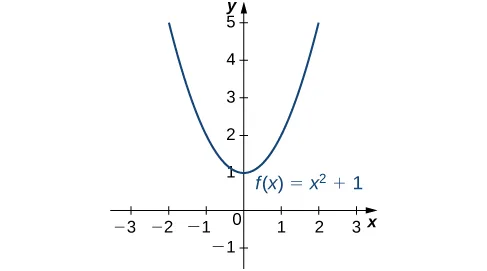
Consider the function over the interval As Therefore, the function does not have a largest value. However, since for all real numbers and when the function has a smallest value, 1, when We say that 1 is the absolute minimum of and it occurs at We say that does not have an absolute maximum (see the following figure).
Before proceeding, let’s note two important issues regarding this definition. First, the term absolute here does not refer to absolute value. An absolute extremum may be positive, negative, or zero. Second, if a function has an absolute extremum over an interval at the absolute extremum is The real number is a point in the domain at which the absolute extremum occurs. For example, consider the function over the interval Since
for all real numbers we say has an absolute maximum over at The absolute maximum is It occurs at as shown in Figure 4.13(b).
A function may have both an absolute maximum and an absolute minimum, just one extremum, or neither. Figure 4.13 shows several functions and some of the different possibilities regarding absolute extrema. However, the following theorem, called the Extreme Value Theorem, guarantees that a continuous function over a closed, bounded interval has both an absolute maximum and an absolute minimum.
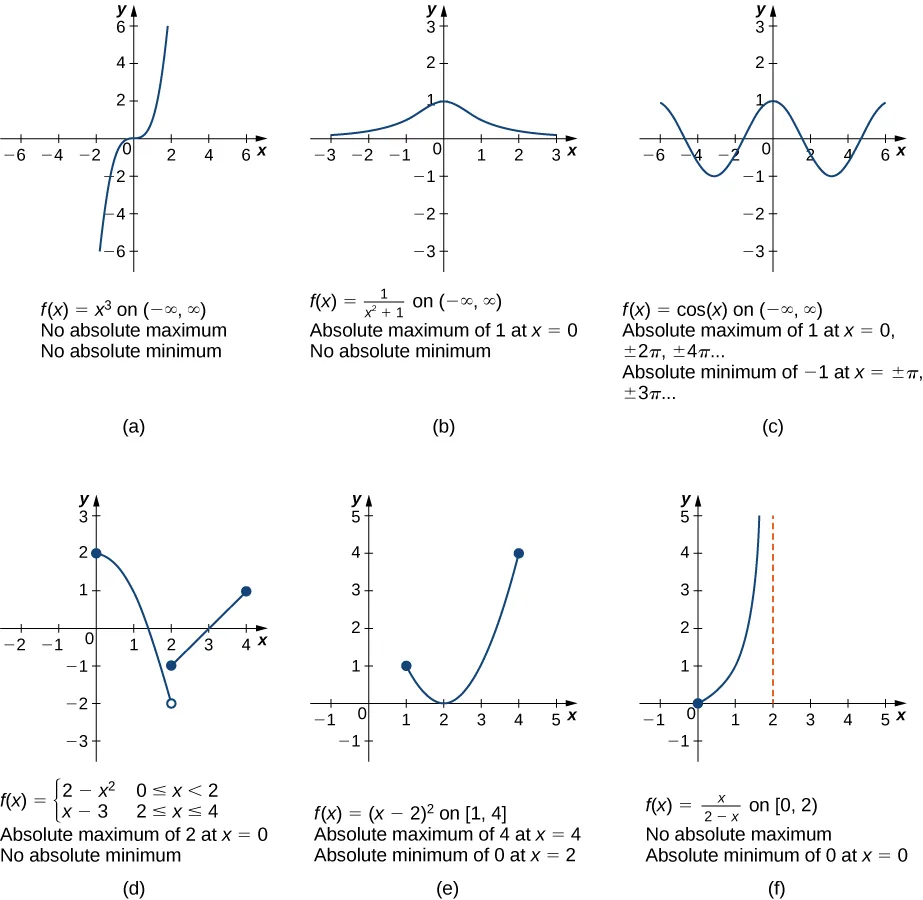
The proof of the extreme value theorem is beyond the scope of this text. Typically, it is proved in a course on real analysis. There are a couple of key points to note about the statement of this theorem. For the extreme value theorem to apply, the function must be continuous over a closed, bounded interval. If the interval is open or the function has even one point of discontinuity, the function may not have an absolute maximum or absolute minimum over For example, consider the functions shown in Figure 4.13(d), (e), and (f). All three of these functions are defined over bounded intervals. However, the function in graph (e) is the only one that has both an absolute maximum and an absolute minimum over its domain. The extreme value theorem cannot be applied to the functions in graphs (d) and (f) because neither of these functions is continuous over a closed, bounded interval. Although the function in graph (d) is defined over the closed interval the function is discontinuous at The function has an absolute maximum over but does not have an absolute minimum. The function in graph (f) is continuous over the half-open interval but is not defined at and therefore is not continuous over a closed, bounded interval. The function has an absolute minimum over but does not have an absolute maximum over These two graphs illustrate why a function over a bounded interval may fail to have an absolute maximum and/or absolute minimum.
Before looking at how to find absolute extrema, let’s examine the related concept of local extrema. This idea is useful in determining where absolute extrema occur.
Local Extrema and Critical Points
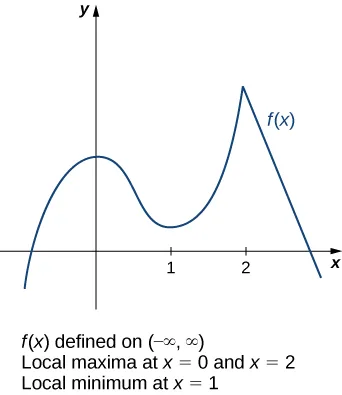
Consider the function shown in Figure 4.14. The graph can be described as two mountains with a valley in the middle. The absolute maximum value of the function occurs at the higher peak, at However, is also a point of interest. Although is not the largest value of the value is larger than for all near 0. We say has a local maximum at Similarly, the function does not have an absolute minimum, but it does have a local minimum at because is less than for near 1.
Note that if has an absolute extremum at and is defined over an interval containing then is also considered a local extremum. If an absolute extremum for a function occurs at an endpoint, we do not consider that to be a local extremum, but instead refer to that as an endpoint extremum.
Given the graph of a function it is sometimes easy to see where a local maximum or local minimum occurs. However, it is not always easy to see, since the interesting features on the graph of a function may not be visible because they occur at a very small scale. Also, we may not have a graph of the function. In these cases, how can we use a formula for a function to determine where these extrema occur?
To answer this question, let’s look at Figure 4.14 again. The local extrema occur at and Notice that at and the derivative At the derivative does not exist, since the function has a corner there. In fact, if has a local extremum at a point the derivative must satisfy one of the following conditions: either or is undefined. Such a value is known as a critical number and it is important in finding extreme values for functions.
As mentioned earlier, if has a local extremum at a point then must be a critical number of This fact is known as Fermat’s theorem.
Proof
Suppose has a local extremum at and is differentiable at We need to show that To do this, we will show that and and therefore Since has a local extremum at has a local maximum or local minimum at Suppose has a local maximum at The case in which has a local minimum at can be handled similarly. There then exists an open interval such that for all Since is differentiable at from the definition of the derivative, we know that
Since this limit exists, both one-sided limits also exist and equal Therefore,
and
Since is a local maximum, we see that for near Therefore, for near but we have From Maxima and Minima we conclude that Similarly, it can be shown that Therefore,
□
From Fermat’s theorem, we conclude that if has a local extremum at then either or is undefined. In other words, local extrema can only occur at critical points.
Note this theorem does not claim that a function must have a local extremum at a critical point. Rather, it states that critical points are candidates for local extrema. For example, consider the function We have when Therefore, is a critical number. However, is increasing over and thus does not have a local extremum at In Figure 4.15, we see several different possibilities for critical points. In some of these cases, the functions have local extrema at critical points, whereas in other cases the functions do not. Note that these graphs do not show all possibilities for the behavior of a function at a critical point.
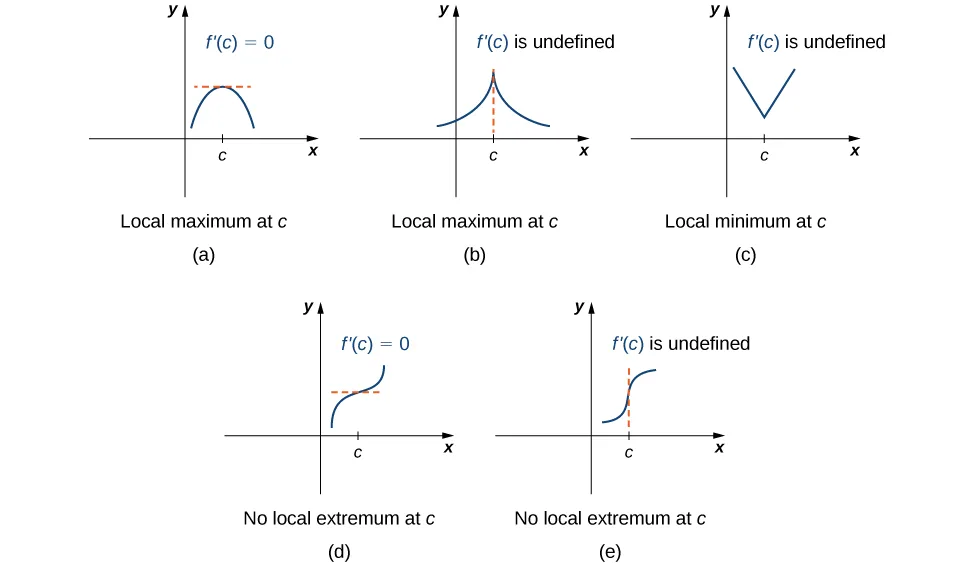
Later in this chapter we look at analytical methods for determining whether a function actually has a local extremum at a critical point. For now, let’s turn our attention to finding critical points. We will use graphical observations to determine whether a critical point is associated with a local extremum.
Locating Absolute Extrema
The extreme value theorem states that a continuous function over a closed, bounded interval has an absolute maximum and an absolute minimum. As shown in Figure 4.13, one or both of these absolute extrema could occur at an endpoint. If an absolute extremum does not occur at an endpoint, however, it must occur at an interior point, in which case the absolute extremum is a local extremum. Therefore, by Fermat’s Theorem, the point at which the local extremum occurs must be a critical point. We summarize this result in the following theorem.
With this idea in mind, let’s examine a procedure for locating absolute extrema.
Now let’s look at how to use this strategy to find the absolute maximum and absolute minimum values for continuous functions.
At this point, we know how to locate absolute extrema for continuous functions over closed intervals. We have also defined local extrema and determined that if a function has a local extremum at a point then must be a critical number of However, being a critical point is not a sufficient condition for to have a local extremum at Later in this chapter, we show how to determine whether a function actually has a local extremum at a critical point. First, however, we need to introduce the Mean Value Theorem, which will help as we analyze the behavior of the graph of a function.
Key Concepts
- A function may have both an absolute maximum and an absolute minimum, have just one absolute extremum, or have no absolute maximum or absolute minimum.
- If a function has a local extremum, the point at which it occurs must be a critical point. However, a function need not have a local extremum at a critical point.
- A continuous function over a closed, bounded interval has an absolute maximum and an absolute minimum. Each extremum occurs at a critical point or an endpoint.