In the previous two sections, we looked at the definite integral and its relationship to the area under the curve of a function. Unfortunately, so far, the only tools we have available to calculate the value of a definite integral are geometric area formulas and limits of Riemann sums, and both approaches are extremely cumbersome. In this section we look at some more powerful and useful techniques for evaluating definite integrals.
These new techniques rely on the relationship between differentiation and integration. This relationship was discovered and explored by both Sir Isaac Newton and Gottfried Wilhelm Leibniz (among others) during the late 1600s and early 1700s, and it is codified in what we now call the Fundamental Theorem of Calculus, which has two parts that we examine in this section. Its very name indicates how central this theorem is to the entire development of calculus.
Before we get to this crucial theorem, however, let’s examine another important theorem, the Mean Value Theorem for Integrals, which is needed to prove the Fundamental Theorem of Calculus.
The Mean Value Theorem for Integrals
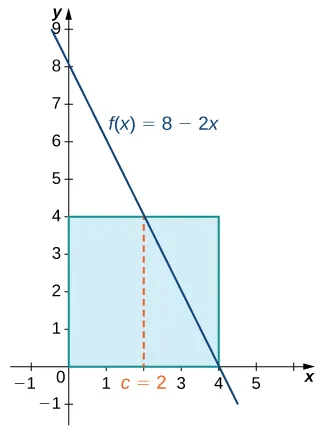
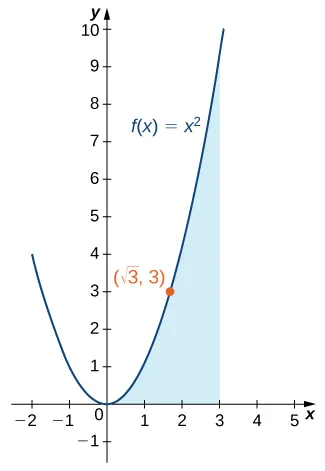
The Mean Value Theorem for Integrals states that a continuous function on a closed interval takes on its average value at some point in that interval. The theorem guarantees that if is continuous, a point c exists in an interval such that the value of the function at c is equal to the average value of over We state this theorem mathematically with the help of the formula for the average value of a function that we presented at the end of the preceding section.
Proof
Since is continuous on by the extreme value theorem (see Maxima and Minima), it assumes minimum and maximum values—m and M, respectively—on Then, for all x in we have Therefore, by the comparison theorem (see The Definite Integral), we have
Dividing by gives us
Since is a number between m and M, and since is continuous and assumes the values m and M over by the Intermediate Value Theorem (see Continuity), there is a number over such that
and the proof is complete.
□
Fundamental Theorem of Calculus Part 1: Integrals and Antiderivatives
As mentioned earlier, the Fundamental Theorem of Calculus is an extremely powerful theorem that establishes the relationship between differentiation and integration, and gives us a way to evaluate definite integrals without using Riemann sums or calculating areas. The theorem is comprised of two parts, the first of which, the Fundamental Theorem of Calculus, Part 1, is stated here. Part 1 establishes the relationship between differentiation and integration.
Before we delve into the proof, a couple of subtleties are worth mentioning here. First, a comment on the notation. Note that we have defined a function, as the definite integral of another function, from the point a to the point x. At first glance, this is confusing, because we have said several times that a definite integral is a number, and here it looks like it’s a function. The key here is to notice that for any particular value of x, the definite integral is a number. So the function returns a number (the value of the definite integral) for each value of x.
Second, it is worth commenting on some of the key implications of this theorem. There is a reason it is called the Fundamental Theorem of Calculus. Not only does it establish a relationship between integration and differentiation, but also it guarantees that any integrable function has an antiderivative.
Proof
Applying the definition of the derivative, we have
Looking carefully at this last expression, we see is just the average value of the function over the interval Therefore, by The Mean Value Theorem for Integrals, there is some number in such that
In addition, since c is between x and x + h, c approaches x as h approaches zero. Also, since is continuous, we have Putting all these pieces together, we have
and the proof is complete.
□
Fundamental Theorem of Calculus, Part 2: The Evaluation Theorem
The Fundamental Theorem of Calculus, Part 2, is perhaps the most important theorem in calculus. After tireless efforts by mathematicians for approximately 500 years, new techniques emerged that provided scientists with the necessary tools to explain many phenomena. Using calculus, astronomers could finally determine distances in space and map planetary orbits. Everyday financial problems such as calculating marginal costs or predicting total profit could now be handled with simplicity and accuracy. Engineers could calculate the bending strength of materials or the three-dimensional motion of objects. Our view of the world was forever changed with calculus.
After finding approximate areas by adding the areas of n rectangles, the application of this theorem is straightforward by comparison. It almost seems too simple that the area of an entire curved region can be calculated by just evaluating an antiderivative at the first and last endpoints of an interval.
We often see the notation to denote the expression We use this vertical bar and associated limits a and b to indicate that we should evaluate the function at the upper limit (in this case, b), and subtract the value of the function evaluated at the lower limit (in this case, ).
The Fundamental Theorem of Calculus, Part 2 (also known as the evaluation theorem) states that if we can find an antiderivative for the integrand, then we can evaluate the definite integral by evaluating the antiderivative at the endpoints of the interval and subtracting.
Proof
Let be a regular partition of Then, we can write
Now, we know F is an antiderivative of f over so by the Mean Value Theorem (see The Mean Value Theorem) for we can find in such that
Then, substituting into the previous equation, we have
Taking the limit of both sides as we obtain
□
Key Concepts
- The Mean Value Theorem for Integrals states that for a continuous function over a closed interval, there is a value c such that equals the average value of the function. See The Mean Value Theorem for Integrals.
- The Fundamental Theorem of Calculus, Part 1 shows the relationship between the derivative and the integral. See Fundamental Theorem of Calculus, Part 1.
- The Fundamental Theorem of Calculus, Part 2 is a formula for evaluating a definite integral in terms of an antiderivative of its integrand. The total area under a curve can be found using this formula. See The Fundamental Theorem of Calculus, Part 2.
Key Equations
| Mean Value Theorem for Integrals | If is continuous over an interval then there is at least one point such that |