Two mountain climbers start their climb at base camp, taking two different routes, one steeper than the other, and arrive at the peak at exactly the same time. Is it necessarily true that, at some point, both climbers increased in altitude at the same rate?
← Back to Calculus Volume 1
Calculus Volume 1 · 5.3 The Fundamental Theorem of Calculus
The Fundamental Theorem of Calculus: practice problems
35 problems from the book, with its answers. Check your working, or have any of them explained to you on the whiteboard.
Exercises 149
In the following exercises, use the Fundamental Theorem of Calculus, Part 1, to find each derivative.
Exercises 151
In the following exercises, use the Fundamental Theorem of Calculus, Part 1, to find each derivative.
Exercises 153
In the following exercises, use the Fundamental Theorem of Calculus, Part 1, to find each derivative.
Exercises 155
In the following exercises, use the Fundamental Theorem of Calculus, Part 1, to find each derivative.
Exercises 157
In the following exercises, use the Fundamental Theorem of Calculus, Part 1, to find each derivative.
Exercises 159
In the following exercises, use the Fundamental Theorem of Calculus, Part 1, to find each derivative.
Exercises 161
In the following exercises, use the Fundamental Theorem of Calculus, Part 1, to find each derivative.
The graph of where f is a piecewise constant function, is shown here.
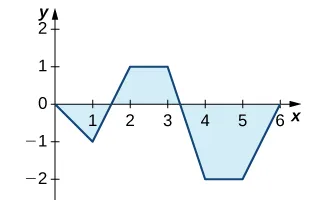
- Over which intervals is f positive? Over which intervals is it negative? Over which intervals, if any, is it equal to zero?
- What are the maximum and minimum values of f?
- What is the average value of f?
Exercises 163
In the following exercises, use the Fundamental Theorem of Calculus, Part 1, to find each derivative.
The graph of where ℓ is a piecewise linear function, is shown here.
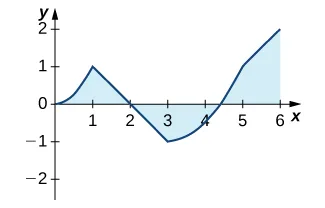
- Over which intervals is ℓ positive? Over which intervals is it negative? Over which, if any, is it zero?
- Over which intervals is ℓ increasing? Over which is it decreasing? Over which intervals, if any, is it constant?
- What is the average value of ℓ?
Exercises 165
In the following exercises, use a calculator to estimate the area under the curve by computing T₁₀, the average of the left- and right-endpoint Riemann sums using rectangles. Then, using the Fundamental Theorem of Calculus, Part 2, determine the exact area.
[T] over
Exercises 167
In the following exercises, use a calculator to estimate the area under the curve by computing T₁₀, the average of the left- and right-endpoint Riemann sums using rectangles. Then, using the Fundamental Theorem of Calculus, Part 2, determine the exact area.
[T] over
Exercises 169
In the following exercises, use a calculator to estimate the area under the curve by computing T₁₀, the average of the left- and right-endpoint Riemann sums using rectangles. Then, using the Fundamental Theorem of Calculus, Part 2, determine the exact area.
[T] over
Exercises 171
In the following exercises, evaluate each definite integral using the Fundamental Theorem of Calculus, Part 2.
Exercises 173
In the following exercises, evaluate each definite integral using the Fundamental Theorem of Calculus, Part 2.
Exercises 174
In the following exercises, evaluate each definite integral using the Fundamental Theorem of Calculus, Part 2.
Exercises 175
In the following exercises, evaluate each definite integral using the Fundamental Theorem of Calculus, Part 2.
Exercises 177
In the following exercises, evaluate each definite integral using the Fundamental Theorem of Calculus, Part 2.
Exercises 179
In the following exercises, evaluate each definite integral using the Fundamental Theorem of Calculus, Part 2.
Exercises 181
In the following exercises, evaluate each definite integral using the Fundamental Theorem of Calculus, Part 2.
Exercises 183
In the following exercises, evaluate each definite integral using the Fundamental Theorem of Calculus, Part 2.
Exercises 185
In the following exercises, evaluate each definite integral using the Fundamental Theorem of Calculus, Part 2.
Exercises 187
In the following exercises, evaluate each definite integral using the Fundamental Theorem of Calculus, Part 2.
Exercises 189
In the following exercises, evaluate each definite integral using the Fundamental Theorem of Calculus, Part 2.
Exercises 190
In the following exercises, use the evaluation theorem to express the integral as a function
Exercises 191
In the following exercises, use the evaluation theorem to express the integral as a function
Exercises 193
In the following exercises, use the evaluation theorem to express the integral as a function
Exercises 195
In the following exercises, identify the roots of the integrand to remove absolute values, then evaluate using the Fundamental Theorem of Calculus, Part 2.
Exercises 197
In the following exercises, identify the roots of the integrand to remove absolute values, then evaluate using the Fundamental Theorem of Calculus, Part 2.
Exercises 199
In the following exercises, identify the roots of the integrand to remove absolute values, then evaluate using the Fundamental Theorem of Calculus, Part 2.
Suppose the rate of gasoline consumption over the course of a year in the United States can be modeled by a sinusoidal function of the form gal/mo.
- What is the average monthly consumption, and for which values of t is the rate at time t equal to the average rate?
- What is the number of gallons of gasoline consumed in the United States in a year?
Exercises 201
In the following exercises, identify the roots of the integrand to remove absolute values, then evaluate using the Fundamental Theorem of Calculus, Part 2.
Explain why, if f is continuous over and is not equal to a constant, there is at least one point such that and at least one point such that
Exercises 203
In the following exercises, identify the roots of the integrand to remove absolute values, then evaluate using the Fundamental Theorem of Calculus, Part 2.
A point on an ellipse with major axis length 2a and minor axis length 2b has the coordinates
- Show that the distance from this point to the focus at is where
Exercises 205
In the following exercises, identify the roots of the integrand to remove absolute values, then evaluate using the Fundamental Theorem of Calculus, Part 2.
The force of gravitational attraction between the Sun and a planet is where m is the mass of the planet, M is the mass of the Sun, G is a universal constant, and is the distance between the Sun and the planet when the planet is at an angle with the major axis of its orbit. Assuming that , , and the ellipse parameters and (half-lengths of the major and minor axes) are given, set up—but do not evaluate—an integral that expresses in terms of the average gravitational force between the Sun and the planet.
Key terms · 4
- fundamental theorem of calculus
- the theorem, central to the entire development of calculus, that establishes the relationship between differentiation and integration
- fundamental theorem of calculus, part 1
- uses a definite integral to define an antiderivative of a function
- fundamental theorem of calculus, part 2
- (also, evaluation theorem) we can evaluate a definite integral by evaluating the antiderivative of the integrand at the endpoints of the interval and subtracting
- mean value theorem for integrals
- guarantees that a point c exists such that $f (c)$ is equal to the average value of the function
Learn 5.3 on the whiteboard
The tutor teaches the whole section, drawing it out step by step and answering your questions as you go.