Use basic integration formulas to compute the following antiderivatives or definite integrals.
← Back to Calculus Volume 1
Calculus Volume 1 · 5.4 Integration Formulas and the Net Change Theorem
Integration Formulas and the Net Change Theorem: practice problems
25 problems from the book, with its answers. Check your working, or have any of them explained to you on the whiteboard.
Exercises 209
Use basic integration formulas to compute the following antiderivatives or definite integrals.
Exercises 211
Use basic integration formulas to compute the following antiderivatives or definite integrals.
Exercises 213
Use basic integration formulas to compute the following antiderivatives or definite integrals.
Write an integral that expresses the increase in the perimeter of a square when its side length s increases from 2 units to 4 units and evaluate the integral.
Exercises 215
Use basic integration formulas to compute the following antiderivatives or definite integrals.
A regular N-gon (an N-sided polygon with sides that have equal length s, such as a pentagon or hexagon) has perimeter Ns. Write an integral that expresses the increase in perimeter of a regular N-gon when the length of each side increases from 1 unit to 2 units and evaluate the integral.
Exercises 217
Use basic integration formulas to compute the following antiderivatives or definite integrals.
A dodecahedron is a Platonic solid with a surface that consists of 12 pentagons, each of equal area. By how much does the surface area of a dodecahedron increase as the side length of each pentagon doubles from 1 unit to 2 units?
Exercises 219
Use basic integration formulas to compute the following antiderivatives or definite integrals.
Write an integral that quantifies the change in the area of the surface of a cube when its side length doubles from s unit to 2s units and evaluate the integral.
Exercises 221
Use basic integration formulas to compute the following antiderivatives or definite integrals.
Write an integral that quantifies the increase in the surface area of a sphere as its radius doubles from R unit to 2R units and evaluate the integral.
Exercises 222
Use basic integration formulas to compute the following antiderivatives or definite integrals.
Write an integral that quantifies the increase in the volume of a sphere as its radius doubles from R unit to 2R units and evaluate the integral.
Exercises 223
Use basic integration formulas to compute the following antiderivatives or definite integrals.
Suppose that a particle moves along a straight line with velocity where (in meters per second). Find the displacement at time t and the total distance traveled up to
Exercises 225
Use basic integration formulas to compute the following antiderivatives or definite integrals.
Suppose that a particle moves along a straight line with velocity defined by where (in meters per second). Find the displacement at time t and the total distance traveled up to
Exercises 227
Use basic integration formulas to compute the following antiderivatives or definite integrals.
A ball is thrown upward from a height of 1.5 m at an initial speed of 40 m/sec. Acceleration resulting from gravity is −9.8 m/sec². Neglecting air resistance, solve for the velocity and the height of the ball t seconds after it is thrown and before it returns to the ground.
Exercises 229
Use basic integration formulas to compute the following antiderivatives or definite integrals.
The area of a circular shape is growing at a constant rate. If the area increases from 4π units to 9π units between times and find the net change in the radius during that time.
Exercises 231
Use basic integration formulas to compute the following antiderivatives or definite integrals.
Water flows into a conical tank with cross-sectional area πx² at height x and volume up to height x. If water flows into the tank at a rate of 1 m³/min, find the height of water in the tank after 5 min. Find the change in height between 5 min and 10 min.
Exercises 233
Use basic integration formulas to compute the following antiderivatives or definite integrals.
The following table lists the electrical power in gigawatts—the rate at which energy is consumed—used in a certain city for different hours of the day, in a typical 24-hour period, with hour 1 corresponding to midnight to 1 a.m.
Hour Power Hour Power 1 28 13 48 2 25 14 49 3 24 15 49 4 23 16 50 5 24 17 50 6 27 18 Exercises 235
Use basic integration formulas to compute the following antiderivatives or definite integrals.
The data in the following table are used to estimate the average power output produced by Peter Sagan for each of the last 18 sec of Stage 1 of the 2012 Tour de France.
Source: sportsexercisengineering.com Second Watts Second Watts 1 600 10 1200 2 500 11 1170 3 575 12 1125 4 1050 13 1100 5 925 14 1075 6 Exercises 237
Use basic integration formulas to compute the following antiderivatives or definite integrals.
The distribution of incomes as of 2012 in the United States in $5000 increments is given in the following table. The kth row denotes the percentage of households with incomes between and The row contains all households with income between $200,000 and $250,000.
Source: http://www.census.gov/prod/2013pubs/p60-245.pdf 0 3.5 11 3.5 21 1.5 31 0.6 Exercises 239
Use basic integration formulas to compute the following antiderivatives or definite integrals.
For a given motor vehicle, the maximum achievable deceleration from braking is approximately 7 m/sec² on dry concrete. On wet asphalt, it is approximately 2.5 m/sec². Given that 1 mph corresponds to 0.447 m/sec, find the total distance that a car travels in meters on dry concrete after the brakes are applied until it comes to a complete stop if the initial velocity is 67 mph (30 m/sec) or if the initial braking velocity is 56 mph (25 m/sec). Find the corresponding distances if the surface is slippery wet asphalt.
Exercises 241
Use basic integration formulas to compute the following antiderivatives or definite integrals.
Sandra is a 25-year old woman who weighs 120 lb. She burns cal/hr while walking on her treadmill. Her caloric intake from drinking Gatorade is 100t calories/hour during the tth hour. What is her net decrease in calories after walking for 3 hours?
Exercises 243
Use basic integration formulas to compute the following antiderivatives or definite integrals.
Although some engines are more efficient at given a horsepower than others, on average, fuel efficiency decreases with horsepower at a rate of mpg/horsepower. If a typical 50-horsepower engine has an average fuel efficiency of 32 mpg, what is the average fuel efficiency of an engine with the following horsepower: 150, 300, 450?
Exercises 245
Use basic integration formulas to compute the following antiderivatives or definite integrals.
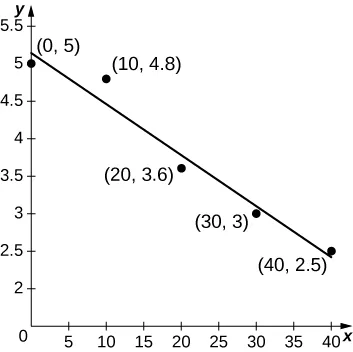
[T] The following table provides hypothetical data regarding the level of service for a certain highway.
Highway Speed Range (mph) Vehicles per Hour per Lane Density Range (vehicles/mi) > 60 < 600 < 10 60–57 600–1000 10–20 57–54 1000–1500 20–30 54–46 1500–1900 30–45 46–30 1900–2100 45–70 <30 Unstable 70–200 - Plot vehicles per hour per lane on the x-axis and highway speed on the y-axis.
- Compute the average decrease in speed (in miles per hour) per unit increase in congestion (vehicles per hour per lane) as the latter increases from 600 to 1000, from 1000 to 1500, and from 1500 to 2100. Does the decrease in miles per hour depend linearly on the increase in vehicles per hour per lane?
Exercises 247
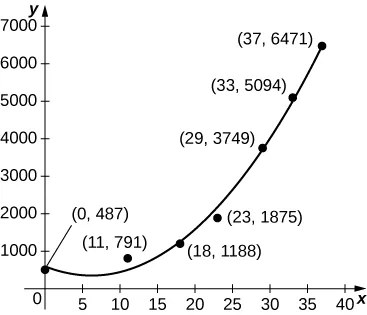
For the next two exercises use the data in the following table, which displays bald eagle populations from 1963 to 2000 in the continental United States.
Source: http://www.fws.gov/Midwest/eagle/population/chtofprs.html. Year Population of Breeding Pairs of Bald Eagles 1963 487 1974 791 1981 1188 1986 1875 1992 3749 1996 5094 2000 6471 [T] The graph below plots the cubic against the data in the preceding table, normalized so that corresponds to 1963. Estimate the average number of bald eagles per year present for the 37 years by computing the average value of over
Exercises 249
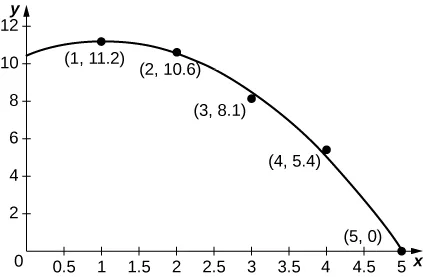
As a car accelerates, it does not accelerate at a constant rate; rather, the acceleration is variable. For the following exercises, use the following table, which contains the acceleration measured at every second as a driver merges onto a freeway.
Time (sec) Acceleration (mph/sec) 1 11.2 2 10.6 3 8.1 4 5.4 5 0 As a car accelerates, it does not accelerate at a constant rate; rather, the acceleration is variable. For the next three exercises use the following table, which contains the acceleration measured at every second as a driver merges onto a freeway.
Time (sec) Acceleration (mph/sec) 1 11.2 2 10.6 3 8.1 4 Exercises 251
As a car accelerates, it does not accelerate at a constant rate; rather, the acceleration is variable. For the following exercises, use the following table, which contains the acceleration measured at every second as a driver merges onto a freeway.
Time (sec) Acceleration (mph/sec) 1 11.2 2 10.6 3 8.1 4 5.4 5 0 As a car accelerates, it does not accelerate at a constant rate; rather, the acceleration is variable. For the next three exercises use the following table, which contains the acceleration measured at every second as a driver merges onto a freeway.
Time (sec) Acceleration (mph/sec) 1 11.2 2 10.6 3 8.1 4 Exercises 253
As a car accelerates, it does not accelerate at a constant rate; rather, the acceleration is variable. For the following exercises, use the following table, which contains the acceleration measured at every second as a driver merges onto a freeway.
Time (sec) Acceleration (mph/sec) 1 11.2 2 10.6 3 8.1 4 5.4 5 0 As a car accelerates, it does not accelerate at a constant rate; rather, the acceleration is variable. For the next three exercises use the following table, which contains the acceleration measured at every second as a driver merges onto a freeway.
Time (sec) Acceleration (mph/sec) 1 11.2 2 10.6 3 8.1 4
Key terms · 1
- net change theorem
- if we know the rate of change of a quantity, the net change theorem says the future quantity is equal to the initial quantity plus the integral of the rate of change of the quantity
Learn 5.4 on the whiteboard
The tutor teaches the whole section, drawing it out step by step and answering your questions as you go.