Preparing your lesson…正在准备你的课程…正在準備你的課程…Preparando tu lección…Préparation de votre leçon…Deine Lektion wird vorbereitet…Sto preparando la tua lezione…Preparando sua aula…レッスンを準備しています…수업을 준비하고 있어요…Menyediakan pelajaran anda…Menyiapkan pelajaranmu…
9.4 Effusion and Diffusion of Gases | ahaboard
Preparing your lesson…正在准备你的课程…正在準備你的課程…Preparando tu lección…Préparation de votre leçon…Deine Lektion wird vorbereitet…Sto preparando la tua lezione…Preparando sua aula…レッスンを準備しています…수업을 준비하고 있어요…Menyediakan pelajaran anda…Menyiapkan pelajaranmu…
If you have ever been in a room when a piping hot pizza was delivered, you have been made aware of the fact that gaseous molecules can quickly spread throughout a room, as evidenced by the pleasant aroma that soon reaches your nose. Although gaseous molecules travel at tremendous speeds (hundreds of meters per second), they collide with other gaseous molecules and travel in many different directions before reaching the desired target. At room temperature, a gaseous molecule will experience billions of collisions per second. The mean free path is the average distance a molecule travels between collisions. The mean free path increases with decreasing pressure; in general, the mean free path for a gaseous molecule will be hundreds of times the diameter of the molecule
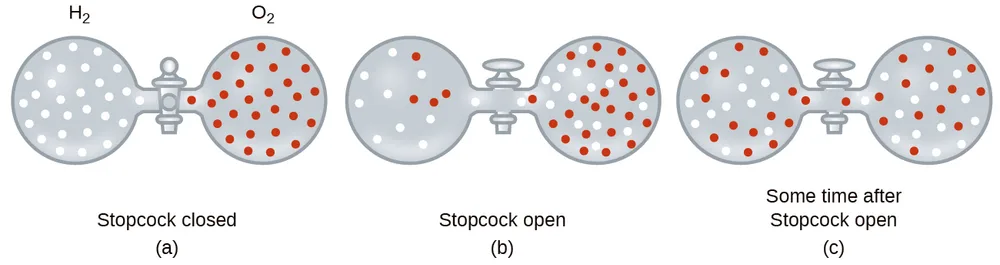
In general, we know that when a sample of gas is introduced to one part of a closed container, its molecules very quickly disperse throughout the container; this process by which molecules disperse in space in response to differences in concentration is called diffusion (shown in Figure 9.27). The gaseous atoms or molecules are, of course, unaware of any concentration gradient, they simply move randomly—regions of higher concentration have more particles than regions of lower concentrations, and so a net movement of species from high to low concentration areas takes place. In a closed environment, diffusion will ultimately result in equal concentrations of gas throughout, as depicted in Figure 9.27. The gaseous atoms and molecules continue to move, but since their concentrations are the same in both bulbs, the rates of transfer between the bulbs are equal (no net transfer of molecules occurs).
Figure 9.27(a) Two gases, H₂ and O₂, are initially separated. (b) When the stopcock is opened, they mix together. The lighter gas, H₂, passes through the opening faster than O₂, so just after the stopcock is opened, more H₂ molecules move to the O₂ side than O₂ molecules move to the H₂ side. (c) After a short time, both the slower-moving O₂ molecules and the faster-moving H₂ molecules have distributed themselves evenly on both sides of the vessel.
We are often interested in the rate of diffusion, the amount of gas passing through some area per unit time:
rate of diffusion=unit of timeamount of gas passing through an area
The diffusion rate depends on several factors: temperature; the mass of the atoms or molecules; the concentration gradient (the increase or decrease in concentration from one point to another); the amount of surface area available for diffusion; and the distance the gas particles must travel. Note also that the time required for diffusion to occur is inversely proportional to the rate of diffusion, as shown in the rate of diffusion equation.
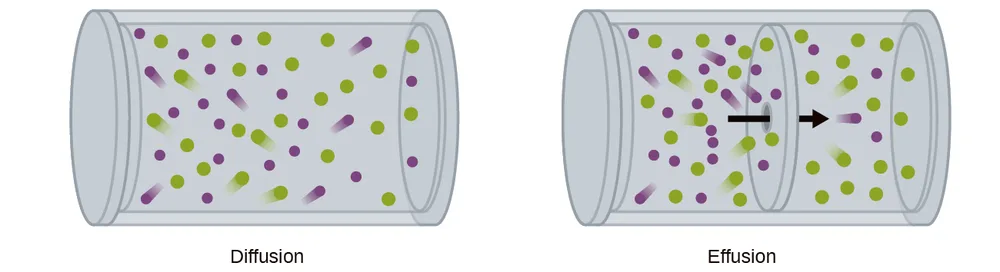
A process involving movement of gaseous species similar to diffusion is effusion, the escape of gas molecules through a tiny hole such as a pinhole in a balloon into a vacuum (Figure 9.28). Although diffusion and effusion rates both depend on the molar mass of the gas involved, their rates are not equal; however, the ratios of their rates are the same.
Figure 9.28Diffusion involves the unrestricted dispersal of molecules throughout space due to their random motion. When this process is restricted to passage of molecules through very small openings in a physical barrier, the process is called effusion.
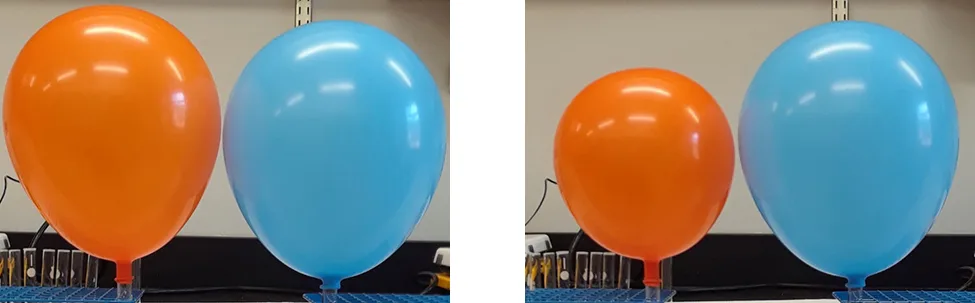
If a mixture of gases is placed in a container with porous walls, the gases effuse through the small openings in the walls. The lighter gases pass through the small openings more rapidly (at a higher rate) than the heavier ones (Figure 9.29). In 1832, Thomas Graham studied the rates of effusion of different gases and formulated Graham’s law of effusion: The rate of effusion of a gas is inversely proportional to the square root of its molar mass:
rate of effusion∝M1
This means that if two gases A and B are at the same temperature and pressure, the ratio of their effusion rates is inversely proportional to the ratio of the square roots of their molar masses:
rate of effusion of Brate of effusion of A=MAMB
Figure 9.29The left photograph shows two balloons inflated with different gases, helium (orange) and argon (blue).The right-side photograph shows the balloons approximately 12 hours after being filled, at which time the helium balloon has become noticeably more deflated than the argon balloon, due to the greater effusion rate of the lighter helium gas. (credit: modification of work by Paul Flowers)
Key Concepts and Summary
Gaseous atoms and molecules move freely and randomly through space. Diffusion is the process whereby gaseous atoms and molecules are transferred from regions of relatively high concentration to regions of relatively low concentration. Effusion is a similar process in which gaseous species pass from a container to a vacuum through very small orifices. The rates of effusion of gases are inversely proportional to the square roots of their densities or to the square roots of their atoms/molecules’ masses (Graham’s law).
Key Equations
rate of diffusion=unit of timeamount of gas passing through an area
rate of effusion of gas Brate of effusion of gas A=mAmB=MAMB
Hydrogen effuses four times as rapidly as oxygen.
Check Your Learning
At a particular pressure and temperature, nitrogen gas effuses at the rate of 79 mL/s. Under the same conditions, at what rate will sulfur dioxide effuse?
Answer
52 mL/s
To get:
time for Neamount of Ne transferredtime for Xeamount of Xe transferred=MXeMNe
Noting that amount of A = amount of B, and solving for time for Ne:
time for Neamount of Netime for Xeamount of Xe=time for Xetime for Ne=MXeMNe=MXeMNe
and substitute values:
243stime for Ne=131.3g mol20.2g mol=0.392
Finally, solve for the desired quantity:
time for Ne=0.392×243s=95.3s
Note that this answer is reasonable: Since Ne is lighter than Xe, the effusion rate for Ne will be larger than that for Xe, which means the time of effusion for Ne will be smaller than that for Xe.
Check Your Learning
A party balloon filled with helium deflates to 32 of its original volume in 8.0 hours. How long will it take an identical balloon filled with the same number of moles of air (ℳ = 28.2 g/mol) to deflate to 21 of its original volume?
Answer
32 h
Plug in known data:
11.66=MUnknown44.0g/mol
Solve:
MUnknown=(1.66)244.0g/mol=16.0g/mol
The gas could well be CH₄, the only gas with this molar mass.
Check Your Learning
Hydrogen gas effuses through a porous container 8.97-times faster than an unknown gas. Estimate the molar mass of the unknown gas.
Answer
162 g/mol
Figure 9.30In a diffuser, gaseous UF₆ is pumped through a porous barrier, which partially separates ²³⁵UF₆ from ²³⁸UF₆ The UF₆ must pass through many large diffuser units to achieve sufficient enrichment in ²³⁵U.
The large scale separation of gaseous ²³⁵UF₆ from ²³⁸UF₆ was first done during the World War II, at the atomic energy installation in Oak Ridge, Tennessee, as part of the Manhattan Project (the development of the first atomic bomb). Although the theory is simple, this required surmounting many daunting technical challenges to make it work in practice. The barrier must have tiny, uniform holes (about 10–6 cm in diameter) and be porous enough to produce high flow rates. All materials (the barrier, tubing, surface coatings, lubricants, and gaskets) need to be able to contain, but not react with, the highly reactive and corrosive UF₆.
Because gaseous diffusion plants require very large amounts of energy (to compress the gas to the high pressures required and drive it through the diffuser cascade, to remove the heat produced during compression, and so on), it is now being replaced by gas centrifuge technology, which requires far less energy. A current hot political issue is how to deny this technology to Iran, to prevent it from producing enough enriched uranium for them to use to make nuclear weapons.