Preparing your lesson…正在准备你的课程…正在準備你的課程…Preparando tu lección…Préparation de votre leçon…Deine Lektion wird vorbereitet…Sto preparando la tua lezione…Preparando sua aula…レッスンを準備しています…수업을 준비하고 있어요…Menyediakan pelajaran anda…Menyiapkan pelajaranmu…
9.1 Gas Pressure | ahaboard
Preparing your lesson…正在准备你的课程…正在準備你的課程…Preparando tu lección…Préparation de votre leçon…Deine Lektion wird vorbereitet…Sto preparando la tua lezione…Preparando sua aula…レッスンを準備しています…수업을 준비하고 있어요…Menyediakan pelajaran anda…Menyiapkan pelajaranmu…
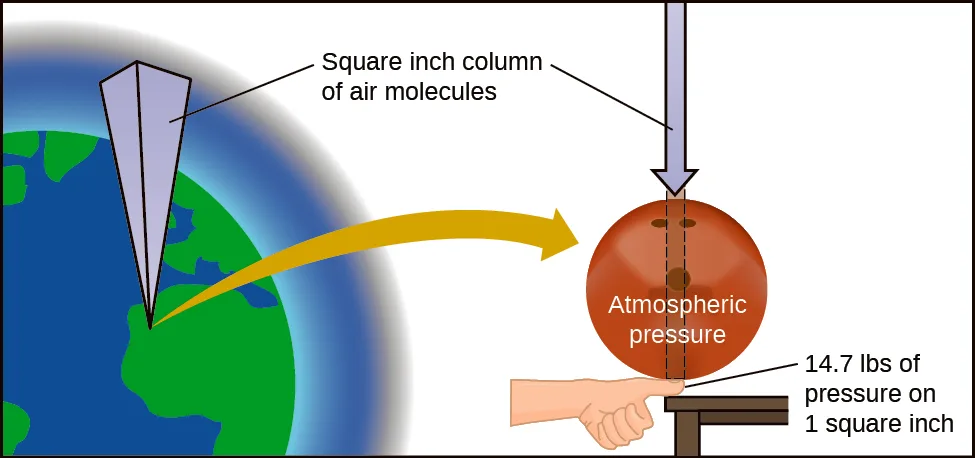
The earth’s atmosphere exerts a pressure, as does any other gas. Although we do not normally notice atmospheric pressure, we are sensitive to pressure changes—for example, when your ears “pop” during take-off and landing while flying, or when you dive underwater. Gas pressure is caused by the force exerted by gas molecules colliding with the surfaces of objects (Figure 9.2). Although the force of each collision is very small, any surface of appreciable area experiences a large number of collisions in a short time, which can result in a high pressure. In fact, normal air pressure is strong enough to crush a metal container when not balanced by equal pressure from inside the container.
Figure 9.2The atmosphere above us exerts a large pressure on objects at the surface of the earth, roughly equal to the weight of a bowling ball pressing on an area the size of a human thumbnail.
Atmospheric pressure is caused by the weight of the column of air molecules in the atmosphere above an object, such as the tanker car. At sea level, this pressure is roughly the same as that exerted by a full-grown African elephant standing on a doormat, or a typical bowling ball resting on your thumbnail. These may seem like huge amounts, and they are, but life on earth has evolved under such atmospheric pressure. If you actually perch a bowling ball on your thumbnail, the pressure experienced is twice the usual pressure, and the sensation is unpleasant.
In general, pressure is defined as the force exerted on a given area: P=AF. Note that pressure is directly proportional to force and inversely proportional to area. Thus, pressure can be increased either by increasing the amount of force or by decreasing the area over which it is applied; pressure can be decreased by decreasing the force or increasing the area.
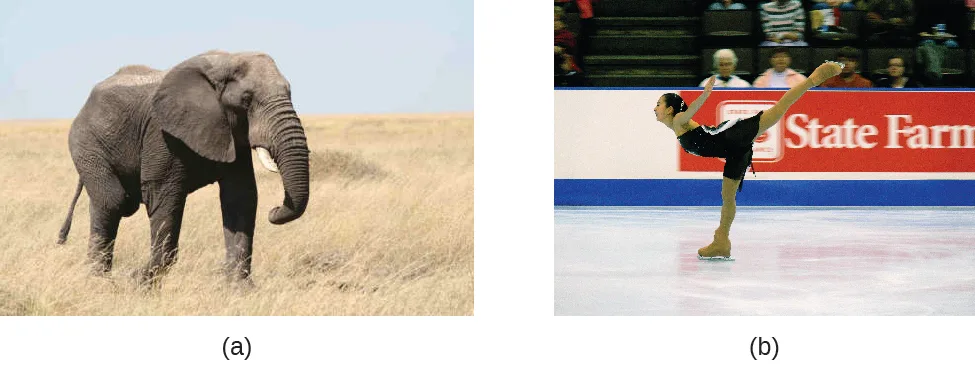
Let’s apply this concept to determine which exerts a greater pressure in Figure 9.3—the elephant or the figure skater? A large African elephant can weigh 7 tons, supported on four feet, each with a diameter of about 1.5 ft (footprint area of 250 in²), so the pressure exerted by each foot is about 14 lb/in²:
pressure per elephant foot=14,000elephantlb×4 feet1 elephant×250in21 foot=14lb/in2
The figure skater weighs about 120 lbs, supported on two skate blades, each with an area of about 2 in², so the pressure exerted by each blade is about 30 lb/in²:
pressure per skate blade=120skaterlb×2 blades1 skater×2in21 blade=30lb/in2
Even though the elephant is more than one hundred-times heavier than the skater, it exerts less than one-half of the pressure. On the other hand, if the skater removes their skates and stands with bare feet (or regular footwear) on the ice, the larger area over which their weight is applied greatly reduces the pressure exerted:
pressure per human foot=120skaterlb×2 feet1 skater×30in21 foot=2lb/in2
Figure 9.3Although (a) an elephant’s weight is large, creating a very large force on the ground, (b) the figure skater exerts a much higher pressure on the ice due to the small surface area of the skates. (credit a: modification of work by Guido da Rozze; credit b: modification of work by Ryosuke Yagi)
The SI unit of pressure is the pascal (Pa), with 1 Pa = 1 N/m², where N is the newton, a unit of force defined as 1 kg m/s². One pascal is a small pressure; in many cases, it is more convenient to use units of kilopascal (1 kPa = 1000 Pa) or bar (1 bar = 100,000 Pa). In the United States, pressure is often measured in pounds of force on an area of one square inch—pounds per square inch (psi)—for example, in car tires. Pressure can also be measured using the unit atmosphere (atm), which originally represented the average sea level air pressure at the approximate latitude of Paris (45°). Table 9.1 provides some information on these and a few other common units for pressure measurements
Table 9.1
Pressure Units
Unit Name and Abbreviation
Definition or Relation to Other Unit
pascal (Pa)
1 Pa = 1 N/m² recommended IUPAC unit
kilopascal (kPa)
1 kPa = 1000 Pa
pounds per square inch (psi)
air pressure at sea level is ~14.7 psi
atmosphere (atm)
1 atm = 101,325 Pa = 760 torr air pressure at sea level is ~1 atm
bar (bar, or b)
1 bar = 100,000 Pa (exactly) commonly used in meteorology
millibar (mbar, or mb)
1000 mbar = 1 bar
inches of mercury (in. Hg)
1 in. Hg = 3386 Pa used by aviation industry, also some weather reports
torr
1 torr=7601atm
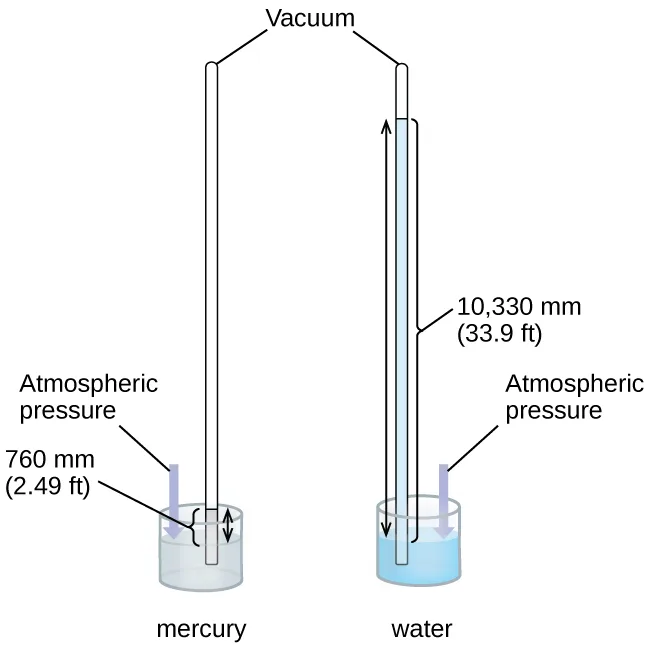
We can measure atmospheric pressure, the force exerted by the atmosphere on the earth’s surface, with a barometer (Figure 9.4). A barometer is a glass tube that is closed at one end, filled with a nonvolatile liquid such as mercury, and then inverted and immersed in a container of that liquid. The atmosphere exerts pressure on the liquid outside the tube, the column of liquid exerts pressure inside the tube, and the pressure at the liquid surface is the same inside and outside the tube. The height of the liquid in the tube is therefore proportional to the pressure exerted by the atmosphere.
Figure 9.4In a barometer, the height, h, of the column of liquid is used as a measurement of the air pressure. Using very dense liquid mercury (left) permits the construction of reasonably sized barometers, whereas using water (right) would require a barometer more than 30 feet tall.
If the liquid is water, normal atmospheric pressure will support a column of water over 10 meters high, which is rather inconvenient for making (and reading) a barometer. Because mercury (Hg) is about 13.6-times denser than water, a mercury barometer only needs to be 13.61 as tall as a water barometer—a more suitable size. Standard atmospheric pressure of 1 atm at sea level (101,325 Pa) corresponds to a column of mercury that is about 760 mm (29.92 in.) high. The torr was originally intended to be a unit equal to one millimeter of mercury, but it no longer corresponds exactly. The pressure exerted by a fluid due to gravity is known as hydrostatic pressure, p:
p=hρg
where h is the height of the fluid, ρ (lowercase Greek letter rho) is the density of the fluid, and g is acceleration due to gravity.
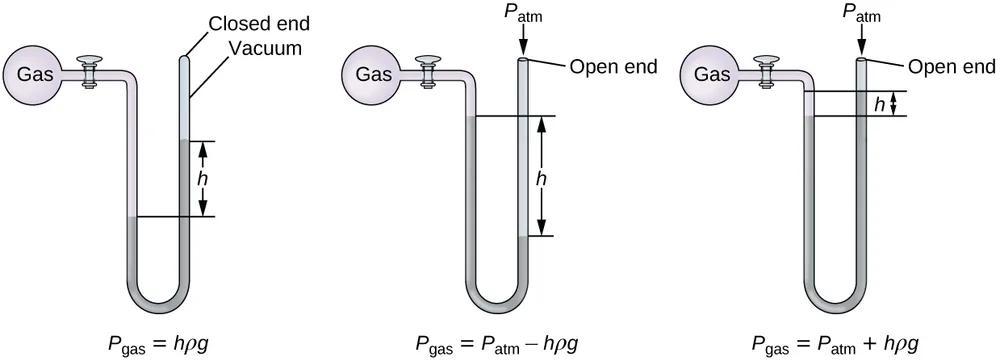
A manometer is a device similar to a barometer that can be used to measure the pressure of a gas trapped in a container. A closed-end manometer is a U-shaped tube with one closed arm, one arm that connects to the gas to be measured, and a nonvolatile liquid (usually mercury) in between. As with a barometer, the distance between the liquid levels in the two arms of the tube (h in the diagram) is proportional to the pressure of the gas in the container. An open-end manometer (Figure 9.5) is the same as a closed-end manometer, but one of its arms is open to the atmosphere. In this case, the distance between the liquid levels corresponds to the difference in pressure between the gas in the container and the atmosphere.
Figure 9.5A manometer can be used to measure the pressure of a gas. The (difference in) height between the liquid levels (h) is a measure of the pressure. Mercury is usually used because of its large density.
Key Concepts and Summary
Gases exert pressure, which is force per unit area. The pressure of a gas may be expressed in the SI unit of pascal or kilopascal, as well as in many other units including torr, atmosphere, and bar. Atmospheric pressure is measured using a barometer; other gas pressures can be measured using one of several types of manometers.
Key Equations
P=AF
p = hρg
named after Evangelista Torricelli, inventor of the barometer
Calculate the height of a column of water at 25 °C that corresponds to normal atmospheric pressure. The density of water at this temperature is 1.0 g/cm³.
Answer
10.3 m
(b) 264torr×760torr1atm×1atm101,325 Pa=35,200 Pa
(c) 35,200Pa×100,000Pa1 bar=0.352 bar
Check Your Learning
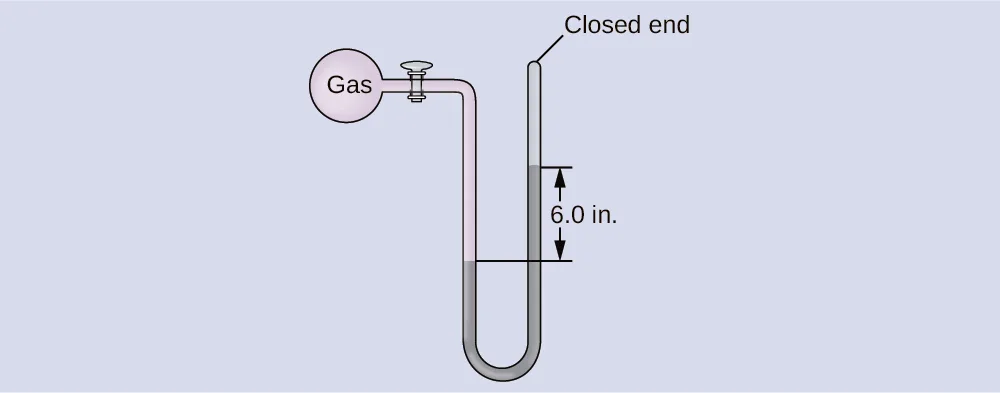
The pressure of a sample of gas is measured with a closed-end manometer. The liquid in the manometer is mercury. Determine the pressure of the gas in:
(a) torr
(b) Pa
(c) bar
Answer
(a) ~150 torr; (b) ~20,000 Pa; (c) ~0.20 bar
(c) 1.18atm×1atm101.325 kPa=1.20×10²kPa
Check Your Learning
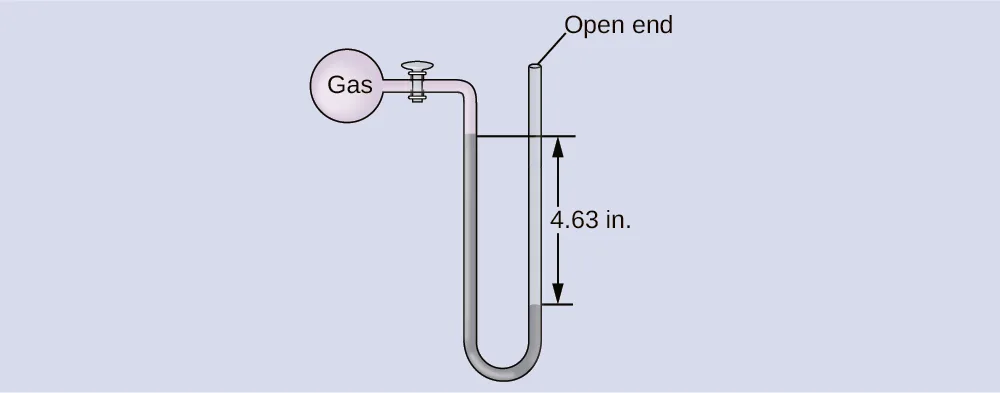
The pressure of a sample of gas is measured at sea level with an open-end Hg manometer, as shown to the right. Determine the pressure of the gas in:
(a) mm Hg
(b) atm
(c) kPa
Answer
(a) 642 mm Hg; (b) 0.845 atm; (c) 85.6 kPa
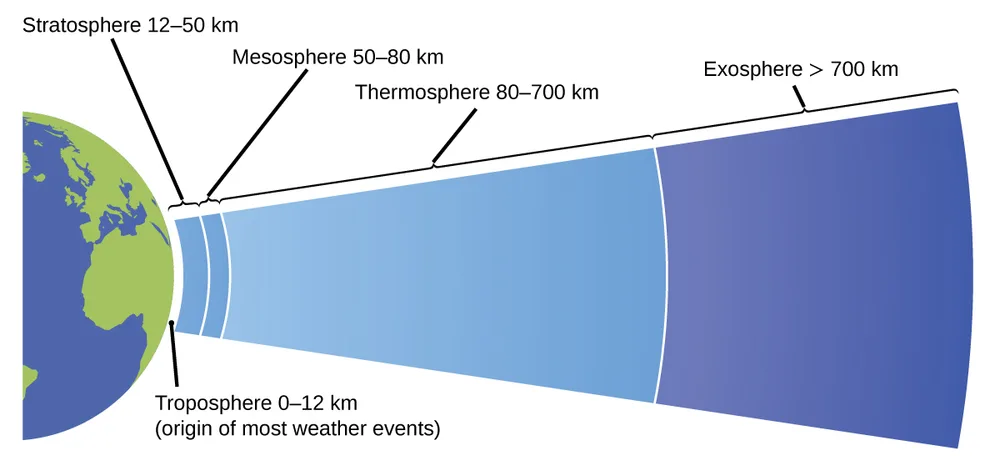
Figure 9.8Earth’s atmosphere has five layers: the troposphere, the stratosphere, the mesosphere, the thermosphere, and the exosphere.
Climatology is the study of the climate, averaged weather conditions over long time periods, using atmospheric data. However, climatologists study patterns and effects that occur over decades, centuries, and millennia, rather than shorter time frames of hours, days, and weeks like meteorologists. Atmospheric science is an even broader field, combining meteorology, climatology, and other scientific disciplines that study the atmosphere.