As discussed earlier, hydronium and hydroxide ions are present both in pure water and in all aqueous solutions, and their concentrations are inversely proportional as determined by the ion product of water (K). The concentrations of these ions in a solution are often critical determinants of the solution’s properties and the chemical behaviors of its other solutes, and specific vocabulary has been developed to describe these concentrations in relative terms. A solution is neutral if it contains equal concentrations of hydronium and hydroxide ions; acidic if it contains a greater concentration of hydronium ions than hydroxide ions; and basic if it contains a lesser concentration of hydronium ions than hydroxide ions.
A common means of expressing quantities that may span many orders of magnitude is to use a logarithmic scale. One such scale that is very popular for chemical concentrations and equilibrium constants is based on the p-function, defined as shown where “X” is the quantity of interest and “log” is the base-10 logarithm:
The pH of a solution is therefore defined as shown here, where [H₃O⁺] is the molar concentration of hydronium ion in the solution:
Rearranging this equation to isolate the hydronium ion molarity yields the equivalent expression:
Likewise, the hydroxide ion molarity may be expressed as a p-function, or pOH:
or
Finally, the relation between these two ion concentration expressed as p-functions is easily derived from the K expression:
At 25 °C, the value of K is 1.0 10⁻¹⁴, and so:
As was shown in Example 14.1, the hydronium ion molarity in pure water (or any neutral solution) is 1.0 10⁻⁷ M at 25 °C. The pH and pOH of a neutral solution at this temperature are therefore:
And so, at this temperature, acidic solutions are those with hydronium ion molarities greater than 1.0 10⁻⁷ M and hydroxide ion molarities less than 1.0 10⁻⁷ M (corresponding to pH values less than 7.00 and pOH values greater than 7.00). Basic solutions are those with hydronium ion molarities less than 1.0 10⁻⁷ M and hydroxide ion molarities greater than 1.0 10⁻⁷ M (corresponding to pH values greater than 7.00 and pOH values less than 7.00).
Since the autoionization constant K is temperature dependent, these correlations between pH values and the acidic/neutral/basic adjectives will be different at temperatures other than 25 °C. For example, the “Check Your Learning” exercise accompanying Example 14.1 showed the hydronium molarity of pure water at 80 °C is 4.9 10⁻⁷ M, which corresponds to pH and pOH values of:
At this temperature, then, neutral solutions exhibit pH = pOH = 6.31, acidic solutions exhibit pH less than 6.31 and pOH greater than 6.31, whereas basic solutions exhibit pH greater than 6.31 and pOH less than 6.31. This distinction can be important when studying certain processes that occur at other temperatures, such as enzyme reactions in warm-blooded organisms at a temperature around 36–40 °C. Unless otherwise noted, references to pH values are presumed to be those at 25 °C (Table 14.1).
| Summary of Relations for Acidic, Basic and Neutral Solutions | ||
| Classification | Relative Ion Concentrations | pH at 25 °C |
| acidic | [H₃O⁺] > [OH⁻] | pH < 7 |
| neutral | [H₃O⁺] = [OH⁻] | pH = 7 |
| basic | [H₃O⁺] < [OH⁻] | pH > 7 |
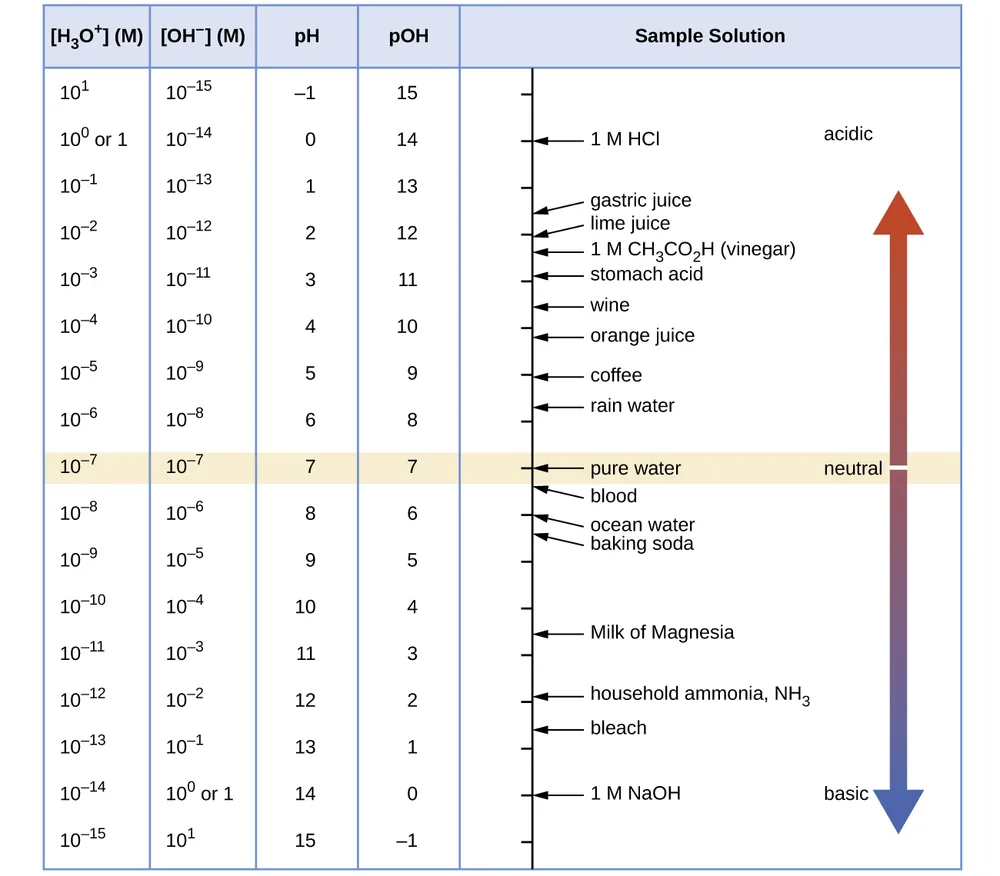
Figure 14.2 shows the relationships between [H₃O⁺], [OH⁻], pH, and pOH for solutions classified as acidic, basic, and neutral.
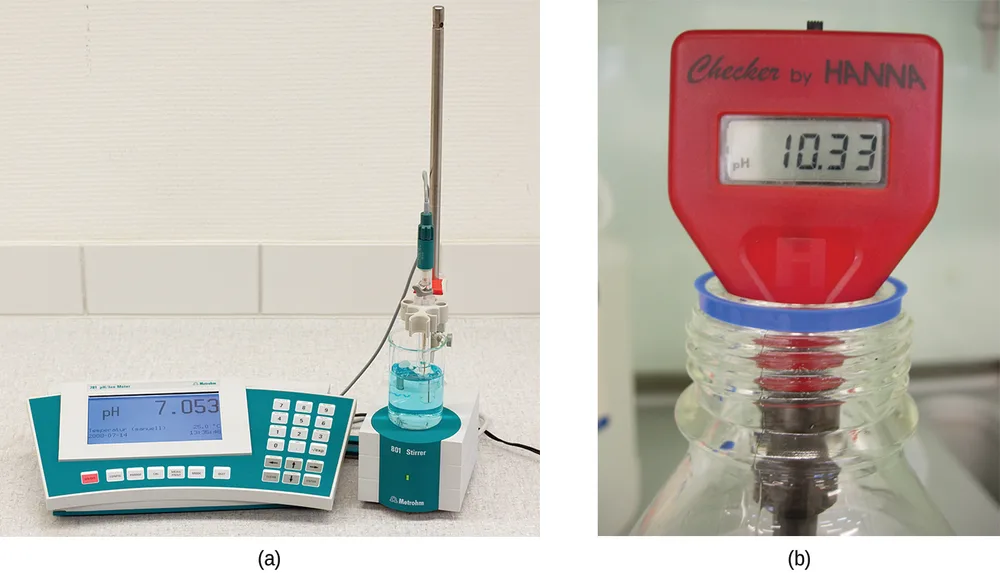
The acidity of a solution is typically assessed experimentally by measurement of its pH. The pOH of a solution is not usually measured, as it is easily calculated from an experimentally determined pH value. The pH of a solution can be directly measured using a pH meter (Figure 14.4).
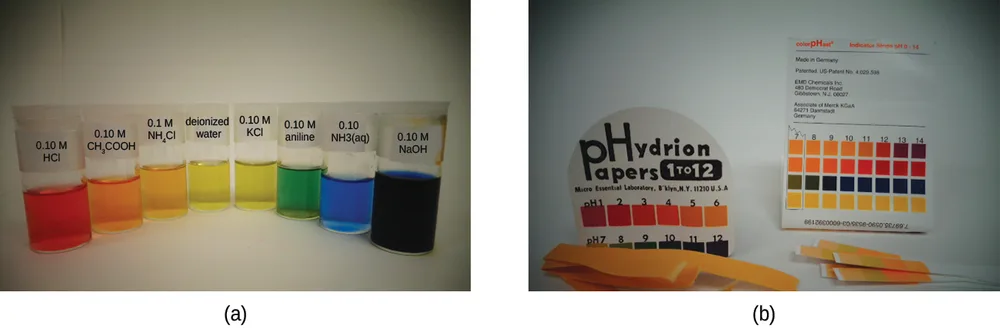
The pH of a solution may also be visually estimated using colored indicators (Figure 14.5). The acid-base equilibria that enable use of these indicator dyes for pH measurements are described in a later section of this chapter.
Key Concepts and Summary
Concentrations of hydronium and hydroxide ions in aqueous media are often represented as logarithmic pH and pOH values, respectively. At 25 °C, the autoprotolysis equilibrium for water requires the sum of pH and pOH to equal 14 for any aqueous solution. The relative concentrations of hydronium and hydroxide ion in a solution define its status as acidic ([H₃O⁺] > [OH⁻]), basic ([H₃O⁺] < [OH⁻]), or neutral ([H₃O⁺] = [OH⁻]). At 25 °C, a pH < 7 indicates an acidic solution, a pH > 7 a basic solution, and a pH = 7 a neutral solution.
Key Equations
| pOH = −log[OH⁻] |
| [H₃O⁺] = 10 |
| [OH⁻] = 10 |