Preparing your lesson…正在准备你的课程…正在準備你的課程…Preparando tu lección…Préparation de votre leçon…Deine Lektion wird vorbereitet…Sto preparando la tua lezione…Preparando sua aula…レッスンを準備しています…수업을 준비하고 있어요…Menyediakan pelajaran anda…Menyiapkan pelajaranmu…
15.1 Precipitation and Dissolution | ahaboard
Preparing your lesson…正在准备你的课程…正在準備你的課程…Preparando tu lección…Préparation de votre leçon…Deine Lektion wird vorbereitet…Sto preparando la tua lezione…Preparando sua aula…レッスンを準備しています…수업을 준비하고 있어요…Menyediakan pelajaran anda…Menyiapkan pelajaranmu…
Solubility equilibria are established when the dissolution and precipitation of a solute species occur at equal rates. These equilibria underlie many natural and technological processes, ranging from tooth decay to water purification. An understanding of the factors affecting compound solubility is, therefore, essential to the effective management of these processes. This section applies previously introduced equilibrium concepts and tools to systems involving dissolution and precipitation.
The Solubility Product
Recall from the chapter on solutions that the solubility of a substance can vary from essentially zero (insoluble or sparingly soluble) to infinity (miscible). A solute with finite solubility can yield a saturated solution when it is added to a solvent in an amount exceeding its solubility, resulting in a heterogeneous mixture of the saturated solution and the excess, undissolved solute. For example, a saturated solution of silver chloride is one in which the equilibrium shown below has been established.
AgCl(s)precipitation⇌dissolutionAg+(aq)+Cl-(aq)
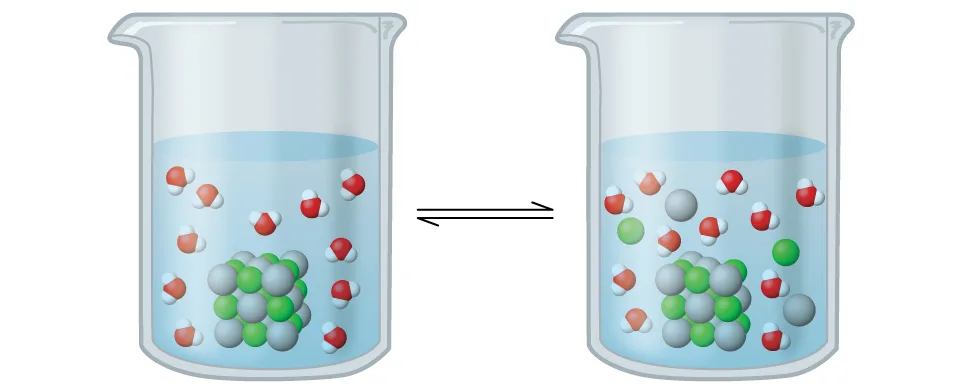
In this solution, an excess of solid AgCl dissolves and dissociates to produce aqueous Ag⁺ and Cl– ions at the same rate that these aqueous ions combine and precipitate to form solid AgCl (Figure 15.2). Because silver chloride is a sparingly soluble salt, the equilibrium concentration of its dissolved ions in the solution is relatively low.
Figure 15.2Silver chloride is a sparingly soluble ionic solid. When it is added to water, it dissolves slightly and produces a mixture consisting of a very dilute solution of Ag⁺ and Cl– ions in equilibrium with undissolved silver chloride.
The equilibrium constant for solubility equilibria such as this one is called the solubility product constant, Ksp, in this case
AgCl(s)⇌Ag+(aq)+Cl-(aq)Ksp=[Ag+(aq)][Cl-(aq)]
Recall that only gases and solutes are represented in equilibrium constant expressions, so the Ksp does not include a term for the undissolved AgCl. A listing of solubility product constants for several sparingly soluble compounds is provided in Appendix J.
Ksp and Solubility
The Ksp of a slightly soluble ionic compound may be simply related to its measured solubility provided the dissolution process involves only dissociation and solvation, for example:
MpXq(s)⇌pMm+(aq)+qXn-(aq)
For cases such as these, one may derive Ksp values from provided solubilities, or vice-versa. Calculations of this sort are most conveniently performed using a compound’s molar solubility, measured as moles of dissolved solute per liter of saturated solution.
Predicting Precipitation
The equation that describes the equilibrium between solid calcium carbonate and its solvated ions is:
It is important to realize that this equilibrium is established in any aqueous solution containing Ca²⁺ and CO₃2– ions, not just in a solution formed by saturating water with calcium carbonate. Consider, for example, mixing aqueous solutions of the soluble compounds sodium carbonate and calcium nitrate. If the concentrations of calcium and carbonate ions in the mixture do not yield a reaction quotient, Qsp, that exceeds the solubility product, Ksp, then no precipitation will occur. If the ion concentrations yield a reaction quotient greater than the solubility product, then precipitation will occur, lowering those concentrations until equilibrium is established (Qsp = ). The comparison of to to predict precipitation is an example of the general approach to predicting the direction of a reaction first introduced in the chapter on equilibrium. For the specific case of solubility equilibria:
Qsp < Ksp: the reaction proceeds in the forward direction (solution is not saturated; no precipitation observed)
Qsp > Ksp: the reaction proceeds in the reverse direction (solution is supersaturated; precipitation will occur)
This predictive strategy and related calculations are demonstrated in the next few example exercises.
In solutions containing two or more ions that may form insoluble compounds with the same counter ion, an experimental strategy called selective precipitation may be used to remove individual ions from solution. By increasing the counter ion concentration in a controlled manner, ions in solution may be precipitated individually, assuming their compound solubilities are adequately different. In solutions with equal concentrations of target ions, the ion forming the least soluble compound will precipitate first (at the lowest concentration of counter ion), with the other ions subsequently precipitating as their compound’s solubilities are reached. As an illustration of this technique, the next example exercise describes separation of a two halide ions via precipitation of one as a silver salt.
Common Ion Effect
Compared with pure water, the solubility of an ionic compound is less in aqueous solutions containing a common ion (one also produced by dissolution of the ionic compound). This is an example of a phenomenon known as the common ion effect, which is a consequence of the law of mass action that may be explained using Le ChÂtelier’s principle. Consider the dissolution of silver iodide:
AgI(s)⇌Ag+(aq)+I-(aq)
This solubility equilibrium may be shifted left by the addition of either silver(I) or iodide ions, resulting in the precipitation of AgI and lowered concentrations of dissolved Ag⁺ and I–. In solutions that already contain either of these ions, less AgI may be dissolved than in solutions without these ions.
This effect may also be explained in terms of mass action as represented in the solubility product expression:
Ksp=[Ag+][I−]
The mathematical product of silver(I) and iodide ion molarities is constant in an equilibrium mixture regardless of the source of the ions, and so an increase in one ion’s concentration must be balanced by a proportional decrease in the other.
Key Concepts and Summary
The equilibrium constant for an equilibrium involving the precipitation or dissolution of a slightly soluble ionic solid is called the solubility product, Ksp, of the solid. For a heterogeneous equilibrium involving the slightly soluble solid MpXq and its ions Mm+ and Xn–:
MpXq(s)⇌pMm+(aq)+qXn-(aq)
the solubility product expression is:
Ksp=[Mm+]p[Xn-]q
The solubility product of a slightly soluble electrolyte can be calculated from its solubility; conversely, its solubility can be calculated from its Ksp, provided the only significant reaction that occurs when the solid dissolves is the formation of its ions.
A slightly soluble electrolyte begins to precipitate when the magnitude of the reaction quotient for the dissolution reaction exceeds the magnitude of the solubility product. Precipitation continues until the reaction quotient equals the solubility product.
Key Equations
MpXq(s)⇌pMm+(aq)+qXn-(aq)Ksp=[Mm+]p[Xn-]q
Check Your Learning
Write the dissolution equation and the solubility product for each of the following slightly soluble compounds:
In a saturated solution of Mg(OH)₂, the concentration of Mg²⁺ is 1.31 × 10⁻⁴ M. What is the solubility product for Mg(OH)₂?
Mg(OH)2(s)⇌Mg2+(aq)+2OH-(aq)
Answer
8.99 × 10⁻¹²
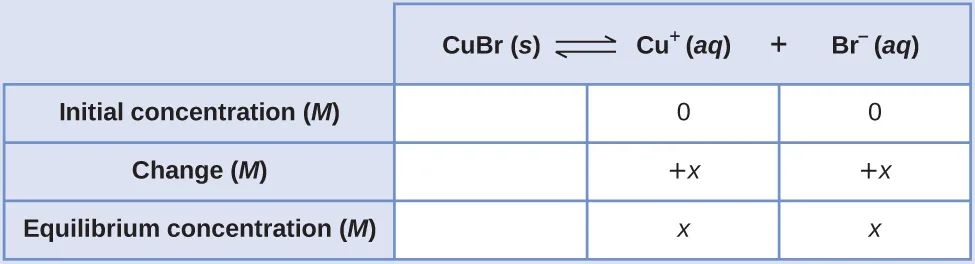
Ksp=[Cu+][Br-]
Following the ICE approach to this calculation yields the table
Substituting the equilibrium concentration terms into the solubility product expression and solving for x yields
Ksp=[Cu+][Br-]
6.3×10−9=(x)(x)=x2
x=(6.3×10⁻⁹)=7.9×10⁻⁵M
Since the dissolution stoichiometry shows one mole of copper(I) ion and one mole of bromide ion are produced for each moles of Br dissolved, the molar solubility of CuBr is 7.9 × 10⁻⁵ M.
Check Your Learning
The Ksp of AgI is 1.5 × 10⁻¹⁶. Calculate the molar solubility of silver iodide.
Answer
1.2 × 10⁻⁸ M
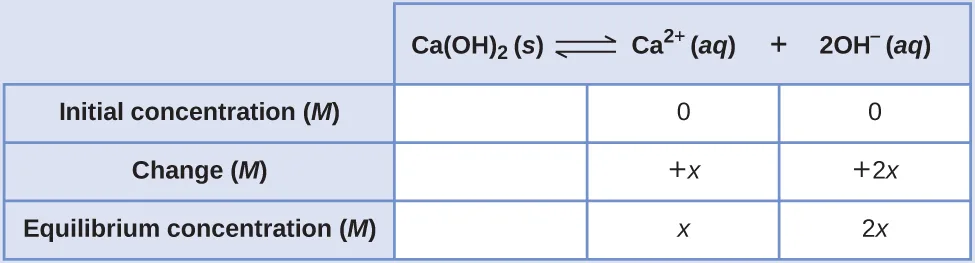
Ksp=[Ca2+][OH-]2
The ICE table for this system is
Substituting terms for the equilibrium concentrations into the solubility product expression and solving for x gives
Ksp=[Ca2+][OH-]2
1.3×10−6=(x)(2x)2=(x)(4x2)=4x3
x=341.3×10−6=6.9×10⁻³M
As defined in the ICE table, x is the molarity of calcium ion in the saturated solution. The dissolution stoichiometry shows a 1:1 relation between moles of calcium ion in solution and moles of compound dissolved, and so, the molar solubility of Ca(OH)₂ is 6.9 × 10⁻³ M.
Check Your Learning
The Ksp of PbI₂ is 1.4 × 10⁻⁸. Calculate the molar solubility of lead(II) iodide.
Answer
1.5 × 10⁻³ M
The dissolution equation for this compound is
PbCrO4(s)⇌Pb2+(aq)+CrO42-(aq)
The dissolution stoichiometry shows a 1:1 relation between the molar amounts of compound and its two ions, and so both [Pb²⁺] and [CrO42-] are equal to the molar solubility of PbCrO₄:
The solubility of TlCl [thallium(I) chloride], an intermediate formed when thallium is being isolated from ores, is 3.12 grams per liter at 20 °C. What is its solubility product?
Answer
1.69 × 10⁻⁴
Calculate the molar solubility of Hg₂Cl₂.
Solution
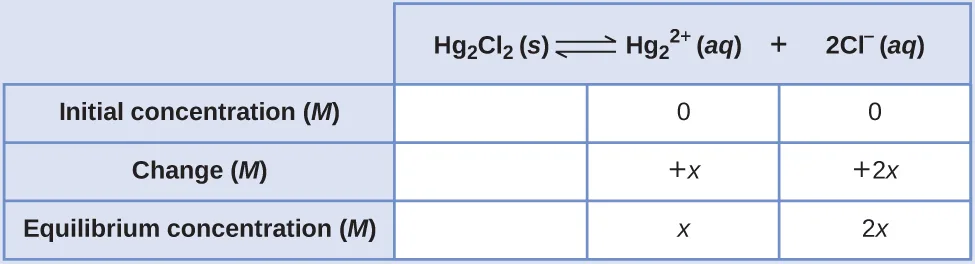
The dissolution stoichiometry shows a 1:1 relation between the amount of compound dissolved and the amount of mercury(I) ions, and so the molar solubility of Hg₂Cl₂ is equal to the concentration of Hg22+ ions
Following the ICE approach results in
Substituting the equilibrium concentration terms into the solubility product expression and solving for x gives
Ksp=[Hg22+][Cl-]2
1.1×10−18=(x)(2x)2
4x3=1.1×10⁻¹⁸
x=3(41.1×10⁻¹⁸)=6.5×10⁻⁷M
[Hg22+]=6.5×10⁻⁷M=6.5×10⁻⁷M
[Cl-]=2x=2(6.5×10⁻⁷)=1.3×10⁻⁶M
The dissolution stoichiometry shows the molar solubility of Hg₂Cl₂ is equal to [Hg22+], or 6.5 × 10⁻⁷ M.
Check Your Learning
Determine the molar solubility of MgF₂ from its solubility product: Ksp = 6.4 × 10⁻⁹.
Answer
1.2 × 10⁻³ M
K
sp
Qsp
K
sp
The concentration of Mg²⁺(aq) in sea water is 0.0537 M. Will Mg(OH)₂ precipitate when enough Ca(OH)₂ is added to give a [OH–] of 0.0010 M?
Solution
Calculation of the reaction quotient under these conditions is shown here:
Q=[Mg2+][OH-]2=(0.0537)(0.0010)2=5.4×10⁻⁸
Because Q is greater than Ksp (Q = 5.4 × 10⁻⁸ is larger than Ksp = 8.9 × 10⁻¹²), the reverse reaction will proceed, precipitating magnesium hydroxide until the dissolved ion concentrations have been sufficiently lowered, so that Qsp = .
Check Your Learning
Predict whether CaHPO₄ will precipitate from a solution with [Ca²⁺] = 0.0001 M and [HPO42-] = 0.001 M.
Answer
No precipitation of CaHPO₄; Q = 1 × 10⁻⁷, which is less than Ksp (7 × 10⁻⁷)
The solubility product is 1.6 × 10⁻¹⁰ (see Appendix J).
AgCl will precipitate if the reaction quotient calculated from the concentrations in the mixture of AgNO₃ and NaCl is greater than Ksp. Because the volume doubles when equal volumes of AgNO₃ and NaCl solutions are mixed, each concentration is reduced to half its initial value
21(2.0×10⁻⁴)M=1.0×10⁻⁴M
The reaction quotient, Q, is greater than Ksp for AgCl, so a supersaturated solution is formed:
Q=[Ag+][Cl-]=(1.0×10⁻⁴)(1.0×10⁻⁴)=1.0×10⁻⁸>Ksp
AgCl will precipitate from the mixture until the dissolution equilibrium is established, with Q equal to Ksp.
Check Your Learning
Will KClO₄ precipitate when 20 mL of a 0.050-M solution of K⁺ is added to 80 mL of a 0.50-M solution of ClO4-? (Hint: Use the dilution equation to calculate the concentrations of potassium and perchlorate ions in the mixture.)
Answer
No, Q = 4.0 × 10⁻³, which is less than Ksp = 1.05 × 10⁻²
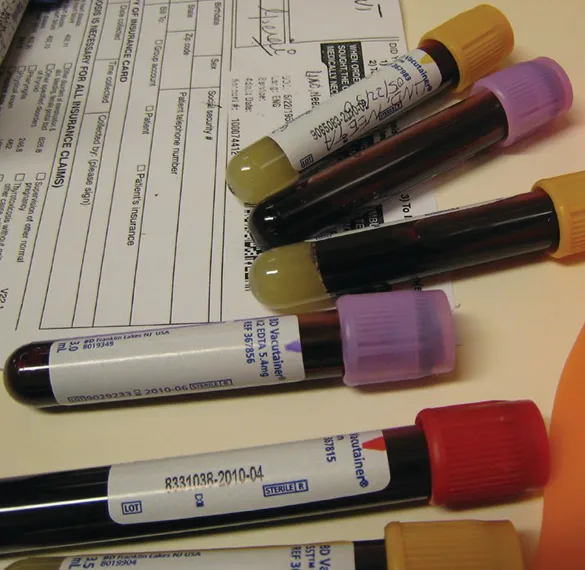
Figure 15.5Anticoagulants can be added to blood that will combine with the Ca²⁺ ions in blood serum and prevent the blood from clotting. (credit: modification of work by Neeta Lind)
Solution
The equilibrium expression is:
CaC2O4(s)⇌Ca2+(aq)+C2O42-(aq)
For this reaction:
Ksp=[Ca2+][C2O42-]=1.96×10⁻⁹
(see Appendix J)
Substitute the provided calcium ion concentration into the solubility product expression and solve for oxalate concentration:
Q=Ksp=[Ca2+][C2O42-]=1.96×10⁻⁹
(2.2×10⁻³)[C2O42-]=1.96×10⁻⁹
[C2O42-]=2.2×10−31.96×10−9=8.9×10⁻⁷M
A concentration of [C2O42-] = 8.9 × 10⁻⁷ M is necessary to initiate the precipitation of CaC₂O₄ under these conditions.
Check Your Learning
If a solution contains 0.0020 mol of CrO42- per liter, what concentration of Ag⁺ ion must be reached by adding solid AgNO₃ before Ag₂CrO₄ begins to precipitate? Neglect any increase in volume upon adding the solid silver nitrate.
(final result rounded to one significant digit, limited by the certainty of the Ksp)
Check Your Learning
The first step in the preparation of magnesium metal is the precipitation of Mg(OH)₂ from sea water by the addition of Ca(OH)₂. The concentration of Mg²⁺(aq) in sea water is 5.37 × 10⁻² M. Calculate the pH at which [Mg²⁺] is decreased to 1.0 × 10⁻⁵ M
Answer
10.97
5Ca2++3PO43-+OH-⇌Ca5(PO4)3⋅OH(s)
Because the amount of calcium ion added does not result in exceeding the solubility products for other calcium salts, the anions of those salts remain behind in the wastewater. The precipitate is then removed by filtration and the water is brought back to a neutral pH by the addition of CO₂ in a recarbonation process. Other chemicals can also be used for the removal of phosphates by precipitation, including iron(III) chloride and aluminum sulfate.
View this site for more information on how phosphorus is removed from wastewater.
If the solution contained about equal concentrations of Cl– and Br–, then the silver salt with the smaller Ksp (AgBr) would precipitate first. The concentrations are not equal, however, so the [Ag⁺] at which AgCl begins to precipitate and the [Ag⁺] at which AgBr begins to precipitate must be calculated. The salt that forms at the lower [Ag⁺] precipitates first.
AgBr precipitates when Q equals Ksp for AgBr
Qsp=Ksp=[Ag+][Br-]=[Ag+](0.00010)=5.0×10⁻¹³
[Ag+]=0.000105.0×10−13=5.0×10⁻⁹M
AgBr begins to precipitate when [Ag⁺] is 5.0 × 10⁻⁹ M.
For AgCl: AgCl precipitates when Q equals Ksp for AgCl (1.6 × 10⁻¹⁰). When [Cl–] = 0.10 M:
Qsp=Ksp=[Ag+][Cl-]=[Ag+](0.10)=1.6×10⁻¹⁰
[Ag+]=0.101.6×10−10=1.6×10⁻⁹M
AgCl begins to precipitate when [Ag⁺] is 1.6 × 10⁻⁹ M.
AgCl begins to precipitate at a lower [Ag⁺] than AgBr, so AgCl begins to precipitate first. Note the chloride ion concentration of the initial mixture was significantly greater than the bromide ion concentration, and so silver chloride precipitated first despite having a Ksp greater than that of silver bromide.
Check Your Learning
If silver nitrate solution is added to a solution which is 0.050 M in both Cl– and Br– ions, at what [Ag⁺] would precipitation begin, and what would be the formula of the precipitate?
Answer
[Ag⁺] = 1.0 × 10⁻¹¹ M; AgBr precipitates first
(a) Adding a common ion, Mg²⁺, will increase the concentration of this ion and shift the solubility equilibrium to the left, decreasing the concentration of hydroxide ion and increasing the amount of undissolved magnesium hydroxide.
(b) Adding a common ion, OH–, will increase the concentration of this ion and shift the solubility equilibrium to the left, decreasing the concentration of magnesium ion and increasing the amount of undissolved magnesium hydroxide.
(c) The added compound does not contain a common ion, and no effect on the magnesium hydroxide solubility equilibrium is expected.
(d) Adding more solid magnesium hydroxide will increase the amount of undissolved compound in the mixture. The solution is already saturated, though, so the concentrations of dissolved magnesium and hydroxide ions will remain the same.
Q=[Mg2+][OH-]2
Thus, changing the amount of solid magnesium hydroxide in the mixture has no effect on the value of Q, and no shift is required to restore Q to the value of the equilibrium constant.
Check Your Learning
What is the effect on the amount of solid NiCO₃ and the concentrations of Ni²⁺ and CO32- when each of the following are added to a saturated solution of NiCO₃
(a) Ni(NO₃)₂
(b) KClO₄
(c) NiCO₃
(d) K₂CO₃
Answer
(a) mass of NiCO₃(s) increases, [Ni²⁺] increases, [CO32-] decreases; (b) no appreciable effect; (c) no effect except to increase the amount of solid NiCO₃; (d) mass of NiCO₃(s) increases, [Ni²⁺] decreases, [CO32-] increases;
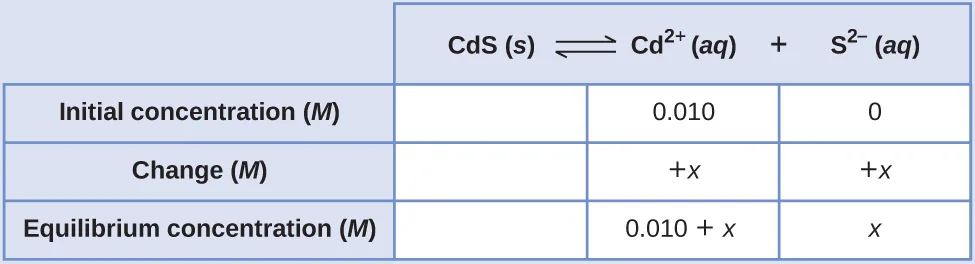
Ksp=[Cd2+][S2-]=1.0×10⁻²⁸
(0.010+x)(x)=1.0×10⁻²⁸
Because Ksp is very small, assume x << 0.010 and solve the simplified equation for x:
(0.010)(x)=1.0×10⁻²⁸
x=1.0×10⁻²⁶M
The molar solubility of CdS in this solution is 1.0 × 10⁻²⁶ M.
Check Your Learning
Calculate the molar solubility of aluminum hydroxide, Al(OH)₃, in a 0.015-M solution of aluminum nitrate, Al(NO₃)₃. The Ksp of Al(OH)₃ is 2 × 10–32.