By now you have progressed from the very informal definition of a limit in the introduction of this chapter to the intuitive understanding of a limit. At this point, you should have a very strong intuitive sense of what the limit of a function means and how you can find it. In this section, we convert this intuitive idea of a limit into a formal definition using precise mathematical language. The formal definition of a limit is quite possibly one of the most challenging definitions you will encounter early in your study of calculus; however, it is well worth any effort you make to reconcile it with your intuitive notion of a limit. Understanding this definition is the key that opens the door to a better understanding of calculus.
Quantifying Closeness
Before stating the formal definition of a limit, we must introduce a few preliminary ideas. Recall that the distance between two points a and b on a number line is given by
- The statement may be interpreted as: The distance between and L is less than ε.
- The statement may be interpreted as: and the distance between x and a is less than δ.
It is also important to look at the following equivalences for absolute value:
- The statement is equivalent to the statement
- The statement is equivalent to the statement and
With these clarifications, we can state the formal epsilon-delta definition of the limit.
This definition may seem rather complex from a mathematical point of view, but it becomes easier to understand if we break it down phrase by phrase. The statement itself involves something called a universal quantifier (for every an existential quantifier (there exists a and, last, a conditional statement (if then Let’s take a look at Table 2.9, which breaks down the definition and translates each part.
| Definition | Translation |
| 1. For every | 1. For every positive distance ε from L, |
| 2. there exists a | 2. There is a positive distance from a, |
| 3. such that | 3. such that |
| 4. if then |
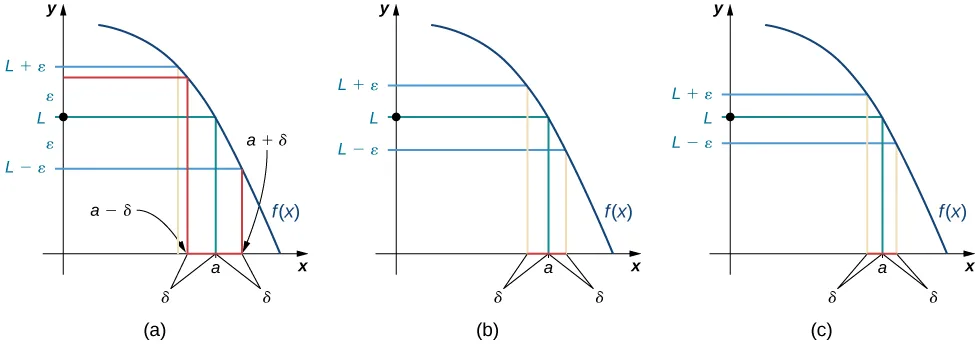
We can get a better handle on this definition by looking at the definition geometrically. Figure 2.39 shows possible values of for various choices of for a given function a number a, and a limit L at a. Notice that as we choose smaller values of ε (the distance between the function and the limit), we can always find a small enough so that if we have chosen an x value within of a, then the value of is within ε of the limit L.
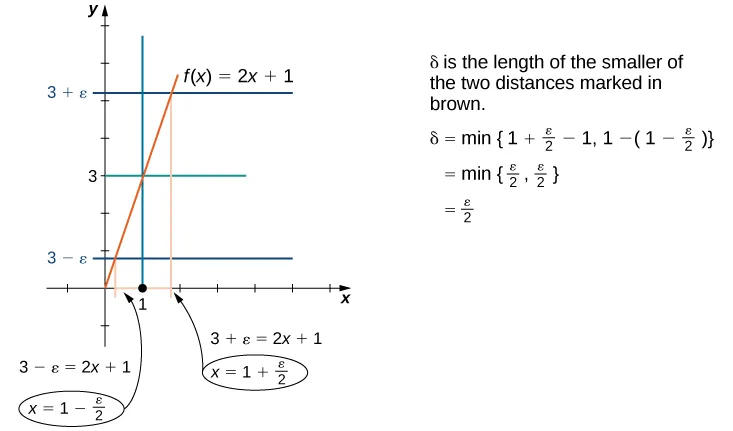
Example 2.39 shows how you can use this definition to prove a statement about the limit of a specific function at a specified value.
The following Problem-Solving Strategy summarizes the type of proof we worked out in Example 2.39.
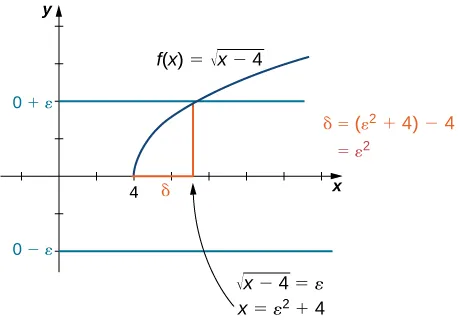
In Example 2.39 and Example 2.40, the proofs were fairly straightforward, since the functions with which we were working were linear. In Example 2.41, we see how to modify the proof to accommodate a nonlinear function.
The geometric approach to proving that the limit of a function takes on a specific value works quite well for some functions. Also, the insight into the formal definition of the limit that this method provides is invaluable. However, we may also approach limit proofs from a purely algebraic point of view. In many cases, an algebraic approach may not only provide us with additional insight into the definition, it may prove to be simpler as well. Furthermore, an algebraic approach is the primary tool used in proofs of statements about limits. For Example 2.42, we take on a purely algebraic approach.
You will find that, in general, the more complex a function, the more likely it is that the algebraic approach is the easiest to apply. The algebraic approach is also more useful in proving statements about limits.
Proving Limit Laws
We now demonstrate how to use the epsilon-delta definition of a limit to construct a rigorous proof of one of the limit laws. The triangle inequality is used at a key point of the proof, so we first review this key property of absolute value.
Proof
We prove the following limit law: If and then
Let
Choose so that if then
Choose so that if then
Choose
Assume
Thus,
Hence,
□
We now explore what it means for a limit not to exist. The limit does not exist if there is no real number L for which Thus, for all real numbers L, To understand what this means, we look at each part of the definition of together with its opposite. A translation of the definition is given in Table 2.10.
| Definition | Opposite |
| 1. For every | 1. There exists so that |
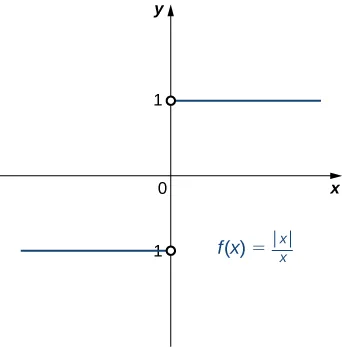
Finally, we may state what it means for a limit not to exist. The limit does not exist if for every real number L, there exists a real number so that for all there is an x satisfying so that Let’s apply this in Example 2.43 to show that a limit does not exist.
One-Sided and Infinite Limits
Just as we first gained an intuitive understanding of limits and then moved on to a more rigorous definition of a limit, we now revisit one-sided limits. To do this, we modify the epsilon-delta definition of a limit to give formal epsilon-delta definitions for limits from the right and left at a point. These definitions only require slight modifications from the definition of the limit. In the definition of the limit from the right, the inequality replaces which ensures that we only consider values of x that are greater than (to the right of) a. Similarly, in the definition of the limit from the left, the inequality replaces which ensures that we only consider values of that are less than (to the left of) .
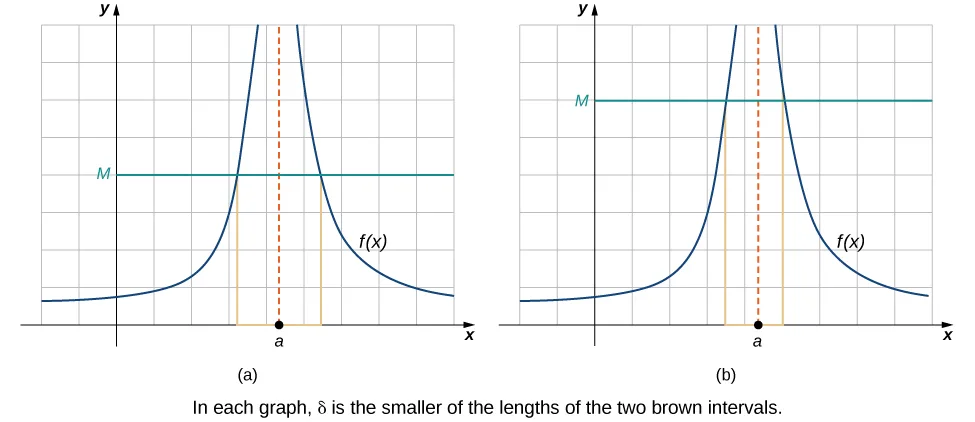
We conclude the process of converting our intuitive ideas of various types of limits to rigorous formal definitions by pursuing a formal definition of infinite limits. To have we want the values of the function to get larger and larger as x approaches a. Instead of the requirement that for arbitrarily small when for small enough we want for arbitrarily large positive when for small enough Figure 2.43 illustrates this idea by showing the value of for successively larger values of .
Key Concepts
- The intuitive notion of a limit may be converted into a rigorous mathematical definition known as the epsilon-delta definition of the limit.
- The epsilon-delta definition may be used to prove statements about limits.
- The epsilon-delta definition of a limit may be modified to define one-sided limits.