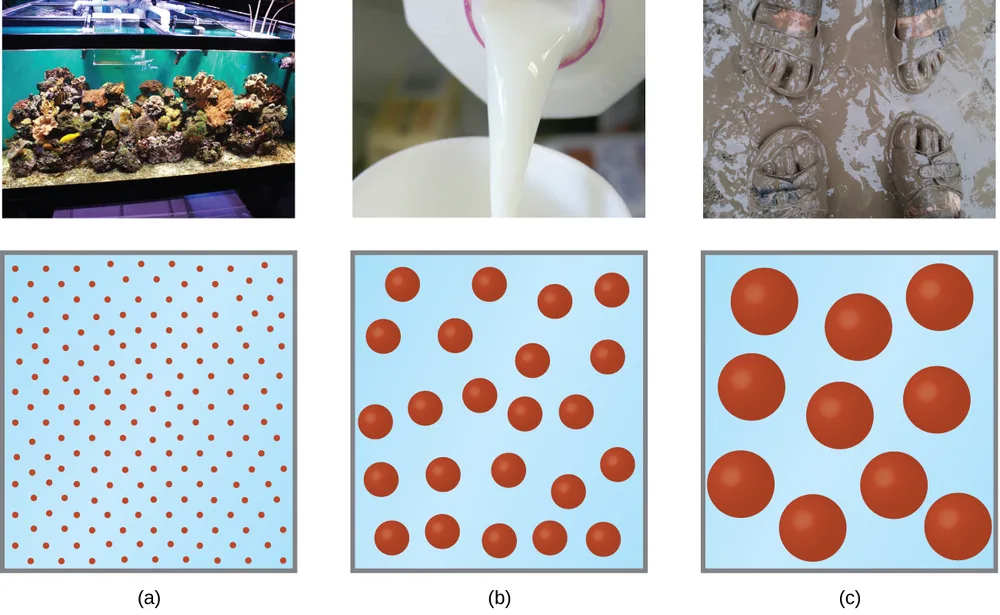
As a child, you may have made suspensions such as mixtures of mud and water, flour and water, or a suspension of solid pigments in water, known as tempera paint. These suspensions are heterogeneous mixtures composed of relatively large particles that are visible (or that can be seen with a magnifying glass). They are cloudy, and the suspended particles settle out after mixing. On the other hand, a solution is a homogeneous mixture in which no settling occurs and in which the dissolved species are molecules or ions. Solutions exhibit completely different behavior from suspensions. A solution may be colored, but it is transparent, the molecules or ions are invisible, and they do not settle out on standing. Another class of mixtures called colloids (or colloidal dispersions) exhibit properties intermediate between those of suspensions and solutions (Figure 11.29). The particles in a colloid are larger than most simple molecules; however, colloidal particles are small enough that they do not settle out upon standing.
The particles in a colloid are large enough to scatter light, a phenomenon called the Tyndall effect. This can make colloidal mixtures appear cloudy or opaque, such as the searchlight beams shown in Figure 11.30. Clouds are colloidal mixtures. They are composed of water droplets that are much larger than molecules, but that are small enough that they do not settle out.

The term “colloid”—from the Greek words kolla, meaning “glue,” and eidos, meaning “like”—was first used in 1861 by Thomas Graham to classify mixtures such as starch in water and gelatin. Many colloidal particles are aggregates of hundreds or thousands of molecules, but others (such as proteins and polymer molecules) consist of a single extremely large molecule. The protein and synthetic polymer molecules that form colloids may have molecular masses ranging from a few thousand to many million atomic mass units.
Analogous to the identification of solution components as “solute” and “solvent,” the components of a colloid are likewise classified according to their relative amounts. The particulate component typically present in a relatively minor amount is called the dispersed phase and the substance or solution throughout which the particulate is dispersed is called the dispersion medium. Colloids may involve virtually any combination of physical states (gas in liquid, liquid in solid, solid in gas, etc.), as illustrated by the examples of colloidal systems given in Table 11.4.
| Examples of Colloidal Systems | |||
| Dispersed Phase | Dispersion Medium | Common Examples | Name |
| solid | gas | smoke, dust | — |
| solid | liquid | starch in water, some inks, paints, milk of magnesia | sol |
| solid | solid | some colored gems, some alloys | — |
| liquid | gas | clouds, fogs, mists, sprays | aerosol |
| liquid | liquid | milk, mayonnaise, butter | emulsion |
| liquid | solid | jellies, gels, pearl, opal (H₂O in SiO₂) |
Preparation of Colloidal Systems
Colloids are prepared by producing particles of colloidal dimensions and distributing these particles throughout a dispersion medium. Particles of colloidal size are formed by two methods:
- Dispersion methods: breaking down larger particles. For example, paint pigments are produced by dispersing large particles by grinding in special mills.
- Condensation methods: growth from smaller units, such as molecules or ions. For example, clouds form when water molecules condense and form very small droplets.
A few solid substances, when brought into contact with water, disperse spontaneously and form colloidal systems. Gelatin, glue, starch, and dehydrated milk powder behave in this manner. The particles are already of colloidal size; the water simply disperses them. Powdered milk particles of colloidal size are produced by dehydrating milk spray. Some atomizers produce colloidal dispersions of a liquid in air.
An emulsion may be prepared by shaking together or blending two immiscible liquids. This breaks one liquid into droplets of colloidal size, which then disperse throughout the other liquid. Oil spills in the ocean may be difficult to clean up, partly because wave action can cause the oil and water to form an emulsion. In many emulsions, however, the dispersed phase tends to coalesce, form large drops, and separate. Therefore, emulsions are usually stabilized by an emulsifying agent, a substance that inhibits the coalescence of the dispersed liquid. For example, a little soap will stabilize an emulsion of kerosene in water. Milk is an emulsion of butterfat in water, with the protein casein serving as the emulsifying agent. Mayonnaise is an emulsion of oil in vinegar, with egg yolk components as the emulsifying agents.
Condensation methods form colloidal particles by aggregation of molecules or ions. If the particles grow beyond the colloidal size range, drops or precipitates form, and no colloidal system results. Clouds form when water molecules aggregate and form colloid-sized particles. If these water particles coalesce to form adequately large water drops of liquid water or crystals of solid water, they settle from the sky as rain, sleet, or snow. Many condensation methods involve chemical reactions. A red colloidal suspension of iron(III) hydroxide may be prepared by mixing a concentrated solution of iron(III) chloride with hot water:
A colloidal gold sol results from the reduction of a very dilute solution of gold(III) chloride by a reducing agent such as formaldehyde, tin(II) chloride, or iron(II) sulfate:
Some gold sols prepared in 1857 are still intact (the particles have not coalesced and settled), illustrating the long-term stability of many colloids.
Soaps and Detergents
Pioneers made soap by boiling fats with a strongly basic solution made by leaching potassium carbonate, K₂CO₃, from wood ashes with hot water. Animal fats contain polyesters of fatty acids (long-chain carboxylic acids). When animal fats are treated with a base like potassium carbonate or sodium hydroxide, glycerol and salts of fatty acids such as palmitic, oleic, and stearic acid are formed. The salts of fatty acids are called soaps. The sodium salt of stearic acid, sodium stearate, has the formula C₁₇H₃₅CO₂Na and contains an uncharged nonpolar hydrocarbon chain, the C₁₇H₃₅— unit, and an ionic carboxylate group, the — unit (Figure 11.31).

Detergents (soap substitutes) also contain nonpolar hydrocarbon chains, such as C₁₂H₂₅—, and an ionic group, such as a sulfate— or a sulfonate— (Figure 11.32). Soaps form insoluble calcium and magnesium compounds in hard water; detergents form water-soluble products—a definite advantage for detergents.

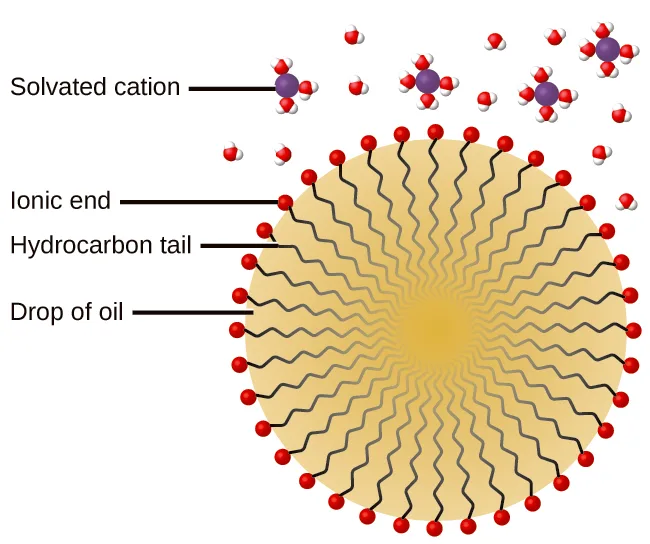
The cleaning action of soaps and detergents can be explained in terms of the structures of the molecules involved. The hydrocarbon (nonpolar) end of a soap or detergent molecule dissolves in, or is attracted to, nonpolar substances such as oil, grease, or dirt particles. The ionic end is attracted by water (polar), illustrated in Figure 11.33. As a result, the soap or detergent molecules become oriented at the interface between the dirt particles and the water so they act as a kind of bridge between two different kinds of matter, nonpolar and polar. Molecules such as this are termed amphiphilic since they have both a hydrophobic (“water-fearing”) part and a hydrophilic (“water-loving”) part. As a consequence, dirt particles become suspended as colloidal particles and are readily washed away.
Electrical Properties of Colloidal Particles
Dispersed colloidal particles are often electrically charged. A colloidal particle of iron(III) hydroxide, for example, does not contain enough hydroxide ions to compensate exactly for the positive charges on the iron(III) ions. Thus, each individual colloidal particle bears a positive charge, and the colloidal dispersion consists of charged colloidal particles and some free hydroxide ions, which keep the dispersion electrically neutral. Most metal hydroxide colloids have positive charges, whereas most metals and metal sulfides form negatively charged dispersions. All colloidal particles in any one system have charges of the same sign. This helps keep them dispersed because particles containing like charges repel each other.
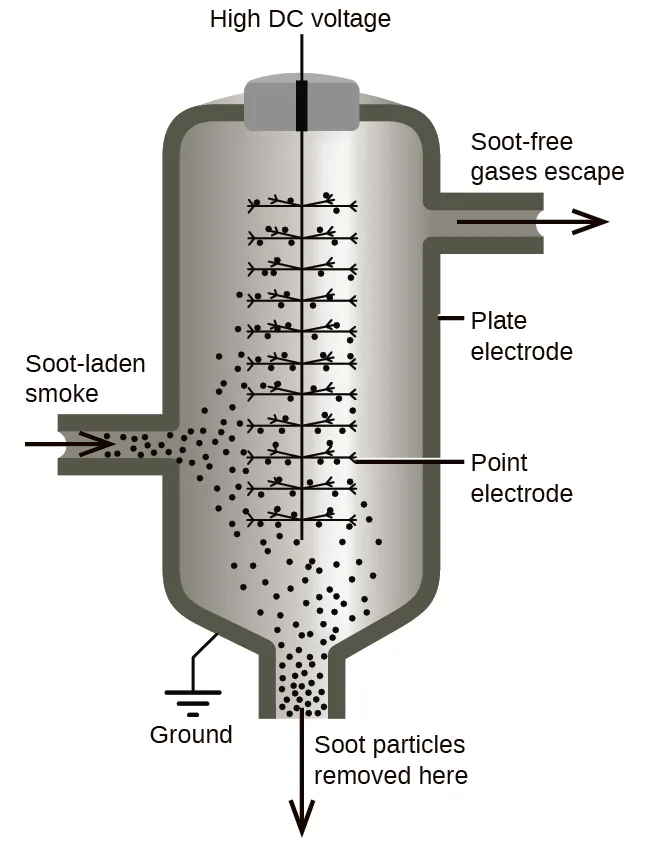
The charged nature of some colloidal particles may be exploited to remove them from a variety of mixtures. For example, the particles comprising smoke are often colloidally dispersed and electrically charged. Frederick Cottrell, an American chemist, developed a process to remove these particles. The charged particles are attracted to highly charged electrodes, where they are neutralized and deposited as dust (Figure 11.36). This is one of the important methods used to clean up the smoke from a variety of industrial processes. The process is also important in the recovery of valuable products from the smoke and flue dust of smelters, furnaces, and kilns. There are also similar electrostatic air filters designed for home use to improve indoor air quality.
Gels
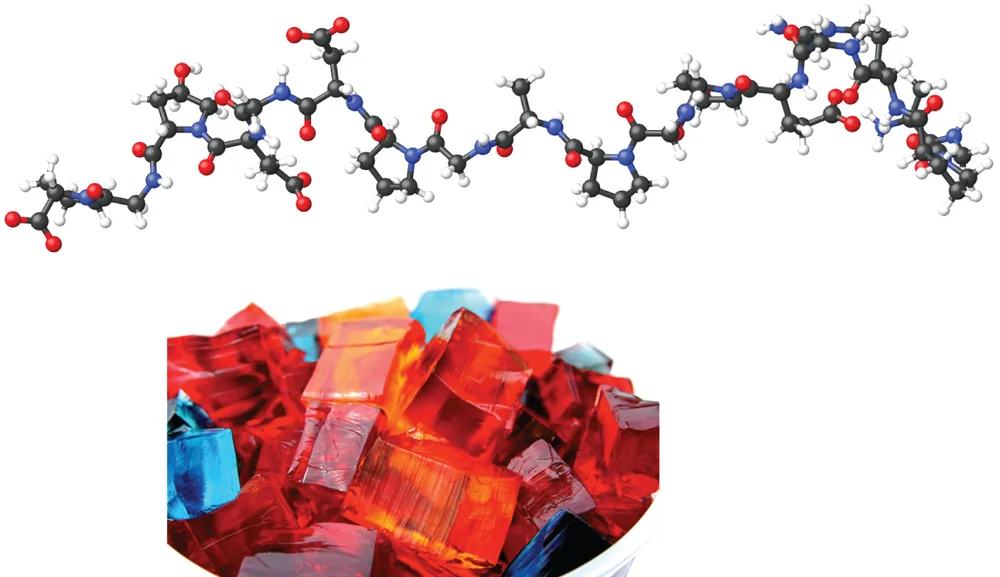
Gelatin desserts, such as Jell-O, are a type of colloid (Figure 11.37). Gelatin sets on cooling because the hot aqueous mixture of gelatin coagulates as it cools, yielding an extremely viscous body known as a gel. A gel is a colloidal dispersion of a liquid phase throughout a solid phase. It appears that the fibers of the dispersing medium form a complex three-dimensional network, the interstices being filled with the liquid medium or a dilute solution of the dispersing medium.
Pectin, a carbohydrate from fruit juices, is a gel-forming substance important in jelly making. Silica gel, a colloidal dispersion of hydrated silicon dioxide, is formed when dilute hydrochloric acid is added to a dilute solution of sodium silicate. Canned Heat is a flammable gel made by mixing alcohol and a saturated aqueous solution of calcium acetate.
Key Concepts and Summary
Colloids are mixtures in which one or more substances are dispersed as relatively large solid particles or liquid droplets throughout a solid, liquid, or gaseous medium. The particles of a colloid remain dispersed and do not settle due to gravity, and they are often electrically charged. Colloids are widespread in nature and are involved in many technological applications.