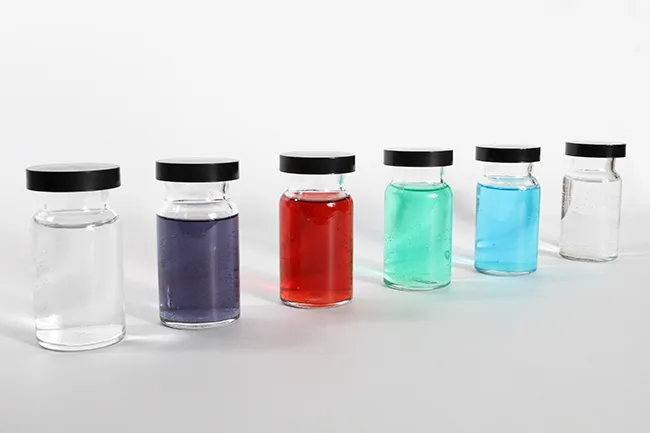
The hemoglobin in your blood, the chlorophyll in green plants, vitamin B-12, and the catalyst used in the manufacture of polyethylene all contain coordination compounds. Ions of the metals, especially the transition metals, are likely to form complexes. Many of these compounds are highly colored (Figure 19.12). In the remainder of this chapter, we will consider the structure and bonding of these remarkable compounds.
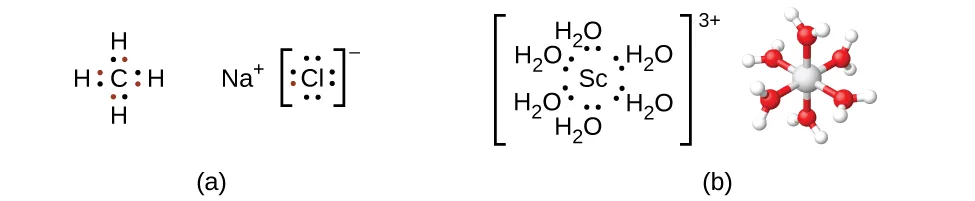
Remember that in most main group element compounds, the valence electrons of the isolated atoms combine to form chemical bonds that satisfy the octet rule. For instance, the four valence electrons of carbon overlap with electrons from four hydrogen atoms to form CH₄. The one valence electron leaves sodium and adds to the seven valence electrons of chlorine to form the ionic formula unit NaCl (Figure 19.13). Transition metals do not normally bond in this fashion. They primarily form coordinate covalent bonds, a form of the Lewis acid-base interaction in which both of the electrons in the bond are contributed by a donor (Lewis base) to an electron acceptor (Lewis acid). The Lewis acid in coordination complexes, often called a central metal ion (or atom), is often a transition metal or inner transition metal, although main group elements can also form coordination compounds. The Lewis base donors, called ligands, can be a wide variety of chemicals—atoms, molecules, or ions. The only requirement is that they have one or more electron pairs, which can be donated to the central metal. Most often, this involves a donor atom with a lone pair of electrons that can form a coordinate bond to the metal.
The coordination sphere consists of the central metal ion or atom plus its attached ligands. Brackets in a formula enclose the coordination sphere; species outside the brackets are not part of the coordination sphere. The coordination number of the central metal ion or atom is the number of donor atoms bonded to it. The coordination number for the silver ion in [Ag(NH₃)₂]⁺ is two (Figure 19.14). For the copper(II) ion in [CuCl₄]²⁻, the coordination number is four, whereas for the cobalt(II) ion in [Co(H₂O)₆]²⁺ the coordination number is six. Each of these ligands is monodentate, from the Greek for “one toothed,” meaning that they connect with the central metal through only one atom. In this case, the number of ligands and the coordination number are equal.

Many other ligands coordinate to the metal in more complex fashions. Bidentate ligands are those in which two atoms coordinate to the metal center. For example, ethylenediamine (en, H₂NCH₂CH₂NH₂) contains two nitrogen atoms, each of which has a lone pair and can serve as a Lewis base (Figure 19.15). Both of the atoms can coordinate to a single metal center. In the complex [Co(en)₃]³⁺, there are three bidentate en ligands, and the coordination number of the cobalt(III) ion is six. The most common coordination numbers are two, four, and six, but examples of all coordination numbers from 1 to 15 are known.
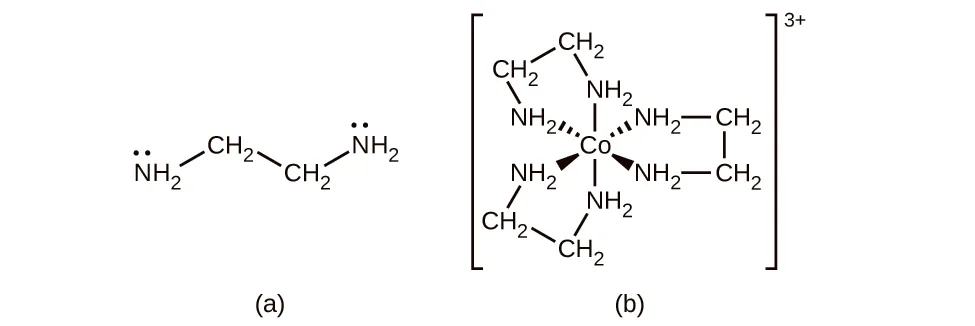
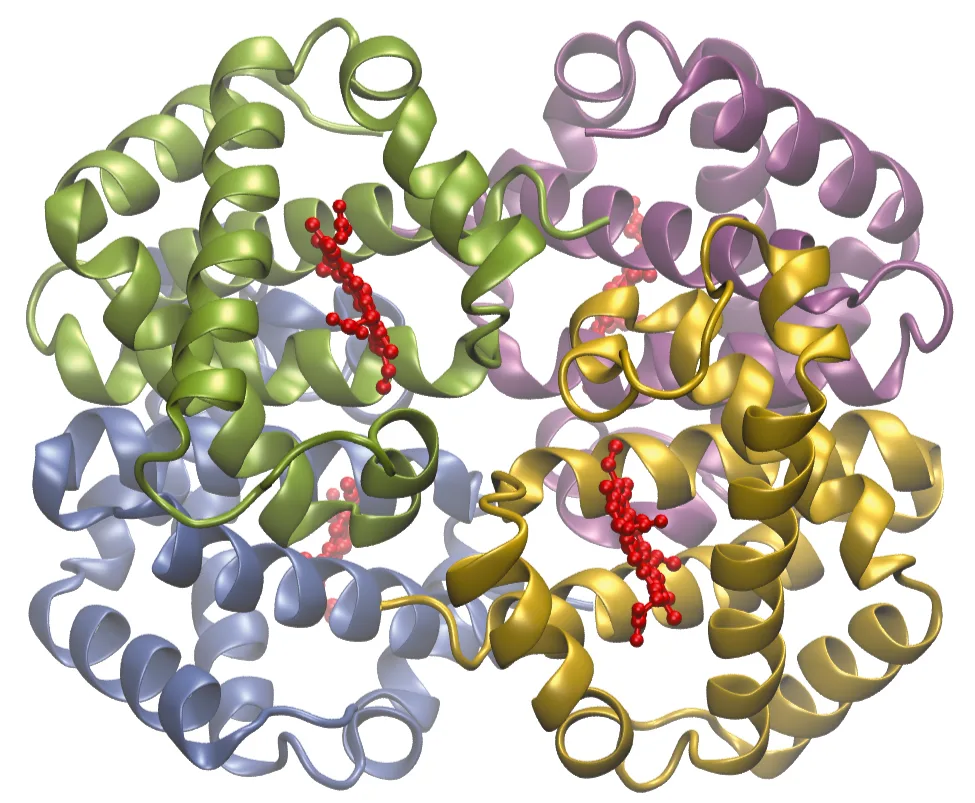
Any ligand that bonds to a central metal ion by more than one donor atom is a polydentate ligand (or “many teeth”) because it can bite into the metal center with more than one bond. The term chelate (pronounced “KEY-late”) from the Greek for “claw” is also used to describe this type of interaction. Many polydentate ligands are chelating ligands, and a complex consisting of one or more of these ligands and a central metal is a chelate. A chelating ligand is also known as a chelating agent. A chelating ligand holds the metal ion rather like a crab’s claw would hold a marble. Figure 19.15 showed one example of a chelate. The heme complex in hemoglobin is another important example (Figure 19.16). It contains a polydentate ligand with four donor atoms that coordinate to iron.
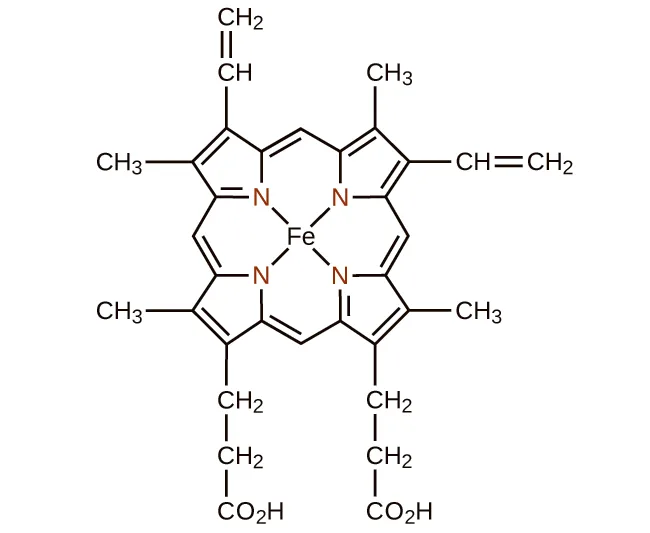
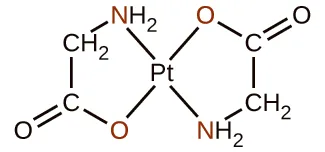
Polydentate ligands are sometimes identified with prefixes that indicate the number of donor atoms in the ligand. As we have seen, ligands with one donor atom, such as NH₃, Cl⁻, and H₂O, are monodentate ligands. Ligands with two donor groups are bidentate ligands. Ethylenediamine, H₂NCH₂CH₂NH₂, and the anion of the acid glycine, (Figure 19.17) are examples of bidentate ligands. Tridentate ligands, tetradentate ligands, pentadentate ligands, and hexadentate ligands contain three, four, five, and six donor atoms, respectively. The ligand in heme (Figure 19.16) is a tetradentate ligand.
The Naming of Complexes
The nomenclature of the complexes is patterned after a system suggested by Alfred Werner, a Swiss chemist and Nobel laureate, whose outstanding work more than 100 years ago laid the foundation for a clearer understanding of these compounds. The following five rules are used for naming complexes:
- If a coordination compound is ionic, name the cation first and the anion second, in accordance with the usual nomenclature.
- Name the ligands first, followed by the central metal. Name the ligands alphabetically. Negative ligands (anions) have names formed by adding -o to the stem name of the group. For examples, see Table 19.1. For most neutral ligands, the name of the molecule is used. The four common exceptions are aqua (H₂O), ammine (NH₃), carbonyl (CO), and nitrosyl (NO). For example, name [Pt(NH₃)₂Cl₄] as diamminetetrachloroplatinum(IV).
- If more than one ligand of a given type is present, the number is indicated by the prefixes di- (for two), tri- (for three), tetra- (for four), penta- (for five), and hexa- (for six). Sometimes, the prefixes bis- (for two), tris- (for three), and tetrakis- (for four) are used when the name of the ligand already includes di-, tri-, or tetra-, or when the ligand name begins with a vowel. For example, the ion bis(bipyridyl)osmium(II) uses bis- to signify that there are two ligands attached to Os, and each bipyridyl ligand contains two pyridine groups (C₅H₄N).
When the complex is either a cation or a neutral molecule, the name of the central metal atom is spelled exactly like the name of the element and is followed by a Roman numeral in parentheses to indicate its oxidation state (Table 19.2 and Table 19.3). When the complex is an anion, the suffix -ate is added to the stem of the name of the metal, followed by the Roman numeral designation of its oxidation state (Table 19.4). Sometimes, the Latin name of the metal is used when the English name is clumsy. For example, ferrate is used instead of ironate, plumbate instead leadate, and stannate instead of tinate. The oxidation state of the metal is determined based on the charges of each ligand and the overall charge of the coordination compound. For example, in [Cr(H₂O)₄Cl₂]Br, the coordination sphere (in brackets) has a charge of 1+ to balance the bromide ion. The water ligands are neutral, and the chloride ligands are anionic with a charge of 1− each. To determine the oxidation state of the metal, we set the overall charge equal to the sum of the ligands and the metal: +1 = −2 + x, so the oxidation state (x) is equal to 3+.
| Examples in Which the Complex Is a Cation | |
| [Co(NH₃)₆]Cl₃ | hexaamminecobalt(III) chloride |
| [Pt(NH₃)₄Cl₂]²⁺ | tetraamminedichloroplatinum(IV) ion |
| [Ag(NH₃)₂]⁺ | diamminesilver(I) ion |
| [Cr(H₂O)₄Cl₂]Cl | tetraaquadichlorochromium(III) chloride |
| [Co(H₂NCH₂CH₂NH₂)₃]₂(SO₄)₃ | tris(ethylenediamine)cobalt(III) sulfate |
| Examples in Which the Complex Is Neutral | |
| [Pt(NH₃)₂Cl₄] | diamminetetrachloroplatinum(IV) |
| [Ni(H₂NCH₂CH₂NH₂)₂Cl₂] | dichlorobis(ethylenediamine)nickel(II) |
| Examples in Which the Complex Is an Anion | |
| [PtCl₆]²⁻ | hexachloroplatinate(IV) ion |
| Na₂[SnCl₆] | sodium hexachlorostannate(IV) |
The Structures of Complexes
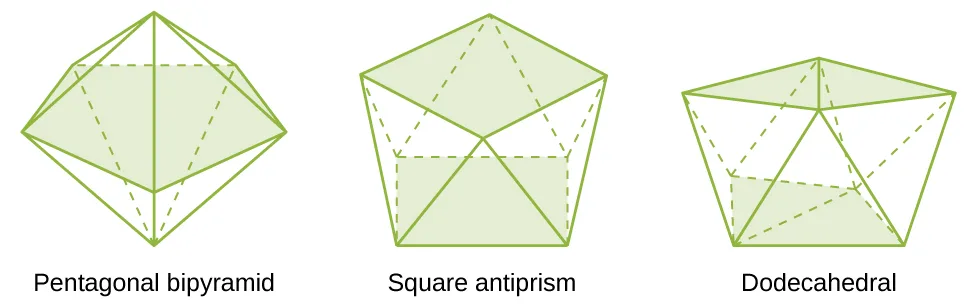
For transition metal complexes, the coordination number determines the geometry around the central metal ion. The most common structures of the complexes in coordination compounds are square planar, tetrahedral, and octahedral, corresponding to coordination numbers of four, four, and six, respectively. Coordination numbers greater than six are less common and yield a variety of structures (see Figure 19.18 and Table 19.5):
| Coordination Numbers and Molecular Geometry | ||
| Coordination Number | Molecular Geometry | Example |
| 2 | linear | [Ag(NH₃)₂]⁺ |
| 3 | trigonal planar | [Cu(CN)₃]²⁻ |
| 4 | tetrahedral(d⁰ or d¹⁰), low oxidation states for M | [Ni(CO)₄] |
| 4 | square planar (d⁸) | [Ni(CN)₄]²⁻ |
| 5 | trigonal bipyramidal | [CoCl₅]²⁻ |
| 5 | square pyramidal | [VO(CN)₄]²⁻ |
| 6 | octahedral | [CoCl₆]³⁻ |
| 7 | pentagonal bipyramid |
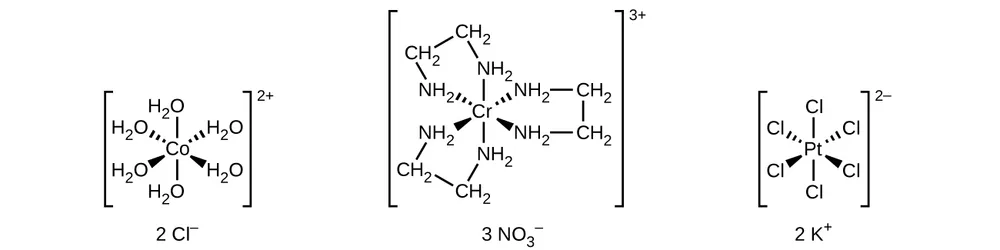
Unlike main group atoms in which both the bonding and nonbonding electrons determine the molecular shape, the nonbonding d-electrons do not change the arrangement of the ligands. Octahedral complexes have a coordination number of six, and the six donor atoms are arranged at the corners of an octahedron around the central metal ion. Examples are shown in Figure 19.19. The chloride and nitrate anions in [Co(H₂O)₆]Cl₂ and [Cr(en)₃](NO₃)₃, and the potassium cations in K₂[PtCl₆], are outside the brackets and are not bonded to the metal ion.
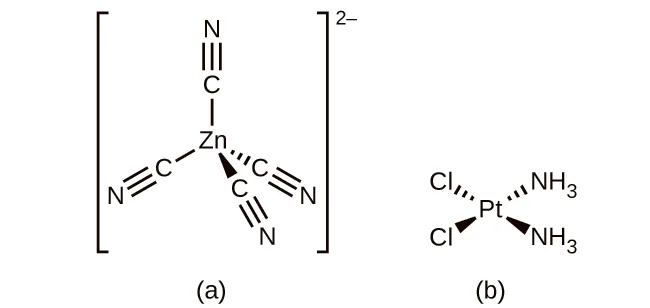
For transition metals with a coordination number of four, two different geometries are possible: tetrahedral or square planar. Unlike main group elements, where these geometries can be predicted from VSEPR theory, a more detailed discussion of transition metal orbitals (discussed in the section on Crystal Field Theory) is required to predict which complexes will be tetrahedral and which will be square planar. In tetrahedral complexes such as [Zn(CN)₄]²⁻ (Figure 19.20), each of the ligand pairs forms an angle of 109.5°. In square planar complexes, such as [Pt(NH₃)₂Cl₂], each ligand has two other ligands at 90° angles (called the cis positions) and one additional ligand at an 180° angle, in the trans position.
Isomerism in Complexes
Isomers are different chemical species that have the same chemical formula. Transition metal complexes often exist as geometric isomers, in which the same atoms are connected through the same types of bonds but with differences in their orientation in space. Coordination complexes with two different ligands in the cis and trans positions from a ligand of interest form isomers. For example, the octahedral [Co(NH₃)₄Cl₂]⁺ ion has two isomers. In the cis configuration, the two chloride ligands are adjacent to each other (Figure 19.21). The other isomer, the trans configuration, has the two chloride ligands directly across from one another.
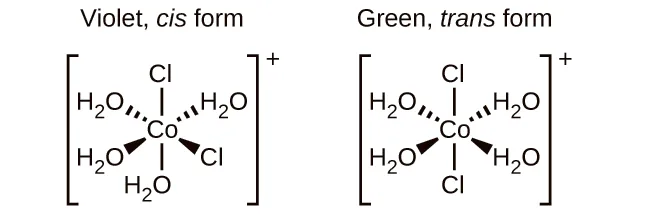
Different geometric isomers of a substance are different chemical compounds. They exhibit different properties, even though they have the same formula. For example, the two isomers of [Co(NH₃)₄Cl₂]NO₃ differ in color; the cis form is violet, and the trans form is green. Furthermore, these isomers have different dipole moments, solubilities, and reactivities. As an example of how the arrangement in space can influence the molecular properties, consider the polarity of the two [Co(NH₃)₄Cl₂]NO₃ isomers. Remember that the polarity of a molecule or ion is determined by the bond dipoles (which are due to the difference in electronegativity of the bonding atoms) and their arrangement in space. In one isomer, cis chloride ligands cause more electron density on one side of the molecule than on the other, making it polar. For the trans isomer, each ligand is directly across from an identical ligand, so the bond dipoles cancel out, and the molecule is nonpolar.
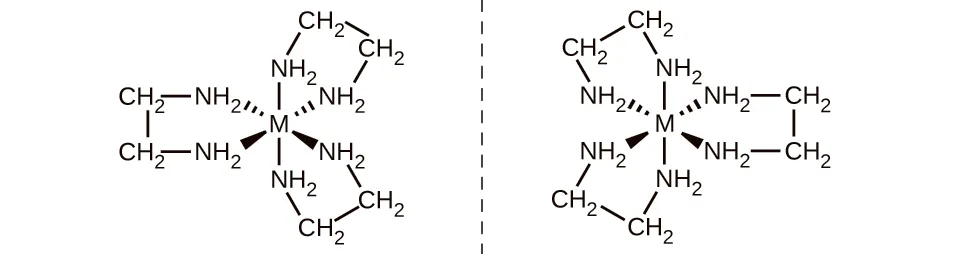
Another important type of isomers are optical isomers, or enantiomers, in which two objects are exact mirror images of each other but cannot be lined up so that all parts match. This means that optical isomers are nonsuperimposable mirror images. A classic example of this is a pair of hands, in which the right and left hand are mirror images of one another but cannot be superimposed. Optical isomers are very important in organic and biochemistry because living systems often incorporate one specific optical isomer and not the other. Unlike geometric isomers, pairs of optical isomers have identical properties (boiling point, polarity, solubility, etc.). Optical isomers differ only in the way they affect polarized light and how they react with other optical isomers. For coordination complexes, many coordination compounds such as [M(en)₃] [in which M is a central metal ion such as iron(III) or cobalt(II)] form enantiomers, as shown in Figure 19.23. These two isomers will react differently with other optical isomers. For example, DNA helices are optical isomers, and the form that occurs in nature (right-handed DNA) will bind to only one isomer of [M(en)₃] and not the other.
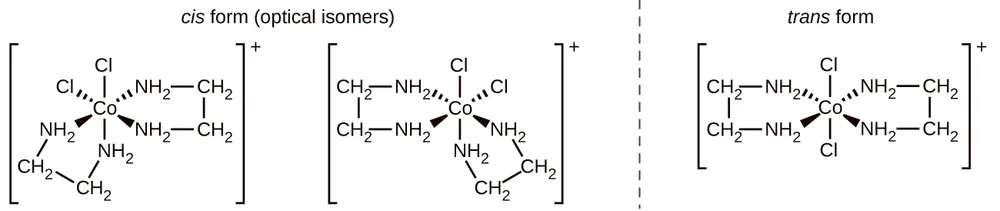
The [Co(en)₂Cl₂]⁺ ion exhibits geometric isomerism (cis/trans), and its cis isomer exists as a pair of optical isomers (Figure 19.24).
Linkage isomers occur when the coordination compound contains a ligand that can bind to the transition metal center through two different atoms. For example, the CN ligand can bind through the carbon atom (cyano) or through the nitrogen atom (isocyano). Similarly, SCN− can be bound through the sulfur or nitrogen atom, affording two distinct compounds ([Co(NH₃)₅SCN]²⁺ or [Co(NH₃)₅NCS]²⁺).
Ionization isomers (or coordination isomers) occur when one anionic ligand in the inner coordination sphere is replaced with the counter ion from the outer coordination sphere. A simple example of two ionization isomers are [CoCl₆][Br] and [CoCl₅Br][Cl].
Coordination Complexes in Nature and Technology
Chlorophyll, the green pigment in plants, is a complex that contains magnesium (Figure 19.25). This is an example of a main group element in a coordination complex. Plants appear green because chlorophyll absorbs red and purple light; the reflected light consequently appears green. The energy resulting from the absorption of light is used in photosynthesis.
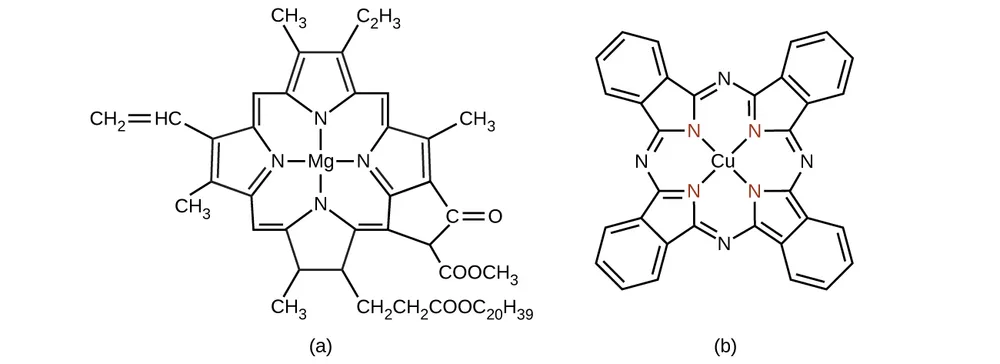
Many other coordination complexes are also brightly colored. The square planar copper(II) complex phthalocyanine blue (from Figure 19.25) is one of many complexes used as pigments or dyes. This complex is used in blue ink, blue jeans, and certain blue paints.
The structure of heme (Figure 19.29), the iron-containing complex in hemoglobin, is very similar to that in chlorophyll. In hemoglobin, the red heme complex is bonded to a large protein molecule (globin) by the attachment of the protein to the heme ligand. Oxygen molecules are transported by hemoglobin in the blood by being bound to the iron center. When the hemoglobin loses its oxygen, the color changes to a bluish red. Hemoglobin will only transport oxygen if the iron is Fe²⁺; oxidation of the iron to Fe³⁺ prevents oxygen transport.
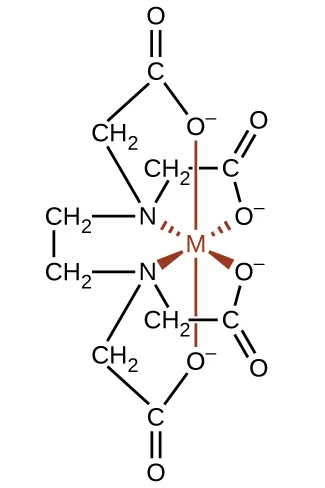
Complexing agents often are used for water softening because they tie up such ions as Ca²⁺, Mg²⁺, and Fe²⁺, which make water hard. Many metal ions are also undesirable in food products because these ions can catalyze reactions that change the color of food. Coordination complexes are useful as preservatives. For example, the ligand EDTA, (HO₂CCH₂)₂NCH₂CH₂N(CH₂CO₂H)₂, coordinates to metal ions through six donor atoms and prevents the metals from reacting (Figure 19.30). This ligand also is used to sequester metal ions in paper production, textiles, and detergents, and has pharmaceutical uses.
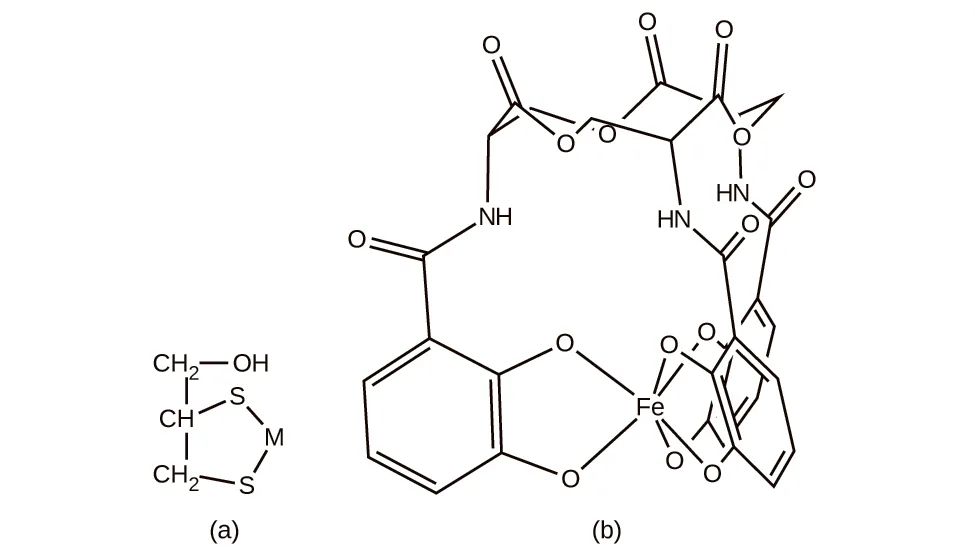
Complexing agents that tie up metal ions are also used as drugs. British Anti-Lewisite (BAL), HSCH₂CH(SH)CH₂OH, is a drug developed during World War I as an antidote for the arsenic-based war gas Lewisite. BAL is now used to treat poisoning by heavy metals, such as arsenic, mercury, thallium, and chromium. The drug is a ligand and functions by making a water-soluble chelate of the metal; the kidneys eliminate this metal chelate (Figure 19.31). Another polydentate ligand, enterobactin, which is isolated from certain bacteria, is used to form complexes of iron and thereby to control the severe iron buildup found in patients suffering from blood diseases such as Cooley’s anemia, who require frequent transfusions. As the transfused blood breaks down, the usual metabolic processes that remove iron are overloaded, and excess iron can build up to fatal levels. Enterobactin forms a water-soluble complex with excess iron, and the body can safely eliminate this complex.
Ligands are also used in the electroplating industry. When metal ions are reduced to produce thin metal coatings, metals can clump together to form clusters and nanoparticles. When metal coordination complexes are used, the ligands keep the metal atoms isolated from each other. It has been found that many metals plate out as a smoother, more uniform, better-looking, and more adherent surface when plated from a bath containing the metal as a complex ion. Thus, complexes such as [Ag(CN)₂]⁻ and [Au(CN)₂]⁻ are used extensively in the electroplating industry.
In 1965, scientists at Michigan State University discovered that there was a platinum complex that inhibited cell division in certain microorganisms. Later work showed that the complex was cis-diamminedichloroplatinum(II), [Pt(NH₃)₂(Cl)₂], and that the trans isomer was not effective. The inhibition of cell division indicated that this square planar compound could be an anticancer agent. In 1978, the US Food and Drug Administration approved this compound, known as cisplatin, for use in the treatment of certain forms of cancer. Since that time, many similar platinum compounds have been developed for the treatment of cancer. In all cases, these are the cis isomers and never the trans isomers. The diammine (NH₃)₂ portion is retained with other groups, replacing the dichloro [(Cl)₂] portion. The newer drugs include carboplatin, oxaliplatin, and satraplatin.
Key Concepts and Summary
The transition elements and main group elements can form coordination compounds, or complexes, in which a central metal atom or ion is bonded to one or more ligands by coordinate covalent bonds. Ligands with more than one donor atom are called polydentate ligands and form chelates. The common geometries found in complexes are tetrahedral and square planar (both with a coordination number of four) and octahedral (with a coordination number of six). Cis and trans configurations are possible in some octahedral and square planar complexes. In addition to these geometrical isomers, optical isomers (molecules or ions that are mirror images but not superimposable) are possible in certain octahedral complexes. Coordination complexes have a wide variety of uses including oxygen transport in blood, water purification, and pharmaceutical use.