For the following exercises, for each pair of points, a. find the slope of the line passing through the points and b. indicate whether the line is increasing, decreasing, horizontal, or vertical.
and
Preparing your lesson…正在准备你的课程…正在準備你的課程…Preparando tu lección…Préparation de votre leçon…Deine Lektion wird vorbereitet…Sto preparando la tua lezione…Preparando sua aula…レッスンを準備しています…수업을 준비하고 있어요…Menyediakan pelajaran anda…Menyiapkan pelajaranmu…
Preparing your lesson…正在准备你的课程…正在準備你的課程…Preparando tu lección…Préparation de votre leçon…Deine Lektion wird vorbereitet…Sto preparando la tua lezione…Preparando sua aula…レッスンを準備しています…수업을 준비하고 있어요…Menyediakan pelajaran anda…Menyiapkan pelajaranmu…
Calculus Volume 1 · 1.2 Basic Classes of Functions
28 problems from the book, with its answers. Check your working, or have any of them explained to you on the whiteboard.
Exercises 59
For the following exercises, for each pair of points, a. find the slope of the line passing through the points and b. indicate whether the line is increasing, decreasing, horizontal, or vertical.
and
Exercises 61
For the following exercises, for each pair of points, a. find the slope of the line passing through the points and b. indicate whether the line is increasing, decreasing, horizontal, or vertical.
and
Exercises 63
Exercises 65
Exercises 67
Exercises 69
Exercises 71
Exercises 73
Exercises 75
Exercises 77
Exercises 79
Exercises 81
Exercises 83
Exercises 85
Exercises 87
Exercises 89
Exercises 91
Exercises 93
Exercises 95
Exercises 97
Exercises 99
Exercises 101
Exercises 103
Exercises 105
Exercises 107
Exercises 109
Exercises 111
Review Exercises 319
The tutor teaches the whole section, drawing it out step by step and answering your questions as you go.
For the following exercises, for each pair of points, a. find the slope of the line passing through the points and b. indicate whether the line is increasing, decreasing, horizontal, or vertical.
and
For the following exercises, for each pair of points, a. find the slope of the line passing through the points and b. indicate whether the line is increasing, decreasing, horizontal, or vertical.
and
For the following exercises, write the equation of the line satisfying the given conditions in slope-intercept form.
Slope passes through
For the following exercises, write the equation of the line satisfying the given conditions in slope-intercept form.
Slope passes through
For the following exercises, write the equation of the line satisfying the given conditions in slope-intercept form.
Passing through and
For the following exercises, write the equation of the line satisfying the given conditions in slope-intercept form.
-intercept and -intercept
For the following exercises, for each linear equation, a. give the slope and -intercept b, if any, and b. graph the line.
For the following exercises, for each linear equation, a. give the slope and -intercept b, if any, and b. graph the line.
For the following exercises, for each linear equation, a. give the slope and -intercept b, if any, and b. graph the line.
For the following exercises, for each linear equation, a. give the slope and -intercept b, if any, and b. graph the line.
For the following exercises, for each polynomial, a. find the degree; b. find the zeros, if any; c. find the -intercept(s), if any; d. use the leading coefficient to determine the graph’s end behavior; and e. determine algebraically whether the polynomial is even, odd, or neither.
For the following exercises, for each polynomial, a. find the degree; b. find the zeros, if any; c. find the -intercept(s), if any; d. use the leading coefficient to determine the graph’s end behavior; and e. determine algebraically whether the polynomial is even, odd, or neither.
For the following exercises, for each polynomial, a. find the degree; b. find the zeros, if any; c. find the -intercept(s), if any; d. use the leading coefficient to determine the graph’s end behavior; and e. determine algebraically whether the polynomial is even, odd, or neither.
For the following exercises, use the graph of to graph each transformed function
For the following exercises, use the graph of to graph each transformed function
For the following exercises, use the graph of to graph each transformed function
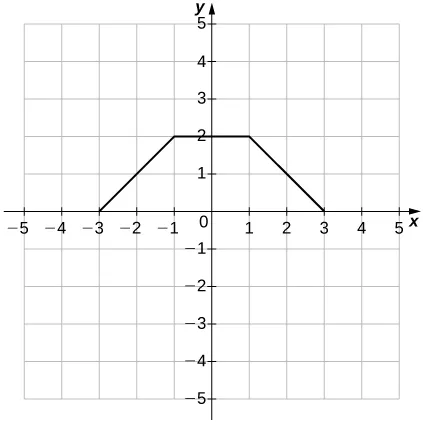
For the following exercises, for each of the piecewise-defined functions, a. evaluate at the given values of the independent variable and b. sketch the graph.
For the following exercises, for each of the piecewise-defined functions, a. evaluate at the given values of the independent variable and b. sketch the graph.
For the following exercises, determine whether the statement is true or false. Explain why.
is an odd root function
For the following exercises, determine whether the statement is true or false. Explain why.
A function of the form where is a real valued constant, is an exponential function.
For the following exercises, determine whether the statement is true or false. Explain why.
[T] A company purchases some computer equipment for $20,500. At the end of a 3-year period, the value of the equipment has decreased linearly to $12,300.
For the following exercises, determine whether the statement is true or false. Explain why.
[T] A family bakery makes cupcakes and sells them at local outdoor festivals. For a music festival, there is a fixed cost of $125 to set up a cupcake stand. The owner estimates that it costs $0.75 to make each cupcake. The owner is interested in determining the total cost as a function of number of cupcakes made.
For the following exercises, determine whether the statement is true or false. Explain why.
[T] A car was purchased for $26,000. The value of the car depreciates by $1500 per year.
For the following exercises, determine whether the statement is true or false. Explain why.
[T] The total cost C to produce a certain item is modeled by the function where x is the number of items produced. Determine the cost to produce 175 items.
For the following exercises, determine whether the statement is true or false. Explain why.
[T] The output (as a percent of total capacity) of nuclear power plants in the United States can be modeled by the function where t is time in years and corresponds to the beginning of 2000. Use the model to predict the approximate percentage output at the beginning of 2015.
Find the degree, y-intercept, and zeros for the following polynomial functions.