Predict the products of oxidizing the molecules shown in this problem. In each case, identify the product that will result from the minimal increase in oxidation state for the highlighted carbon atom:
(a)
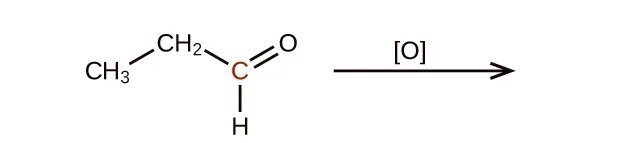
(b)

(c)

Preparing your lesson…正在准备你的课程…正在準備你的課程…Preparando tu lección…Préparation de votre leçon…Deine Lektion wird vorbereitet…Sto preparando la tua lezione…Preparando sua aula…レッスンを準備しています…수업을 준비하고 있어요…Menyediakan pelajaran anda…Menyiapkan pelajaranmu…
Preparing your lesson…正在准备你的课程…正在準備你的課程…Preparando tu lección…Préparation de votre leçon…Deine Lektion wird vorbereitet…Sto preparando la tua lezione…Preparando sua aula…レッスンを準備しています…수업을 준비하고 있어요…Menyediakan pelajaran anda…Menyiapkan pelajaranmu…
Chemistry 2e · 20.3 Aldehydes, Ketones, Carboxylic Acids, and Esters
7 problems from the book, with its answers. Check your working, or have any of them explained to you on the whiteboard.
Exercises 41
Predict the products of oxidizing the molecules shown in this problem. In each case, identify the product that will result from the minimal increase in oxidation state for the highlighted carbon atom:
(a)
(b)
(c)
Exercises 43
Explain why it is not possible to prepare a ketone that contains only two carbon atoms.
Exercises 45
Fatty acids are carboxylic acids that have long hydrocarbon chains attached to a carboxylate group. How does a saturated fatty acid differ from an unsaturated fatty acid? How are they similar?
Exercises 47
Write a condensed structural formula, such as CH₃CH₃, and describe the molecular geometry at each carbon atom.
(a) 2-propanol
(b) acetone
(c) dimethyl ether
(d) acetic acid
(e) 3-methyl-1-hexene
Exercises 51
Write two complete balanced equations for each of the following reactions, one using condensed formulas and one using Lewis structures.
(a) 1-butanol reacts with acetic acid
(b) propionic acid is poured onto solid calcium carbonate
Exercises 53
Alcohols A, B, and C all have the composition C₄H₁₀O. Molecules of alcohol A contain a branched carbon chain and can be oxidized to an aldehyde; molecules of alcohol B contain a linear carbon chain and can be oxidized to a ketone; and molecules of alcohol C can be oxidized to neither an aldehyde nor a ketone. Write the Lewis structures of these molecules.
The tutor teaches the whole section, drawing it out step by step and answering your questions as you go.