Write the Lewis symbols for each of the following ions:
(a) As³⁻
(b) I⁻
(c) Be²⁺
(d) O²⁻
(e) Ga³⁺
(f) Li⁺
(g) N³⁻
Preparing your lesson…正在准备你的课程…正在準備你的課程…Preparando tu lección…Préparation de votre leçon…Deine Lektion wird vorbereitet…Sto preparando la tua lezione…Preparando sua aula…レッスンを準備しています…수업을 준비하고 있어요…Menyediakan pelajaran anda…Menyiapkan pelajaranmu…
Preparing your lesson…正在准备你的课程…正在準備你的課程…Preparando tu lección…Préparation de votre leçon…Deine Lektion wird vorbereitet…Sto preparando la tua lezione…Preparando sua aula…レッスンを準備しています…수업을 준비하고 있어요…Menyediakan pelajaran anda…Menyiapkan pelajaranmu…
Chemistry 2e · 7.3 Lewis Symbols and Structures
11 problems from the book, with its answers. Check your working, or have any of them explained to you on the whiteboard.
Count the valence electrons first: the group number of each main-group atom, plus one for each negative charge, minus one for each positive charge. Put the least electronegative atom in the center (never hydrogen), connect the others with single bonds, and give the outer atoms lone pairs until each has an octet. Leftover electrons go on the central atom. If the central atom still has fewer than eight, turn lone pairs from its neighbours into double or triple bonds. Check the total: it must equal your count. The usual mistakes: miscounting the electrons of an ion, giving hydrogen more than two, and forgetting that atoms from period 3 down, like Se and Xe, can hold more than eight.
Exercises 23
Write the Lewis symbols for each of the following ions:
(a) As³⁻
(b) I⁻
(c) Be²⁺
(d) O²⁻
(e) Ga³⁺
(f) Li⁺
(g) N³⁻
Exercises 25
Write the Lewis symbols of the ions in each of the following ionic compounds and the Lewis symbols of the atom from which they are formed:
(a) MgS
(b) Al₂O₃
(c) GaCl₃
(d) K₂O
(e) Li₃N
(f) KF
Exercises 27
Write the Lewis structure for the diatomic molecule P₂, an unstable form of phosphorus found in high-temperature phosphorus vapor.
Exercises 29
Write Lewis structures for the following:
(a) O₂
(b) H₂CO
(c) AsF₃
(d) ClNO
(e) SiCl₄
(f) H₃O⁺
(g)
(h)
Exercises 31
Write Lewis structures for the following:
(a) SeF₆
(b) XeF₄
(c)
(d) Cl₂BBCl₂ (contains a B–B bond)
Exercises 33
Correct the following statement: “The bonds in solid PbCl₂ are ionic; the bond in a HCl molecule is covalent. Thus, all of the valence electrons in PbCl₂ are located on the Cl⁻ ions, and all of the valence electrons in a HCl molecule are shared between the H and Cl atoms.”
Exercises 35
Methanol, H₃COH, is used as the fuel in some race cars. Ethanol, C₂H₅OH, is used extensively as motor fuel in Brazil. Both methanol and ethanol produce CO₂ and H₂O when they burn. Write the chemical equations for these combustion reactions using Lewis structures instead of chemical formulas.
Exercises 37
Carbon tetrachloride was formerly used in fire extinguishers for electrical fires. It is no longer used for this purpose because of the formation of the toxic gas phosgene, Cl₂CO. Write the Lewis structures for carbon tetrachloride and phosgene.
Exercises 39
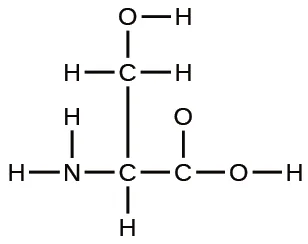
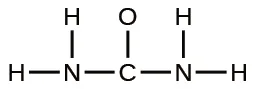
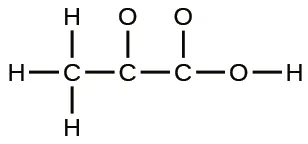
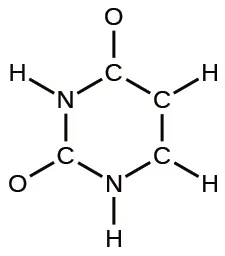
The arrangement of atoms in several biologically important molecules is given here. Complete the Lewis structures of these molecules by adding multiple bonds and lone pairs. Do not add any more atoms.
(a) the amino acid serine:
(b) urea:
(c) pyruvic acid:
(d) uracil:
(e) carbonic acid:
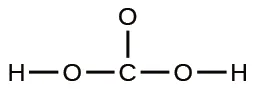
Exercises 41
A compound with a molar mass of about 42 g/mol contains 85.7% carbon and 14.3% hydrogen by mass. Write the Lewis structure for a molecule of the compound.
Exercises 43
How are single, double, and triple bonds similar? How do they differ?
The tutor teaches the whole section, drawing it out step by step and answering your questions as you go.
(j) ClCN
(k)