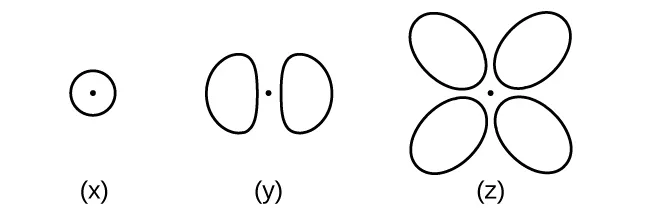
How are the Bohr model and the quantum mechanical model of the hydrogen atom similar? How are they different?
← Back to Chemistry 2e
Chemistry 2e · 6.3 Development of Quantum Theory
Development of Quantum Theory: practice problems
8 problems from the book, with its answers. Check your working, or have any of them explained to you on the whiteboard.
Exercises 33
Exercises 35
Exercises 37
Exercises 39
Exercises 41
Exercises 43
Exercises 45
Key terms · 17
- secondary (angular momentum) quantum number (l)
- quantum number distinguishing the different shapes of orbitals; it is also a measure of the orbital angular momentum
- atomic orbital
- mathematical function that describes the behavior of an electron in an atom (also called the wavefunction)
- d orbital
- region of space with high electron density that is either four lobed or contains a dumbbell and torus shape; describes orbitals with l = 2.
- degenerate orbitals
- orbitals that have the same energy
- electron density
- a measure of the probability of locating an electron in a particular region of space, it is equal to the squared absolute value of the wave function ψ
- f orbital
- multilobed region of space with high electron density, describes orbitals with l = 3
- Heisenberg uncertainty principle
- rule stating that it is impossible to exactly determine both certain conjugate dynamical properties such as the momentum and the position of a particle at the same time. The uncertainty principle is a consequence of quantum particles exhibiting wave–particle duality
- magnetic quantum number (m_l)
- quantum number signifying the orientation of an atomic orbital around the nucleus
- p orbital
- dumbbell-shaped region of space with high electron density, describes orbitals with l = 1
- Pauli exclusion principle
- specifies that no two electrons in an atom can have the same value for all four quantum numbers
- principal quantum number (n)
- quantum number specifying the shell an electron occupies in an atom
- quantum mechanics
- field of study that includes quantization of energy, wave-particle duality, and the Heisenberg uncertainty principle to describe matter
- s orbital
- spherical region of space with high electron density, describes orbitals with l = 0
- shell
- atomic orbitals with the same principal quantum number, n
- spin quantum number (m_s)
- number specifying the electron spin direction, either $+ \ \frac{1}{2}$ or $- \ \frac{1}{2}$
- subshell
- atomic orbitals with the same values of n and l
- wavefunction (ψ)
- mathematical description of an atomic orbital that describes the shape of the orbital; it can be used to calculate the probability of finding the electron at any given location in the orbital, as well as dynamical variables such as the energy and the angular momentum
Learn 6.3 on the whiteboard
The tutor teaches the whole section, drawing it out step by step and answering your questions as you go.