Why is the concept of hybridization required in valence bond theory?
← Back to Chemistry 2e
Chemistry 2e · 8.2 Hybrid Atomic Orbitals
Hybrid Atomic Orbitals: practice problems
7 problems from the book, with its answers. Check your working, or have any of them explained to you on the whiteboard.
Exercises 11
Explain why a carbon atom cannot form five bonds using sp³d hybrid orbitals.
Exercises 13
A molecule with the formula AB₃ could have one of four different shapes. Give the shape and the hybridization of the central A atom for each.
Exercises 15
Sulfuric acid is manufactured by a series of reactions represented by the following equations:
Exercises 17
Analysis of a compound indicates that it contains 77.55% Xe and 22.45% F by mass.
(a) What is the empirical formula for this compound? (Assume this is also the molecular formula in responding to the remaining parts of this exercise).
(b) Write a Lewis structure for the compound.
(c) Predict the shape of the molecules of the compound.
(d) What hybridization is consistent with the shape you predicted?
Exercises 19
Strike-anywhere matches contain a layer of KClO₃ and a layer of P₄S₃. The heat produced by the friction of striking the match causes these two compounds to react vigorously, which sets fire to the wooden stem of the match. KClO₃ contains the ion. P₄S₃ is an unusual molecule with the skeletal structure.
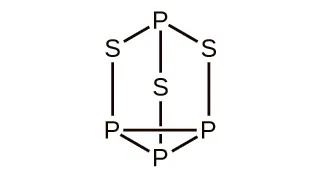
(a) Write Lewis structures for P₄S₃ and the ion.
Exercises 21
Write Lewis structures for NF₃ and PF₅. On the basis of hybrid orbitals, explain the fact that NF₃, PF₃, and PF₅ are stable molecules, but NF₅ does not exist.
Key terms · 7
- hybrid orbital
- orbital created by combining atomic orbitals on a central atom
- hybridization
- model that describes the changes in the atomic orbitals of an atom when it forms a covalent compound
- sp hybrid orbital
- one of a set of two orbitals with a linear arrangement that results from combining one s and one p orbital
- sp^2 hybrid orbital
- one of a set of three orbitals with a trigonal planar arrangement that results from combining one s and two p orbitals
- sp^3 hybrid orbital
- one of a set of four orbitals with a tetrahedral arrangement that results from combining one s and three p orbitals
- sp^3d hybrid orbital
- one of a set of five orbitals with a trigonal bipyramidal arrangement that results from combining one s, three p, and one d orbital
- sp^3d^2 hybrid orbital
- one of a set of six orbitals with an octahedral arrangement that results from combining one s, three p, and two d orbitals
Learn 8.2 on the whiteboard
The tutor teaches the whole section, drawing it out step by step and answering your questions as you go.