In terms of their bulk properties, how do liquids and solids differ? How are they similar?
← Back to Chemistry 2e
Chemistry 2e · 10.1 Intermolecular Forces
Intermolecular Forces: practice problems
11 problems from the book, with its answers. Check your working, or have any of them explained to you on the whiteboard.
Exercises 3
In terms of the kinetic molecular theory, in what ways are liquids similar to gases? In what ways are liquids different from gases?
Exercises 5
What is the evidence that all neutral atoms and molecules exert attractive forces on each other?
Exercises 7
Define the following and give an example of each:
(a) dispersion force
(b) dipole-dipole attraction
(c) hydrogen bond
Exercises 9
Why do the boiling points of the noble gases increase in the order He < Ne < Ar < Kr < Xe?
Exercises 11
Arrange each of the following sets of compounds in order of increasing boiling point temperature:
(a) HCl, H₂O, SiH₄
(b) F₂, Cl₂, Br₂
(c) CH₄, C₂H₆, C₃H₈
(d) O₂, NO, N₂
Exercises 13
On the basis of intermolecular attractions, explain the differences in the boiling points of n–butane (−1 °C) and chloroethane (12 °C), which have similar molar masses.
Exercises 15
The melting point of H₂O(s) is 0 °C. Would you expect the melting point of H₂S(s) to be −85 °C, 0 °C, or 185 °C? Explain your answer.
Exercises 17
Explain why a hydrogen bond between two water molecules is weaker than a hydrogen bond between two hydrogen fluoride molecules.
Exercises 19
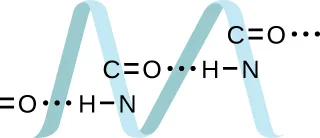
Proteins are chains of amino acids that can form in a variety of arrangements, one of which is a helix. What kind of IMF is responsible for holding the protein strand in this shape? On the protein image, show the locations of the IMFs that hold the protein together:
Exercises 21
Identify the intermolecular forces present in the following solids:
(a) CH₃CH₂OH
(b) CH₃CH₂CH₃
(c) CH₃CH₂Cl
Key terms · 8
- dipole-dipole attraction
- intermolecular attraction between two permanent dipoles
- dispersion force
- (also, London dispersion force) attraction between two rapidly fluctuating, temporary dipoles; significant only when particles are very close together
- hydrogen bonding
- occurs when exceptionally strong dipoles attract; bonding that exists when hydrogen is bonded to one of the three most electronegative elements: F, O, or N
- induced dipole
- temporary dipole formed when the electrons of an atom or molecule are distorted by the instantaneous dipole of a neighboring atom or molecule
- instantaneous dipole
- temporary dipole that occurs for a brief moment in time when the electrons of an atom or molecule are distributed asymmetrically
- intermolecular force
- noncovalent attractive force between atoms, molecules, and/or ions
- polarizability
- measure of the ability of a charge to distort a molecule’s charge distribution (electron cloud)
- van der Waals force
- attractive or repulsive force between molecules, including dipole-dipole, dipole-induced dipole, and London dispersion forces; does not include forces due to covalent or ionic bonding, or the attraction between ions and molecules
Learn 10.1 on the whiteboard
The tutor teaches the whole section, drawing it out step by step and answering your questions as you go.