What phase changes will take place when water is subjected to varying pressure at a constant temperature of 0.005 °C? At 40 °C? At −40 °C?
← Back to Chemistry 2e
Chemistry 2e · 10.4 Phase Diagrams
Phase Diagrams: practice problems
5 problems from the book, with its answers. Check your working, or have any of them explained to you on the whiteboard.
Exercises 57
From the phase diagram for carbon dioxide in Figure 10.34, determine the state of CO₂ at:
(a) 20 °C and 1000 kPa
(b) 10 °C and 2000 kPa
(c) 10 °C and 100 kPa
(d) −40 °C and 500 kPa
(e) −80 °C and 1500 kPa
(f) −80 °C and 10 kPa
Exercises 59
Consider a cylinder containing a mixture of liquid carbon dioxide in equilibrium with gaseous carbon dioxide at an initial pressure of 65 atm and a temperature of 20 °C. Sketch a plot depicting the change in the cylinder pressure with time as gaseous carbon dioxide is released at constant temperature.
Exercises 61
If a severe storm results in the loss of electricity, it may be necessary to use a clothesline to dry laundry. In many parts of the country in the dead of winter, the clothes will quickly freeze when they are hung on the line. If it does not snow, will they dry anyway? Explain your answer.
Exercises 63
Elemental carbon has one gas phase, one liquid phase, and two different solid phases, as shown in the phase diagram:
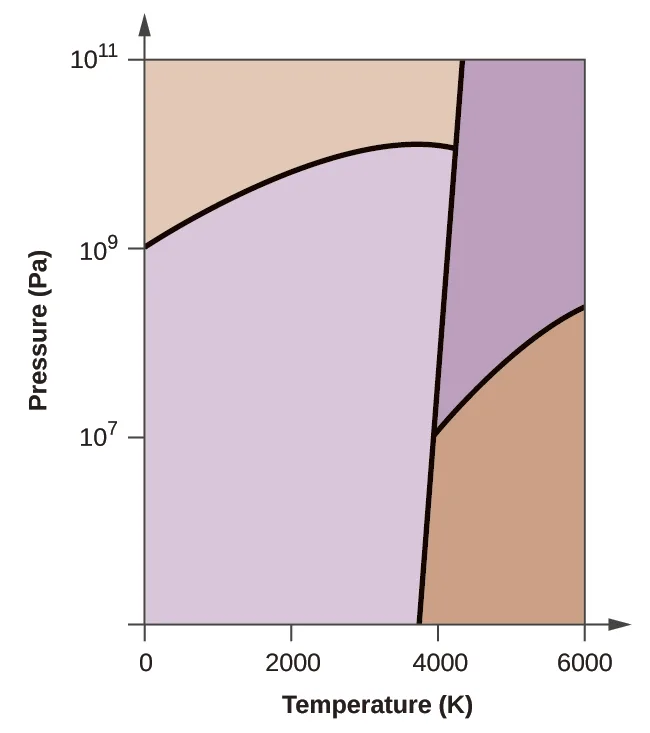
(a) On the phase diagram, label the gas and liquid regions.
(b) Graphite is the most stable phase of carbon at normal conditions. On the phase diagram, label the graphite phase.
(c) If graphite at normal conditions is heated to 2500 K while the pressure is increased to 10¹⁰ Pa, it is converted into diamond. Label the diamond phase.
(d) Circle each triple point on the phase diagram.
(e) In what phase does carbon exist at 5000 K and 10⁸ Pa?
(f) If the temperature of a sample of carbon increases from 3000 K to 5000 K at a constant pressure of 10⁶ Pa, which phase transition occurs, if any?
Key terms · 4
- critical point
- temperature and pressure above which a gas cannot be condensed into a liquid
- phase diagram
- pressure-temperature graph summarizing conditions under which the phases of a substance can exist
- supercritical fluid
- substance at a temperature and pressure higher than its critical point; exhibits properties intermediate between those of gaseous and liquid states
- triple point
- temperature and pressure at which three phases of a substance are in equilibrium
Learn 10.4 on the whiteboard
The tutor teaches the whole section, drawing it out step by step and answering your questions as you go.