Using the bond energies in Table 7.2, determine the approximate enthalpy change for each of the following reactions:
(a)
(b)
(c)
Preparing your lesson…正在准备你的课程…正在準備你的課程…Preparando tu lección…Préparation de votre leçon…Deine Lektion wird vorbereitet…Sto preparando la tua lezione…Preparando sua aula…レッスンを準備しています…수업을 준비하고 있어요…Menyediakan pelajaran anda…Menyiapkan pelajaranmu…
Preparing your lesson…正在准备你的课程…正在準備你的課程…Preparando tu lección…Préparation de votre leçon…Deine Lektion wird vorbereitet…Sto preparando la tua lezione…Preparando sua aula…レッスンを準備しています…수업을 준비하고 있어요…Menyediakan pelajaran anda…Menyiapkan pelajaranmu…
Chemistry 2e · 7.5 Strengths of Ionic and Covalent Bonds
10 problems from the book, with its answers. Check your working, or have any of them explained to you on the whiteboard.
Exercises 65
Using the bond energies in Table 7.2, determine the approximate enthalpy change for each of the following reactions:
(a)
(b)
(c)
Exercises 67
When a molecule can form two different structures, the structure with the stronger bonds is usually the more stable form. Use bond energies to predict the correct structure of the hydroxylamine molecule:
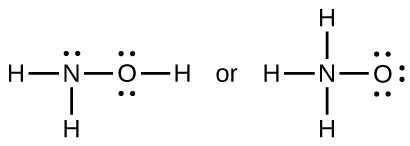
Exercises 69
Using the standard enthalpy of formation data in Appendix G, show how the standard enthalpy of formation of HCl(g) can be used to determine the bond energy.
Exercises 71
Using the standard enthalpy of formation data in Appendix G, determine which bond is stronger: the S–F bond in SF₄(g) or in SF₆(g)?
Exercises 73
Complete the following Lewis structure by adding bonds (not atoms), and then indicate the longest bond:

Exercises 75
Use principles of atomic structure to answer each of the following:1
1This question is taken from the Chemistry Advanced Placement Examination and is used with the permission of the Educational Testing Service.
(a) The radius of the Ca atom is 197 pm; the radius of the Ca²⁺ ion is 99 pm. Account for the difference.
(b) The lattice energy of CaO(s) is –3460 kJ/mol; the lattice energy of K₂O is –2240 kJ/mol. Account for the difference.
(c) Given these ionization values, explain the difference between Ca and K with regard to their first and second ionization energies.
| Element | First Ionization Energy (kJ/mol) | Second Ionization Energy (kJ/mol) |
| K | 419 | 3050 |
| Ca | 590 | 1140 |
(d) The first ionization energy of Mg is 738 kJ/mol and that of Al is 578 kJ/mol. Account for this difference.
Exercises 77
For which of the following substances is the least energy required to convert one mole of the solid into separate ions?
(a) MgO
(b) SrO
(c) KF
(d) CsF
(e) MgF₂
Exercises 79
The lattice energy of LiF is 1023 kJ/mol, and the Li–F distance is 201 pm. MgO crystallizes in the same structure as LiF but with a Mg–O distance of 205 pm. Which of the following values most closely approximates the lattice energy of MgO: 256 kJ/mol, 512 kJ/mol, 1023 kJ/mol, 2046 kJ/mol, or 4008 kJ/mol? Explain your choice.
Exercises 81
Which compound in each of the following pairs has the larger lattice energy? Note: Ba²⁺ and
K⁺ have similar radii; S2– and Cl– have similar radii. Explain your choices.
(a) K₂O or Na₂O
(b) K₂S or BaS
(c) KCl or BaS
(d) BaS or BaCl₂
Exercises 83
Which of the following compounds requires the most energy to convert one mole of the solid into separate ions?
(a) K₂S
(b) K₂O
(c) CaS
(d) Cs₂S
(e) CaO
The tutor teaches the whole section, drawing it out step by step and answering your questions as you go.