Explain why the ions Na⁺ and Cl⁻ are strongly solvated in water but not in hexane, a solvent composed of nonpolar molecules.
← Back to Chemistry 2e
Chemistry 2e · 11.2 Electrolytes
Electrolytes: practice problems
4 problems from the book, with its answers. Check your working, or have any of them explained to you on the whiteboard.
Exercises 11
Consider the solutions presented:
(a) Which of the following sketches best represents the ions in a solution of Fe(NO₃)₃(aq)?
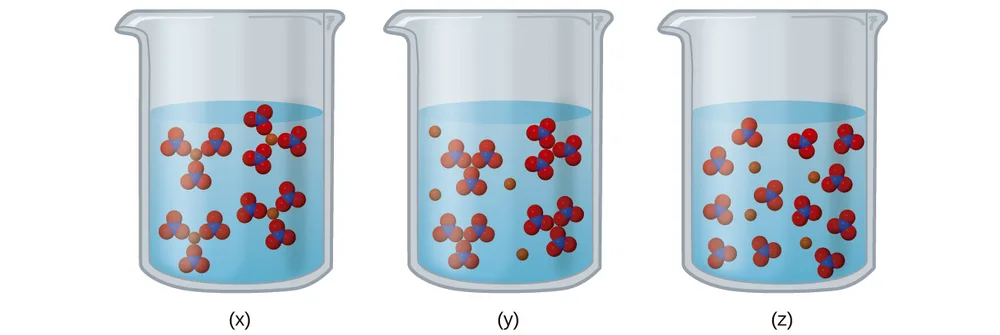
(b) Write a balanced chemical equation showing the products of the dissolution of Fe(NO₃)₃.
Exercises 13
What is the expected electrical conductivity of the following solutions?
(a) NaOH(aq)
(b) HCl(aq)
(c) C₆H₁₂O₆(aq) (glucose)
(d) NH₃(aq)
Exercises 15
Indicate the most important type of intermolecular attraction responsible for solvation in each of the following solutions:
(a) the solutions in Figure 11.7
(b) methanol, CH₃OH, dissolved in ethanol, C₂H₅OH
(c) methane, CH₄, dissolved in benzene, C₆H₆
(d) the polar halocarbon CF₂Cl₂ dissolved in the polar halocarbon CF₂ClCFCl₂
(e) O₂(l) in N₂(l)
Key terms · 6
- dissociation
- physical process accompanying the dissolution of an ionic compound in which the compound’s constituent ions are solvated and dispersed throughout the solution
- electrolyte
- substance that produces ions when dissolved in water
- ion-dipole attraction
- electrostatic attraction between an ion and a polar molecule
- nonelectrolyte
- substance that does not produce ions when dissolved in water
- strong electrolyte
- substance that dissociates or ionizes completely when dissolved in water
- weak electrolyte
- substance that ionizes only partially when dissolved in water
Learn 11.2 on the whiteboard
The tutor teaches the whole section, drawing it out step by step and answering your questions as you go.